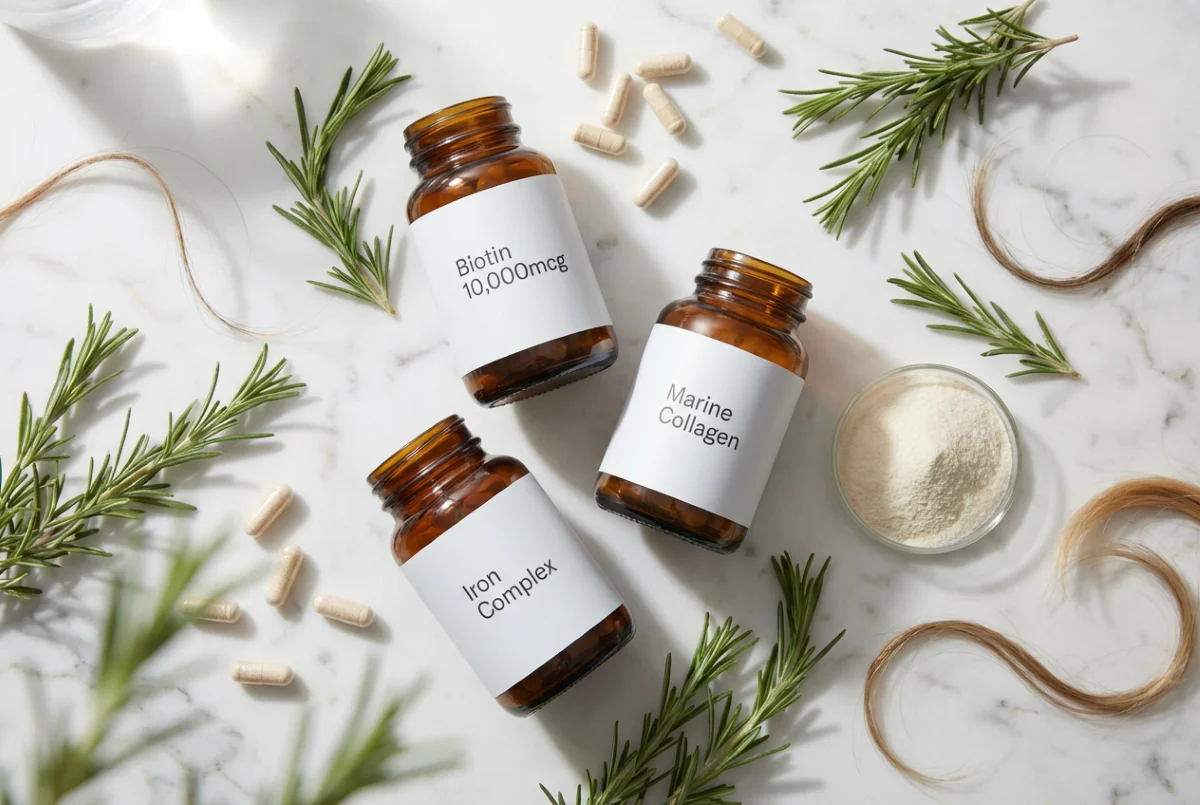
You’re taking biotin. Maybe collagen too. Perhaps iron, zinc, vitamin D.
Every morning, you’re swallowing what feels like a pharmacy. Because somewhere along the way, someone convinced you that hair health supplements were the answer. That if you just found the right combination, your hair would magically transform.
Here’s what nobody tells you. Supplements work. But they don’t work the way you think they do.
I’m going to walk you through 7 of the most popular hair health supplement options. We’ll bust the myths around each one. And then I’m going to show you the one thing supplements absolutely cannot fix, no matter how much you spend or how religiously you take them.
The 7 Most Common Hair Health Supplements (What Actually Works)
Let’s get specific. Because “take a hair vitamin” is terrible advice without context.
1. Biotin: The Overhyped Hero
The Myth: Biotin grows hair faster and thicker in everyone.
The Truth: Biotin only helps if you’re actually deficient. And most people aren’t.
Biotin (vitamin B7) supports keratin production. That part’s real. Your hair is made of keratin, so theoretically, more biotin equals stronger hair structure. But here’s the problem: biotin deficiency is incredibly rare in people eating a normal diet.
A 2017 study in Skin Appendage Disorders found that only 38% of women complaining of hair loss actually had low biotin levels. The rest? They were taking supplements they didn’t need.
What biotin actually does: If you’re deficient (due to genetics, gut issues, or certain medications), supplementing biotin can prevent hair breakage and improve texture. If you’re not deficient, it does basically nothing.
Dosage that matters: 2,500-5,000 mcg daily for deficient individuals. More than 10,000 mcg won’t accelerate results.
2. Marine Collagen: The Structural Support
The Myth: Collagen supplements magically add collagen to your hair.
The Truth: Your body breaks down collagen into amino acids, then rebuilds what it needs where it needs it.
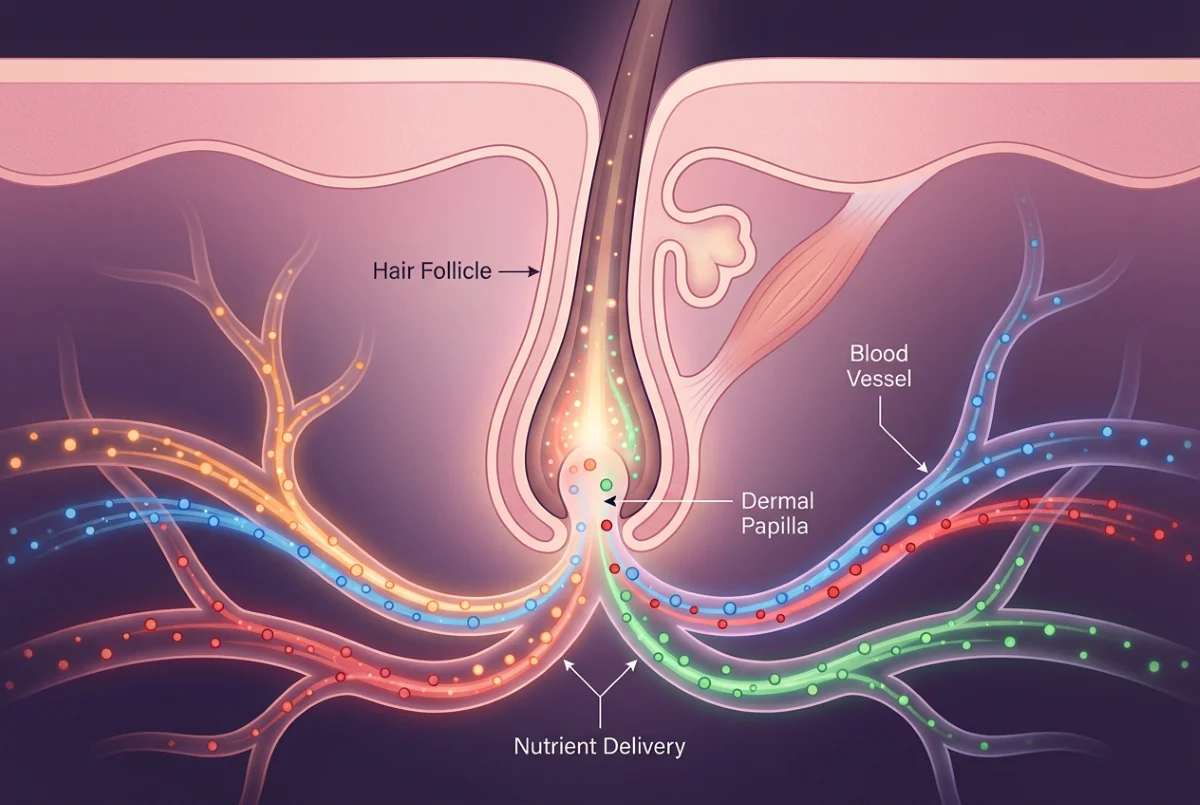
Marine collagen provides the building blocks (primarily glycine, proline, and hydroxyproline) for your body to produce its own collagen. This supports the dermal papilla, the structure at the base of your hair follicle that supplies nutrients.
A 2015 study showed women taking hydrolyzed collagen for 90 days experienced 39% improvement in hair thickness and reduced breakage. But the mechanism isn’t direct. Your body decides where to allocate those amino acids.
What collagen actually does: Provides amino acid building blocks for hair structure, improves scalp circulation, and may prolong the anagen (growth) phase of the hair cycle.
Dosage that matters: 5-10 grams daily of hydrolyzed marine collagen. Type I and Type III are most beneficial for hair.
3. Iron: The Oxygen Transporter
The Myth: Everyone losing hair needs iron.
The Truth: Only people with low ferritin (stored iron) benefit. And taking iron when you don’t need it is dangerous.
Iron is critical for hair growth because it helps red blood cells carry oxygen to your follicles. Without adequate oxygen, follicles go dormant. This is why iron deficiency is the #1 nutritional cause of hair loss in premenopausal women.
But here’s what matters: ferritin levels, not just hemoglobin. You can have “normal” hemoglobin but low ferritin, meaning your iron stores are depleted even though you’re not anemic yet.
What iron actually does: Restores oxygen delivery to follicles, reactivates dormant follicles, and reduces excessive shedding in deficient individuals.
Dosage that matters: 18-45 mg daily for deficiency. Get your ferritin tested first. Optimal ferritin for hair growth is 70-80 ng/mL, not just the “normal” range of 12-150 ng/mL.
WARNING: Never supplement iron without testing. Iron overload causes serious health problems.
4. Vitamin D: The Follicle Activator
The Myth: Vitamin D grows new hair.
The Truth: Vitamin D prevents hair follicle miniaturization, but it won’t reverse genetic hair loss.
Vitamin D receptors exist in hair follicles. Research shows these receptors are critical for the hair cycle, particularly transitioning follicles from telogen (resting) to anagen (growth) phase.
A 2019 study found that women with chronic hair loss had significantly lower vitamin D levels than controls. Supplementation reduced shedding and improved hair density, but primarily in people who were deficient.
What vitamin D actually does: Supports follicle cycling, reduces inflammation around follicles, and helps prevent premature entry into shedding phase.
Dosage that matters: 2,000-4,000 IU daily for deficiency. Test your levels first. Optimal range for hair health is 40-60 ng/mL.
5. Zinc: The Balancer
The Myth: Zinc regrows hair.
The Truth: Zinc prevents excessive shedding in deficient individuals, but too much zinc causes shedding.
Zinc regulates androgen hormones and supports protein synthesis. Both are critical for hair growth. Zinc deficiency is common in people with gut issues, vegetarians, and those under chronic stress.
But here’s the catch: too much zinc depletes copper, which is also essential for hair health. High-dose zinc supplements (>50 mg daily) can paradoxically cause hair loss.
What zinc actually does: Regulates DHT (the hormone that shrinks follicles), supports keratin production, and reduces scalp inflammation.
Dosage that matters: 15-30 mg daily. Never exceed 40 mg unless under medical supervision. Take with copper (1-2 mg) to prevent depletion.
6. Omega-3 Fatty Acids: The Inflammation Fighter
The Myth: Omega-3s grow thicker hair.
The Truth: Omega-3s reduce scalp inflammation and improve hair density indirectly.
EPA and DHA (the omega-3s in fish oil) are potently anti-inflammatory. Chronic scalp inflammation damages follicles and shortens the growth phase. Omega-3 supplementation addresses this underlying damage.
A 2015 study showed women supplementing omega-3, omega-6, and antioxidants for 6 months experienced 89.9% increase in hair density and significant reduction in shedding.
What omega-3s actually do: Reduce follicle inflammation, improve scalp circulation, and support the lipid barrier that protects hair shafts.
Dosage that matters: 1,000-2,000 mg combined EPA/DHA daily from fish oil or algae oil.
7. Saw Palmetto: The DHT Blocker
The Myth: Saw palmetto works like finasteride for hair loss.
The Truth: Saw palmetto is a mild 5-alpha-reductase inhibitor, but evidence is mixed.
DHT (dihydrotestosterone) is the hormone that shrinks hair follicles in androgenic alopecia (pattern hair loss). Saw palmetto theoretically blocks the enzyme that converts testosterone to DHT.
Some studies show promise. A 2012 study found men taking 320 mg daily saw 38% improvement in hair growth after 2 years. But other studies show no effect. It’s controversial.
What saw palmetto might do: Mildly reduce DHT conversion in some individuals, potentially slowing pattern hair loss.
Dosage that matters: 320 mg daily of standardized extract. Results take 6-12 months if they occur at all.
What Hair Health Supplements Can’t Fix
Here’s the uncomfortable truth. You can optimize every internal factor. Perfect ferritin levels. Ideal vitamin D. Omega-3s on point.
And your hair can still be a disaster.
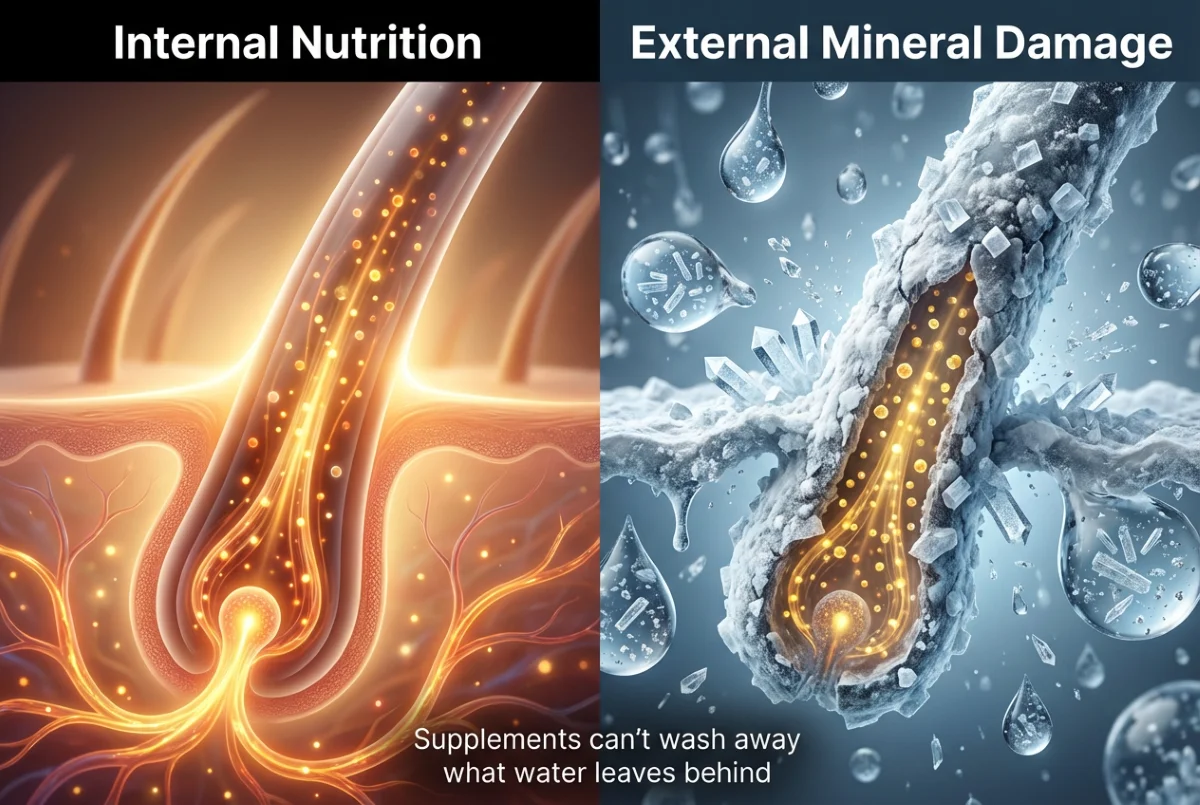
Because supplements address internal nutrition. They deliver building blocks to your follicles through your bloodstream. But they do absolutely nothing about external environmental damage.
Let me be specific. If you live in Dubai, Abu Dhabi, Doha, or most GCC cities, your tap water is heavily desalinated. That process leaves your water loaded with mineral content that traditional water softening doesn’t fully remove.
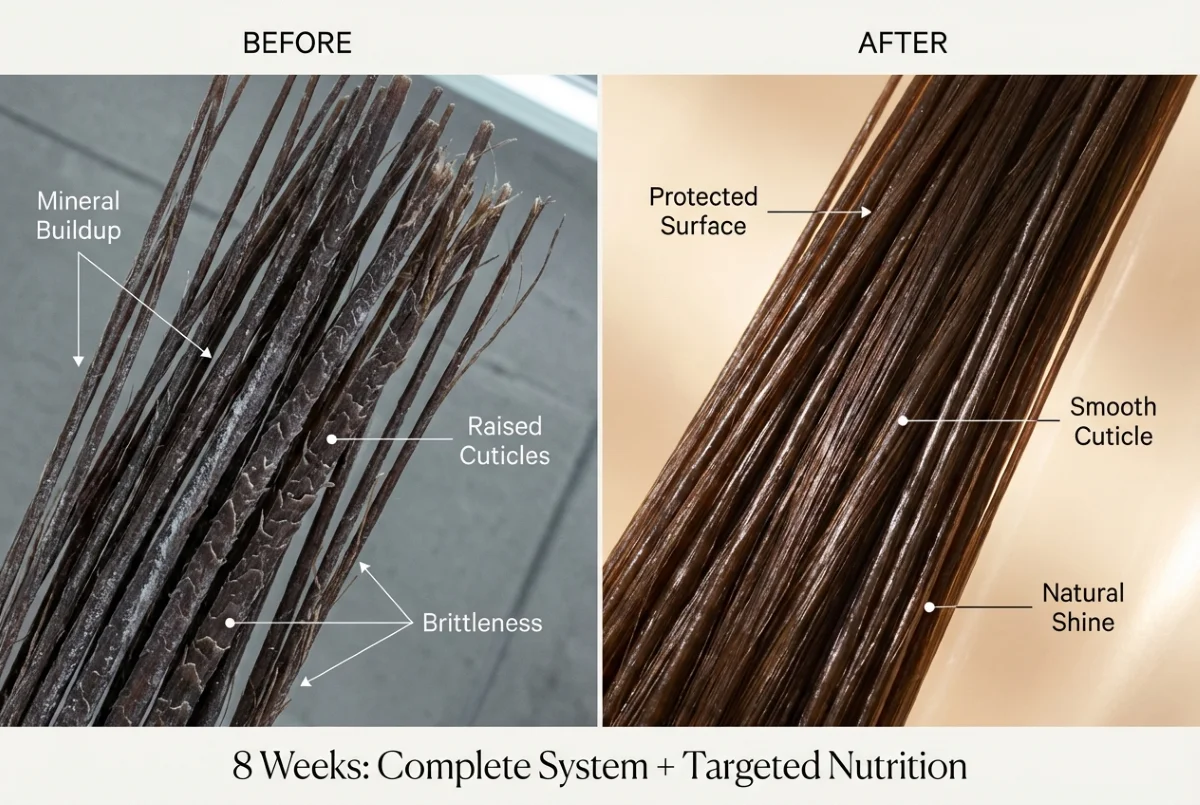
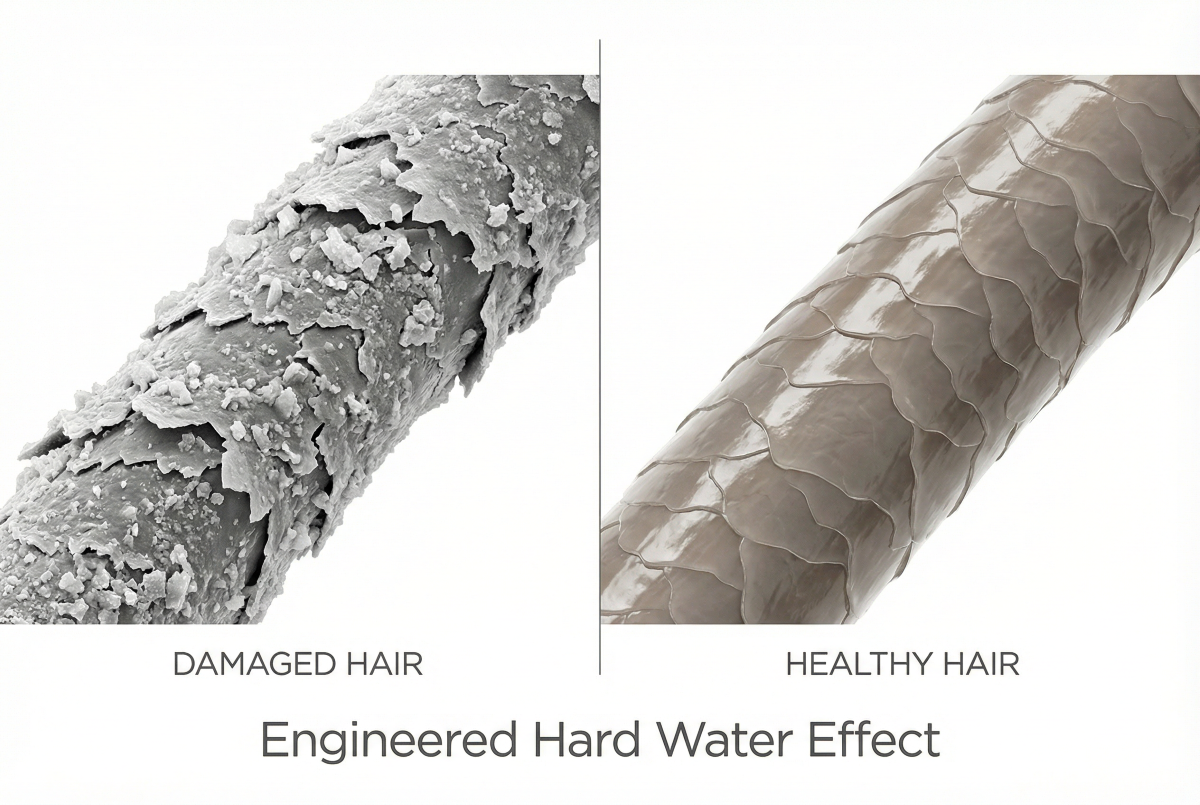
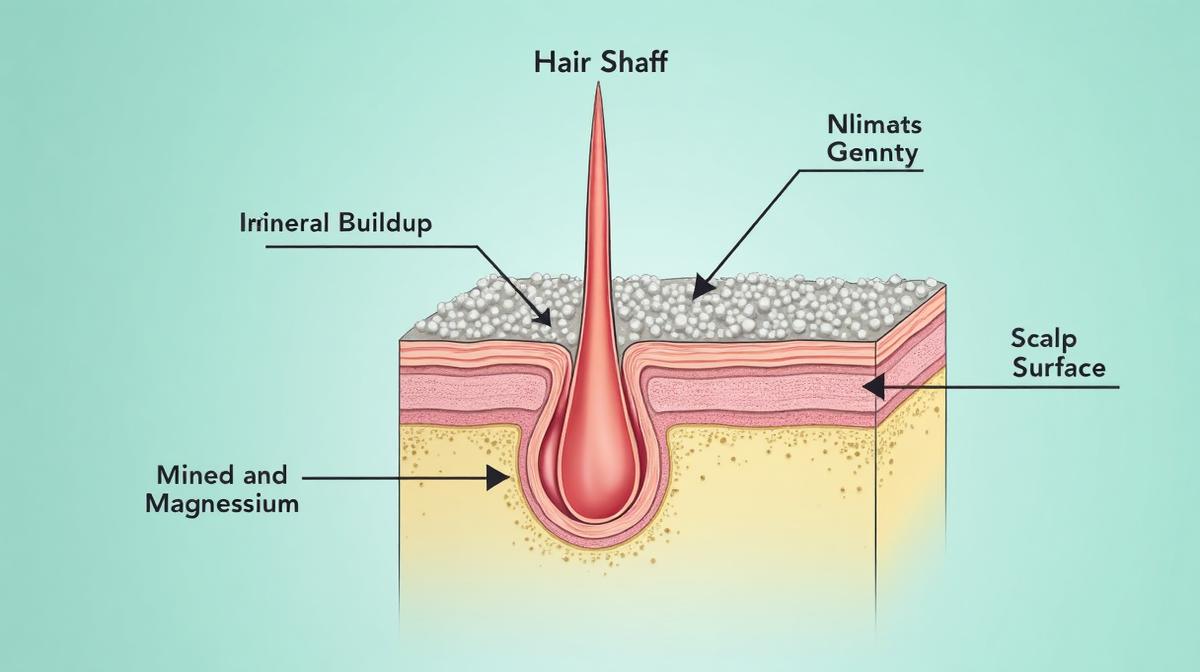
Every time you wash your hair, you’re coating it in calcium, magnesium, chlorine, and salt residues.
These minerals don’t rinse away. They bond to your hair shaft. Over time, they build up in layers. This buildup:
- Blocks moisture absorption (makes hair dry and brittle)
- Prevents proteins from penetrating the hair shaft (makes conditioning products ineffective)
- Creates a rough surface texture (increases tangling and breakage)
- Disrupts the pH balance of your scalp (causes irritation and flaking)
Your biotin can’t chelate minerals. Your collagen can’t dissolve calcium deposits. Your omega-3s can’t create a barrier against hard water exposure.
Supplements feed your follicles from inside. But if your hair is being destroyed from outside, internal nutrition can’t keep up.
This is why so many expats experience sudden hair changes after relocating to the Gulf. It’s not stress. It’s not the heat. It’s not aging. It’s the water.
See How Hard Water Affects Your Hair
The Complete System Approach
Here’s what actually works: internal nutrition plus external protection.
If you’re serious about hair health, you need both angles covered.
Internal: The right hair health supplement protocol (based on your actual deficiencies, not guessing)
External: A chelating shampoo system specifically formulated to remove mineral buildup
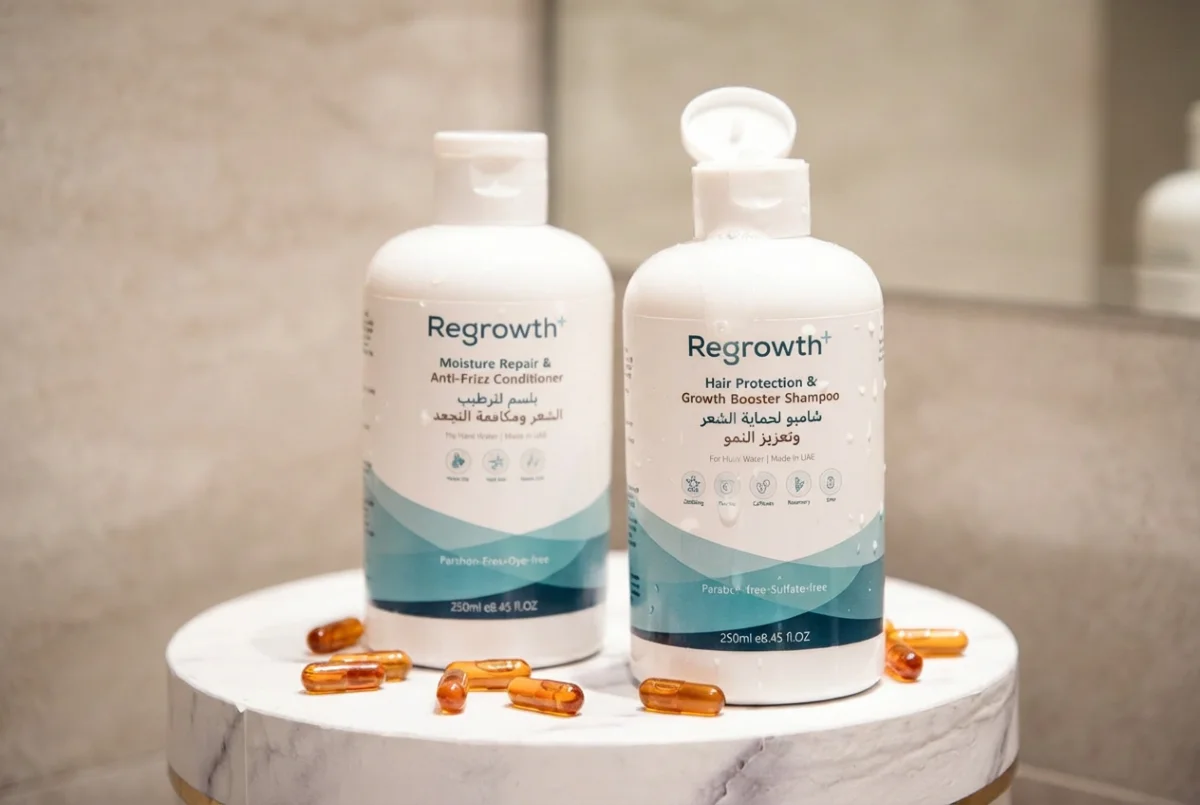
The Regrowth+ Complete System is engineered specifically for hard water conditions common in the GCC. The shampoo contains chelating agents that actively remove mineral deposits. The conditioner creates an oil barrier that prevents new minerals from bonding.
Together, they address the external factor that supplements can’t touch.
Here’s what makes this different:
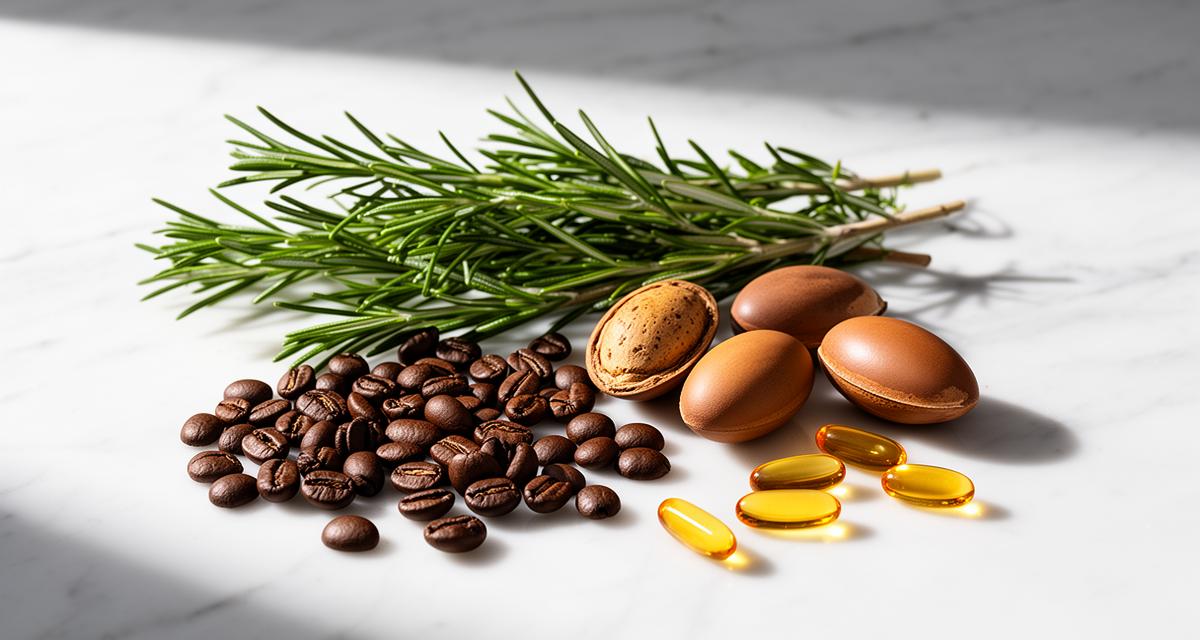
The shampoo doesn’t just clean. It chelates. EDTA and citric acid actively dissolve calcium and magnesium buildup that regular shampoos leave behind. Rosemary and caffeine stimulate follicles. Argan oil and shea butter prevent moisture loss during the chelating process.
The conditioner doesn’t just coat. It protects. Castor oil and olive oil create a water-resistant barrier on each hair shaft. Vitamin B5 repairs damage and locks in hydration.
This isn’t about replacing your hair health supplement routine. It’s about completing it.
You can see the complete formulation and read the science behind each ingredient at regrowthplus.com.
Engineered for GCC water conditions. Removes mineral buildup while delivering targeted nutrients. 119 AED per product, or save 10% with the bundle.
Your Action Plan
If you’re taking hair health supplements but still experiencing problems, here’s your next steps:
1. Get tested. Don’t guess about deficiencies. Test ferritin, vitamin D, zinc, and thyroid function. Supplement what you actually need.
2. Address the water. If you live in an area with hard or desalinated water, no amount of internal nutrition will overcome that external damage.
3. Give it time. Hair growth cycles take 3-6 months to show visible change. You won’t see results in 2 weeks.
4. Monitor progress. Take photos. Track shedding counts. Measure ponytail circumference. Objective data prevents emotional decisions.
The most effective hair health supplement protocol in the world won’t save hair that’s being destroyed by environmental factors. But when you address both internal nutrition and external protection, you’re giving your hair the complete support system it needs to actually thrive.