You’ve noticed more hair in the shower drain since moving to the Gulf. Your scalp feels different. Your hair looks duller, breaks more easily, and won’t hold moisture no matter what products you use. You’re starting to wonder if something in the water is causing actual hair loss.
This article contains affiliate links. See our affiliate disclosure for details.
Here’s the truth: hard water doesn’t directly cause hair loss in the way that hormonal conditions or nutritional deficiencies do. But the mineral buildup it creates weakens hair strands, changes your scalp’s protective barrier, and creates conditions that can accelerate shedding. The distinction matters because it changes how you address the problem.
The confusion is understandable. When you’re losing noticeably more hair after exposure to hard water, it feels like a direct cause-and-effect relationship. But what’s actually happening is more complex and involves multiple mechanisms that compound over time. Let’s look at what the research shows.
What Hard Water Actually Does to Your Hair
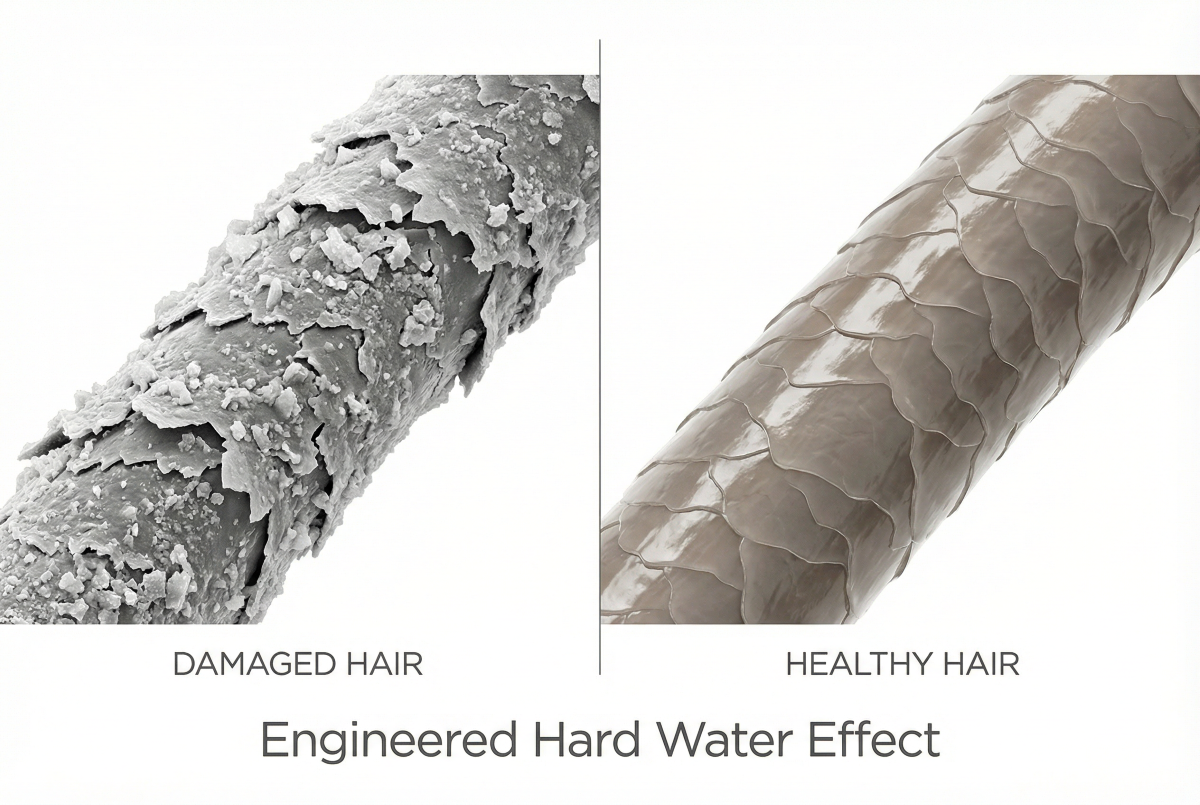
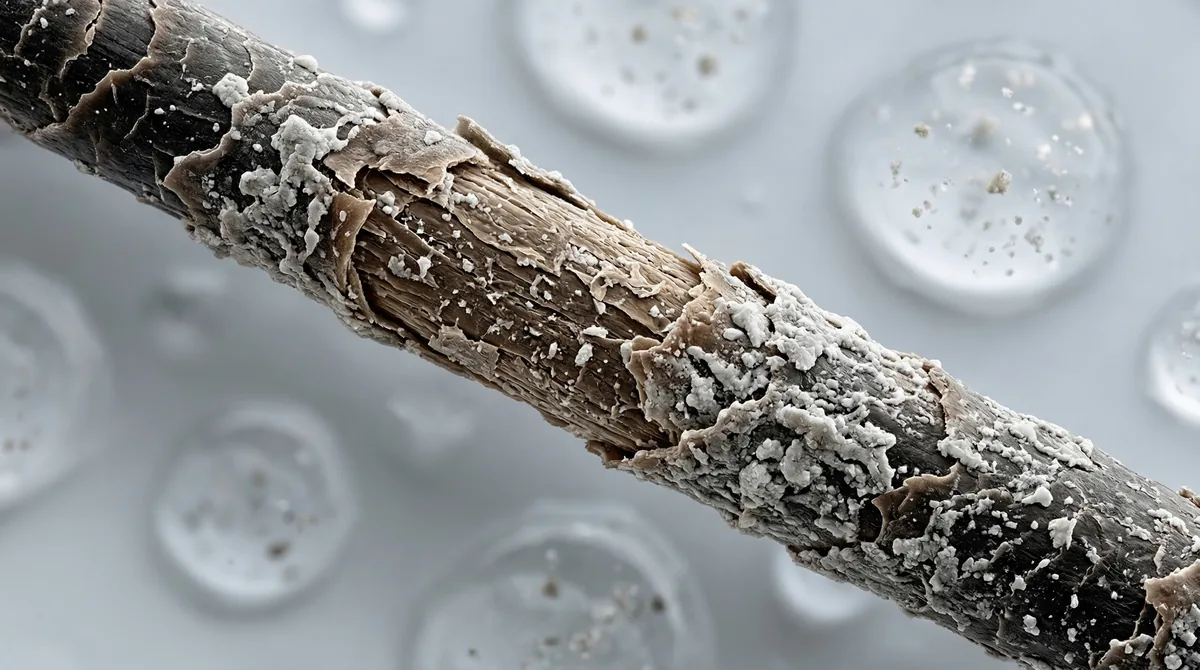
Hard water contains high concentrations of dissolved minerals, primarily calcium and magnesium. When you wash your hair, these minerals don’t rinse away cleanly. They bind to your hair shaft, creating a coating that accumulates with every wash.
This mineral layer changes everything about how your hair behaves. It blocks moisture from penetrating the hair shaft. It makes your hair feel rough and look dull. It prevents your conditioning products from working properly because they can’t reach the hair cuticle through the mineral barrier.
A study published in the International Journal of Trichology found that hard water exposure significantly increased surface roughness and reduced hair strength. The researchers used scanning electron microscopy to show visible deposits on hair shafts after hard water exposure.
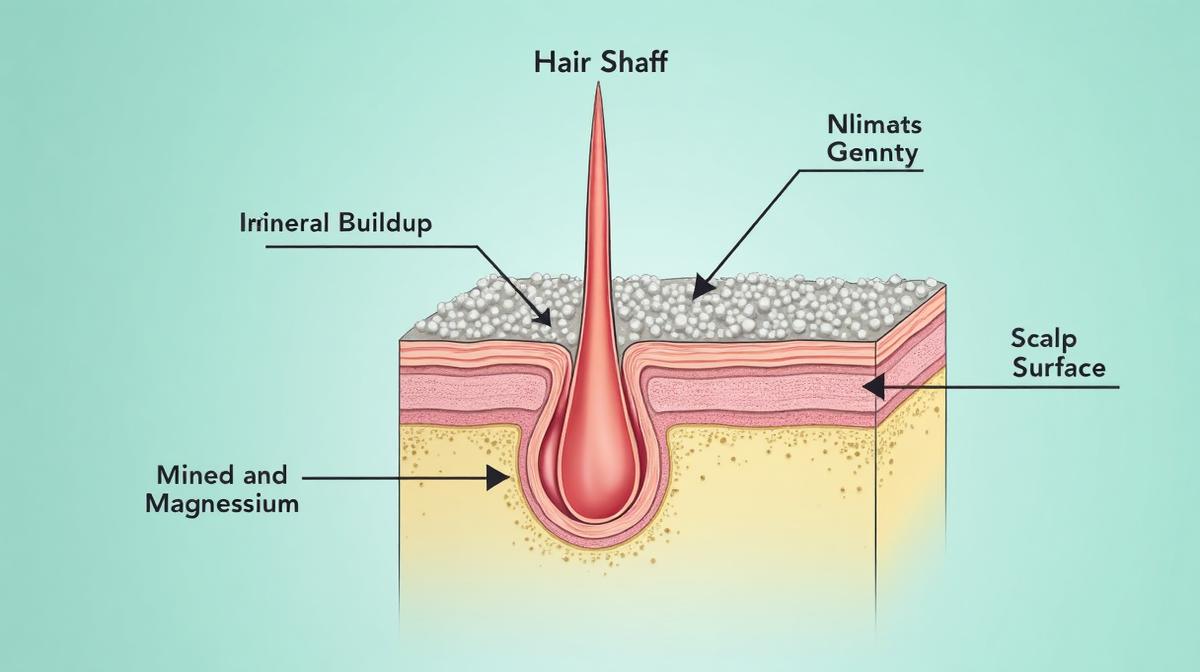
But here’s what matters for hair loss: this mineral buildup doesn’t stop at your hair strands. It accumulates on your scalp, mixing with sebum and dead skin cells to create a thick, waxy layer that can clog follicles and trigger inflammation.
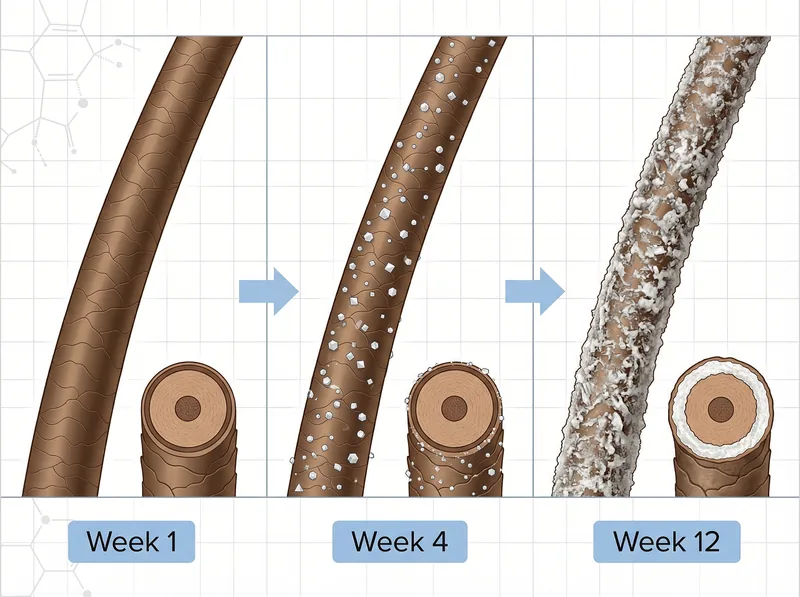 Mineral deposits from hard water create a barrier that prevents moisture absorption and weighs down hair strands
The Indirect Path: How Mineral Buildup Leads to Increased Shedding
Hair loss from hard water isn’t a direct chemical reaction. It’s a cascade of problems that weaken hair and change normal growth cycles.
First, the mineral coating makes hair brittle. Your strands break more easily during brushing, styling, and even just moving your head on a pillow. This breakage looks like hair loss but it’s actually mechanical damage. The hair isn’t falling out from the root, it’s snapping mid-shaft.
Second, the scalp accumulation creates an inflammatory environment. Your scalp’s natural microbiome gets changeed. The pH balance shifts. Your sebaceous glands either overproduce oil trying to compensate or dry out completely. This inflammation can push hair follicles into a resting phase prematurely.
Research in the Journal of Clinical and Aesthetic Dermatology demonstrates that scalp inflammation is a significant factor in telogen effluvium, a condition where hair follicles enter the shedding phase en masse. While hard water alone doesn’t cause telogen effluvium, the chronic low-grade inflammation it creates can contribute to increased shedding in susceptible individuals.
Third, if you’re using minoxidil or other topical hair loss treatments, the mineral barrier prevents proper absorption. You’re applying the treatment, but it’s sitting on top of a waxy layer instead of reaching your scalp. This is why some people find their treatments stop working after moving to areas with hard water.
The Gulf Region Factor: Why It’s Worse Here
Not all hard water is created equal. The Gulf region has some of the highest mineral concentrations in residential water supplies globally, primarily because most water comes from desalination plants.
According to US Geological Survey standards, water with over 180 mg/L of calcium carbonate is considered “very hard.” Many areas in the Gulf region exceed 300 mg/L. Some residential areas test at over 400 mg/L.
The combination of calcium, magnesium, and trace minerals creates a particularly stubborn form of buildup. Add in the region’s climate, where high temperatures and low humidity already stress hair, and you have a perfect storm for hair problems.
This environmental factor explains why so many expats notice dramatic changes in their hair health within months of arrival. It’s not your imagination. The water chemistry is fundamentally different from what your hair adapted to in your home country.
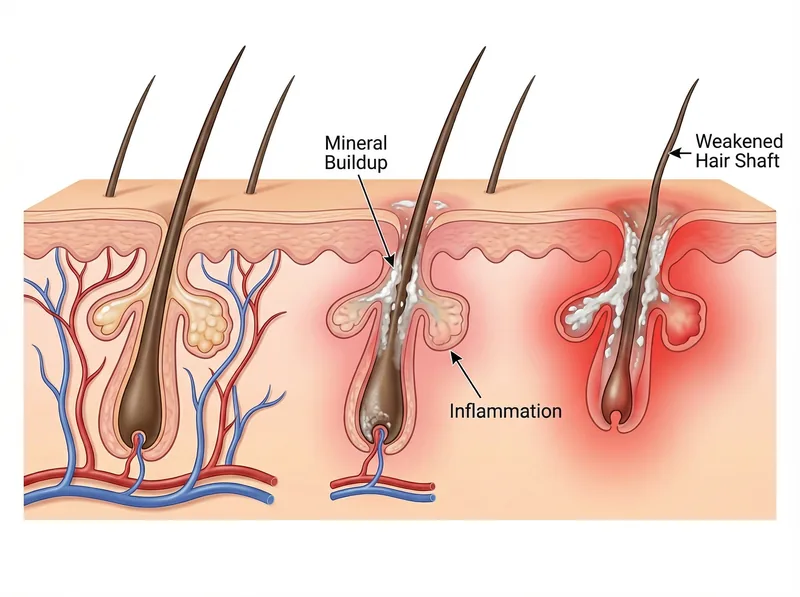 Mineral accumulation triggers inflammation that can change the normal hair growth cycle
What the Science Says About Reversibility
Here’s the good news: if hard water is contributing to your increased shedding, the damage is largely reversible once you address the mineral buildup.
A 2021 study in the International Journal of Cosmetic Science tested hard water effects on hair and found that chelating treatments effectively removed mineral deposits and restored hair’s mechanical properties. The hair didn’t magically regrow overnight, but the breakage stopped and normal growth cycles resumed.
The key is removing existing buildup while preventing new accumulation. This requires a two-step approach: chelation to strip existing minerals, and protection to prevent new deposits from forming.
For chelation, you need a product specifically formulated to bind to calcium and magnesium ions. Regular clarifying shampoos don’t cut it because they’re designed for oil and product buildup, not mineral deposits. A chelating shampoo like Regrowth+ uses ingredients like EDTA or citric acid that specifically target mineral bonds.
Most people see noticeable improvement within 4-6 weeks of consistent chelating treatment. Breakage decreases first. Then hair texture improves. Finally, if inflammation was pushing follicles into premature shedding, you’ll notice the shedding rate normalize as your scalp environment stabilizes.
When Hard Water Isn’t the Problem
It’s important to distinguish between hard water-related shedding and actual hair loss conditions that require medical treatment.
If you’re experiencing sudden, severe hair loss with bald patches, that’s not hard water. That could be alopecia areata, an autoimmune condition that requires dermatological care.
If your hairline is receding in a pattern or your crown is thinning progressively, that’s likely androgenetic alopecia (pattern hair loss), which is hormonal and genetic. Hard water can make it look worse by adding breakage on top of the underlying condition, but it’s not the root cause.
If you’re losing hair all over your scalp in large amounts, especially after a significant stress event, illness, or dietary change, that’s probably telogen effluvium. Hard water can compound the problem, but it didn’t trigger it.
The telltale signs that hard water is a significant factor: your hair problems started or worsened after moving to the Gulf, your hair feels coated and won’t absorb products, you have visible white residue on your scalp or in your hair, and your scalp feels itchy or irritated after washing.
When in doubt, see a dermatologist or trichologist. They can perform a pull test, examine your scalp under magnification, and potentially order blood work to rule out nutritional deficiencies or hormonal issues.
Practical Steps to Address Hard Water Effects
Start with a chelating treatment once a week for the first month. This strips the accumulated mineral buildup from your hair and scalp. You’ll know it’s working when your hair feels lighter and your regular conditioner starts absorbing properly again.
Between chelating treatments, use a gentle, sulfate-free shampoo. Harsh sulfates combined with hard water create even more buildup because they react with the minerals to form soap scum on your hair.
After shampooing, use a diluted apple cider vinegar rinse. Mix one tablespoon of vinegar with one cup of water and pour it through your hair after conditioning. The acidity helps break down mineral deposits and restores your hair’s natural pH. Rinse thoroughly.
Consider installing a shower filter, but understand its limitations. Most shower filters reduce chlorine and some sediment, but they don’t significantly reduce calcium and magnesium at the flow rates needed for showering. They’re helpful but not a complete solution.
If you’re using evidence-based hair loss treatments like minoxidil or finasteride, the chelating step becomes even more critical. You need a clean scalp for these medications to work properly.
For severe cases, some people invest in whole-home water softening systems. These use ion exchange to replace calcium and magnesium with sodium. They’re expensive and require maintenance, but they completely solve the hard water problem.
The Bottom Line on Hard Water and Hair Loss
Does hard water cause hair loss? Not directly. But it creates conditions that lead to increased breakage, scalp inflammation, and changeed growth cycles that can look and feel like hair loss.
The distinction matters because it means the problem is solvable. You’re not dealing with a genetic condition or an autoimmune disorder. You’re dealing with an environmental factor that you can address with the right approach.
Most people see significant improvement within two months of starting a proper chelating routine. Your hair won’t transform overnight, but the trajectory changes. Breakage decreases. Scalp irritation resolves. If you were experiencing increased shedding due to inflammation, that normalizes.
The key is consistency. Hard water exposure is ongoing, so your protection strategy needs to be ongoing too. Think of chelating treatments like exfoliation for your scalp, a regular maintenance step, not a one-time fix.
And if you’ve been struggling with hair loss treatments that aren’t working as expected, addressing the hard water factor might be the missing piece. Clean follicles absorb treatments better. Healthy scalps support better growth. It all connects.
References
- Effect of hard water on hair: A study using atomic force microscopy and scanning electron microscopy - International Journal of Trichology
- The Role of Inflammation in Telogen Effluvium - Journal of Clinical and Aesthetic Dermatology
- Hardness of Water - US Geological Survey
- Effects of Hard Water on Hair: Mechanical Properties and Surface Characteristics - International Journal of Cosmetic Science