This article contains affiliate links. See our affiliate disclosure for details.
You’ve moved to the Gulf, and your hair’s falling apart. Someone tells you to rinse with bottled water after every shower. You try it. Your hair feels… different. Maybe better? But you’re going through twelve bottles a week, your bathroom looks like a convenience store, and you’re not even sure if it’s working.
Here’s the truth: bottled water rinses do help, but only partially. They address mineral buildup on your hair length, but they don’t touch the scalp where most damage happens. And the cost adds up fast, especially if you wash daily.
Let’s break down what actually happens when you rinse with bottled water, how much it costs per week, whether it’s worth the plastic waste, and when you should skip it entirely for a more effective approach.
The Science: What Bottled Water Rinses Actually Do
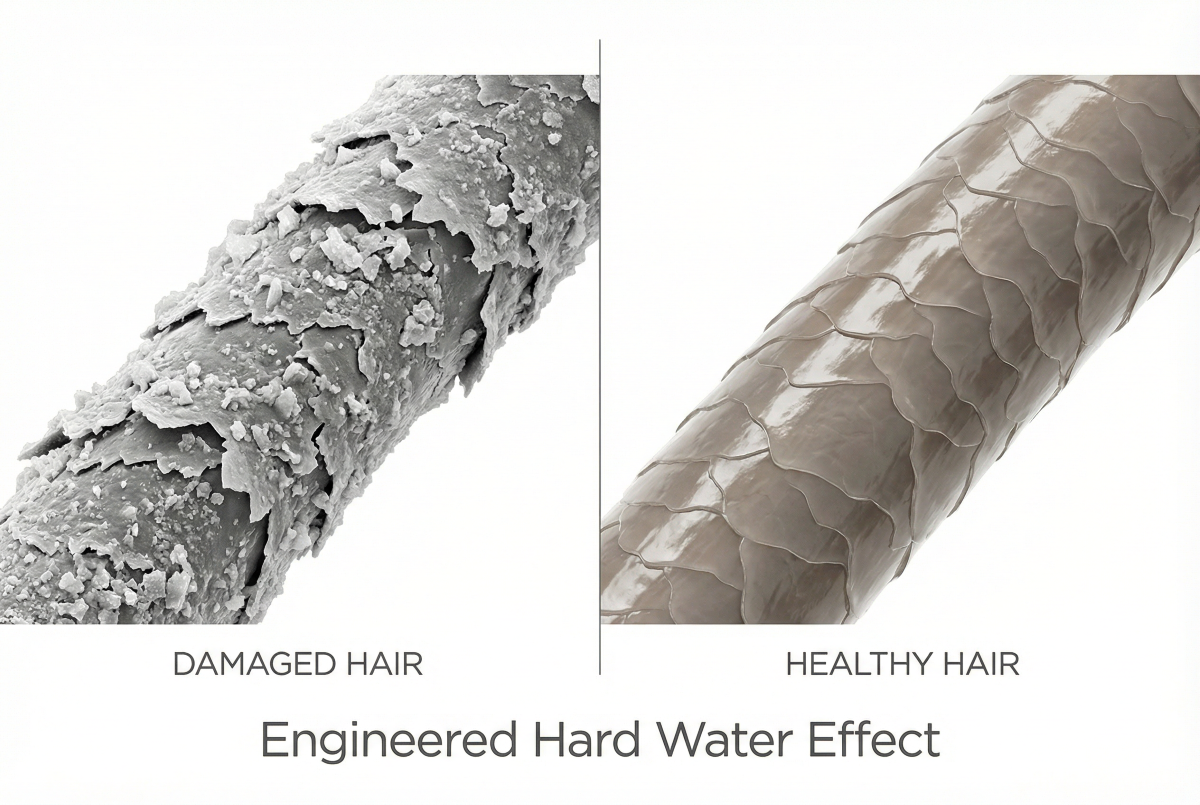
When you rinse your hair with tap water in the Gulf, you’re coating every strand with dissolved minerals, primarily calcium and magnesium carbonates. These minerals don’t rinse off. They bond to your hair’s outer cuticle layer, creating a rough, dull coating that makes hair feel stiff and look lifeless.
A final rinse with bottled or distilled water removes some of those freshly-deposited minerals from the hair shaft. The lower mineral content in bottled water (typically under 50 ppm total dissolved solids) means you’re not adding new buildup during that final rinse. Your hair length gets a cleaner finish.
But here’s what doesn’t happen: the rinse doesn’t remove minerals already embedded in your hair from previous washes. It doesn’t address buildup on your scalp. And it doesn’t prevent minerals from depositing during the shampooing and conditioning steps, which is when most of the damage occurs.
A study published in the International Journal of Trichology found that hard water significantly increases hair surface roughness and reduces tensile strength. A final rinse helps, but it’s addressing symptoms, not the root cause.
The Coverage Gap: Why Your Scalp Still Suffers
The biggest limitation of bottled water rinses? They only work on hair you can physically rinse. That means your scalp, where follicles, sebaceous glands, and new hair growth happen, gets zero protection.
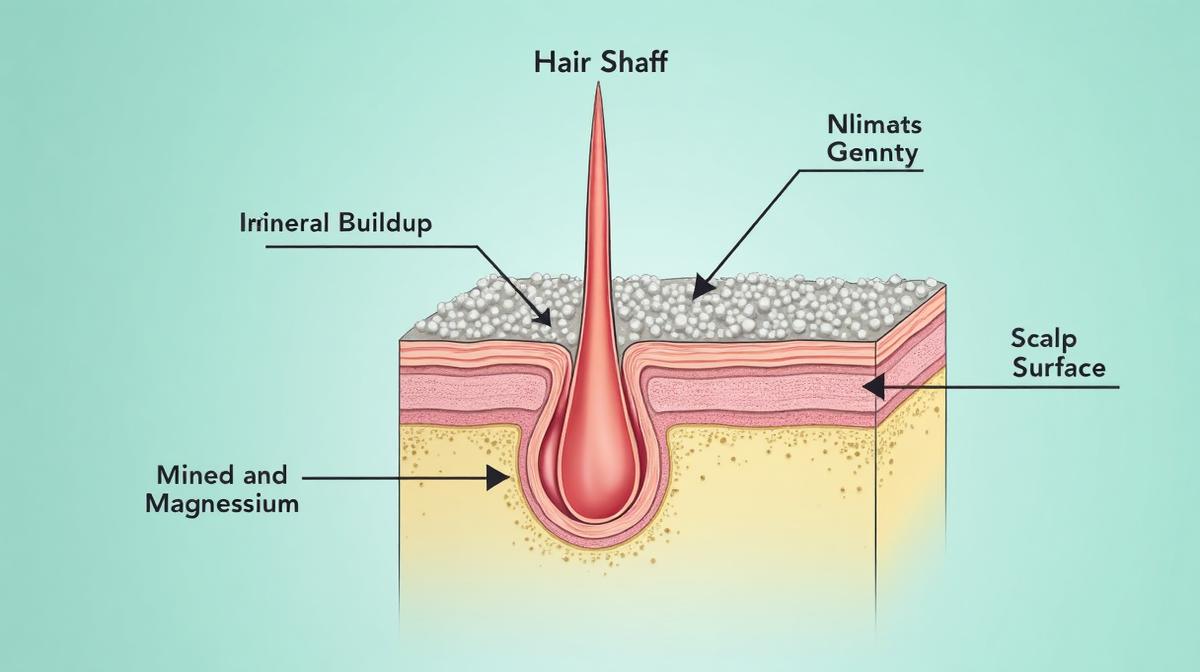
During shampooing, hard water minerals interact with your cleanser to form soap scum. That scum deposits on your scalp, clogs follicles, and changes the scalp’s pH balance. A final rinse with bottled water doesn’t remove that buildup. It’s already there, sitting on your skin.
This is why people who rinse with bottled water often report that their hair length feels better, but they still experience scalp itching, increased shedding, or oily roots. The scalp environment hasn’t improved. You’ve just given the ends of your hair a cleaner finish.
For complete protection, you need a product that chelates minerals during the wash, not after. That’s where chelating shampoos like Regrowth+ come in, they bind to minerals before they deposit, protecting both scalp and hair length in one step.
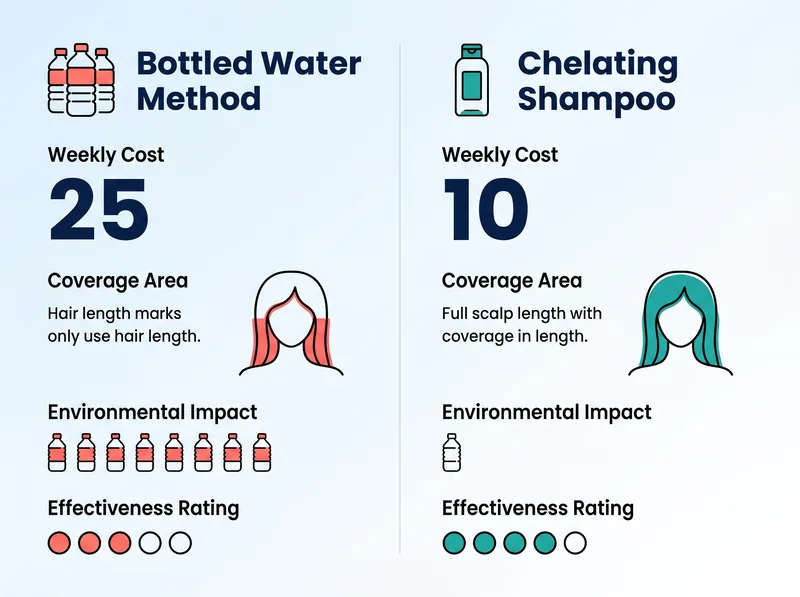 Weekly cost comparison: bottled water rinse method versus chelating shampoo for hard water protection
The Real Cost: Weekly Expense and Environmental Impact
Let’s do the math. If you have shoulder-length hair and wash every other day, you’ll need about 1.5 liters of bottled water per rinse. That’s roughly 5 liters per week, or ten 500ml bottles.
In the Gulf, bottled water costs approximately 1-2 AED per liter. Weekly cost: 5-10 AED. That’s 260-520 AED per year just for final rinses. If you wash daily, double that. If you have long or thick hair requiring more water, add another 30-50%.
Now add the environmental cost. Ten plastic bottles per week equals 520 bottles per year. Even if you recycle (and recycling rates in many regions remain under 10%), you’re contributing significant plastic waste for a solution that only partially works.
Compare that to a chelating shampoo: one 250ml bottle costs around 80-120 AED and lasts 2-3 months. Annual cost: 320-720 AED. Similar price point, but you get full scalp and hair protection, no plastic bottle waste per wash, and you’re not lugging water bottles home weekly.
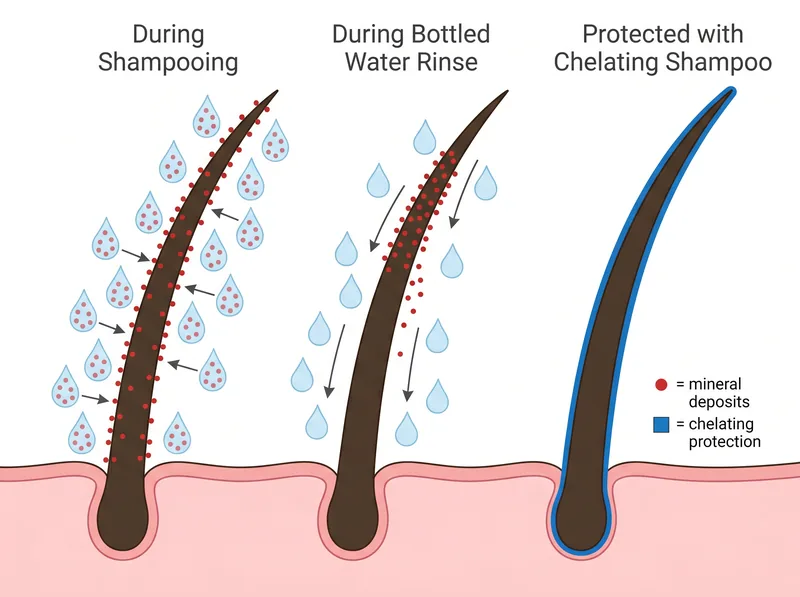 Why bottled water rinses only address part of the problem: minerals deposit during washing, not just rinsing
When Bottled Water Rinses Make Sense (And When They Don’t)
Bottled water rinses aren’t completely useless. They work well in specific scenarios. If you’re traveling short-term and don’t want to buy a full-size chelating shampoo, a final rinse can minimize damage for a week or two. If you have very long hair that’s already damaged and you want to reduce further roughness on the ends, it helps.
They also make sense as a temporary measure while you’re waiting for a chelating shampoo to arrive, or if you’re testing whether hard water is your actual problem before investing in a dedicated solution.
But if you’re washing daily, have scalp issues (itching, flaking, excess oil), or you’re experiencing hair thinning or breakage, bottled water rinses won’t solve your problem. You need something that addresses mineral buildup at the source, during the wash, not after.
And if cost is your concern, the math doesn’t support bottled water as a budget option. You’ll spend just as much annually, with less complete results and far more plastic waste. It’s not the economical workaround it seems.
The More Effective Alternative: Chelating Shampoo
Chelating shampoos work differently. They contain ingredients like EDTA (ethylenediaminetetraacetic acid) or citric acid that bind to mineral ions during the wash. Those minerals never get a chance to deposit on your hair or scalp. They’re rinsed away in the lather.
This means your scalp stays clean. Your follicles don’t get clogged. Your hair’s cuticle layer remains smooth from root to tip. You’re preventing the problem, not treating it after the fact.
A chelating shampoo also works with your existing tap water. You don’t need to haul bottles. You don’t need to do a separate rinse step. You wash normally, and the product does the work. For people washing daily or every other day, that convenience matters.
The science behind chelating shampoos is well-established. They’re used in professional salons specifically to remove mineral buildup before color treatments or chemical services. The same chemistry works for daily hard water exposure.
What About Distilled vs. Bottled Water?
People often ask whether distilled water works better than regular bottled water for final rinses. Short answer: yes, slightly. Distilled water has zero dissolved minerals (0 ppm TDS), while bottled water typically has 20-100 ppm depending on the brand.
That difference matters if you’re doing a final rinse, because even low-mineral bottled water can leave trace deposits over time. Distilled water won’t. But distilled water is also harder to find in large quantities and costs more per liter.
The practical difference? Minimal. If you’re already doing bottled water rinses and your hair feels better, switching to distilled won’t dramatically improve results. You’re still not addressing scalp buildup, and you’re still dealing with the cost and plastic waste.
If you’re committed to the rinse method, distilled is technically superior. But you’re improving a partial solution. The real question is whether the rinse method itself is the right approach for your situation.
DIY Workarounds vs. Systematic Solutions
Bottled water rinses fall into the category of DIY workarounds, quick fixes that address visible symptoms without solving the underlying problem. They’re appealing because they’re simple, low-commitment, and don’t require learning about water chemistry or hair science.
But DIY workarounds have hidden costs. Time spent doing an extra rinse step. Money spent on weekly water bottles. Mental load of remembering to buy and store bottles. And most importantly: incomplete results that leave you wondering if you’re doing enough.
Systematic solutions, like switching to a chelating shampoo or installing a whole-house water softener, require more upfront research and investment. But they solve the problem completely. Your hair and scalp are protected every time you wash. You’re not managing symptoms. You’re eliminating the cause.
For people who’ve just moved to the Gulf and are still figuring out what’s wrong with their hair, a bottled water rinse is a reasonable first test. But if you’ve been doing it for more than a month and you’re still having issues, it’s time to upgrade your approach.
References
- Effect of Hard Water on Hair - International Journal of Trichology
- Plastics: Material-Specific Data - US Environmental Protection Agency
- Water Quality and Hair Health - American Academy of Dermatology