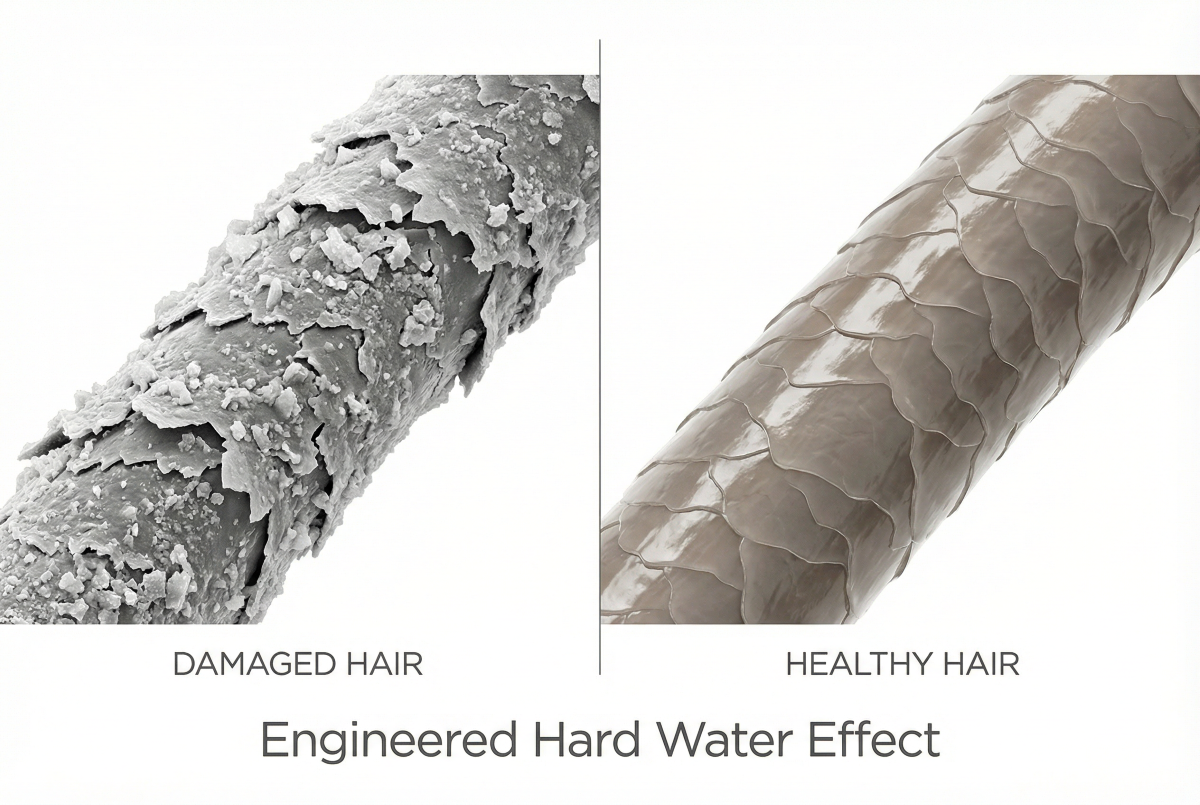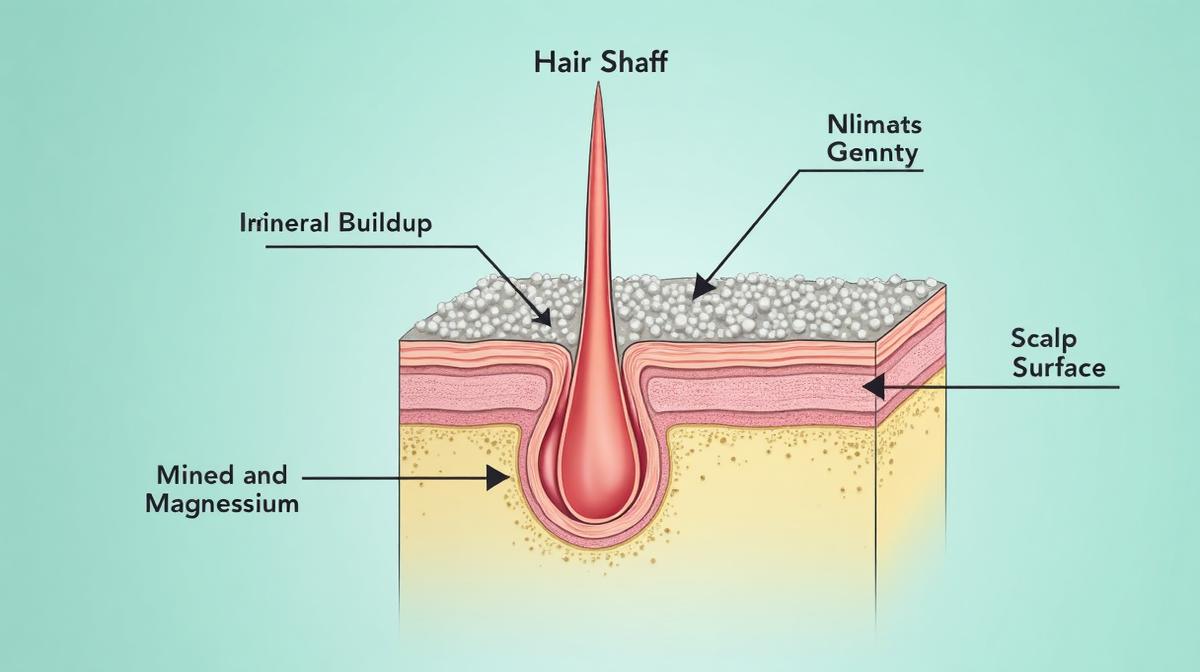
You’ve been researching hard water solutions for weeks. Your hair feels like straw, your scalp itches constantly, and you’re tired of throwing money at products that don’t work. Then someone mentions a whole-house water softener. The promise sounds perfect: soft water from every tap, no more mineral buildup, healthier hair and skin. But the price tag? Anywhere from $1,500 to $4,000 for installation, plus ongoing maintenance costs.
This article contains affiliate links. See our affiliate disclosure for details.
Here’s the thing most companies won’t tell you: a whole-house water softener is massive overkill if your only concern is hair health. It’s like buying a commercial kitchen because you want better toast. Yes, it’ll solve the problem. But there are far more cost-effective solutions that target your actual issue without the four-figure investment.
I’m a dermatologist who’s worked with hundreds of patients in the Gulf region dealing with hard water damage to their hair. I’ve seen people spend thousands on softeners when a $30 chelating shampoo would’ve solved their problem. And I’ve seen others who genuinely needed the whole-house system but waited too long because they didn’t understand the decision framework.
This article breaks down the real costs, the actual hair benefits, and the alternatives nobody talks about. By the end, you’ll know exactly whether a water softener makes sense for your situation, or whether you’re about to waste a lot of money on the wrong solution.
What a Water Softener Actually Does (and Doesn’t Do)
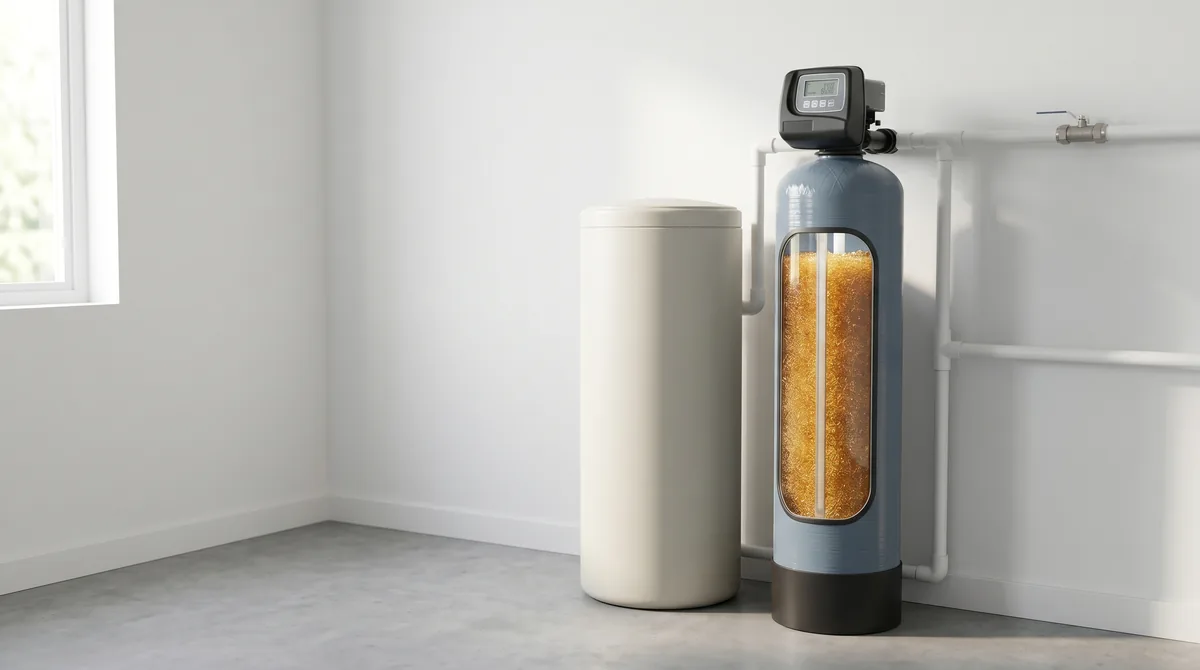
A whole-house water softener uses ion exchange technology to remove calcium and magnesium from your water supply. Hard water contains these minerals at concentrations typically above 120 mg/L in the Gulf region, sometimes exceeding 400 mg/L in areas with desalinated water mixed with groundwater. The softener replaces these hardness minerals with sodium ions through a resin bed, producing water with less than 17 mg/L total hardness.
For your hair, this means no more mineral deposits coating the hair shaft. No more calcium carbonate buildup that makes hair feel rough and tangled. No more magnesium sulfate residue that blocks moisture absorption. The water coming out of your shower is chemically different, and your hair can tell.
But here’s what a water softener doesn’t do: it doesn’t remove chlorine, chloramines, heavy metals, or other contaminants that can also damage hair. It doesn’t address the minerals already deposited in your hair from months or years of hard water exposure. And it doesn’t change the fact that you’ll need to maintain the system, refill salt regularly, and deal with slightly improved sodium levels in your water.
According to research from the US Geological Survey, water softeners are highly effective at removing hardness minerals, but they’re designed for whole-house applications, treating water for dishwashers, washing machines, water heaters, and plumbing fixtures. The hair benefit is real, but it’s a secondary effect of a system designed for a much broader purpose.
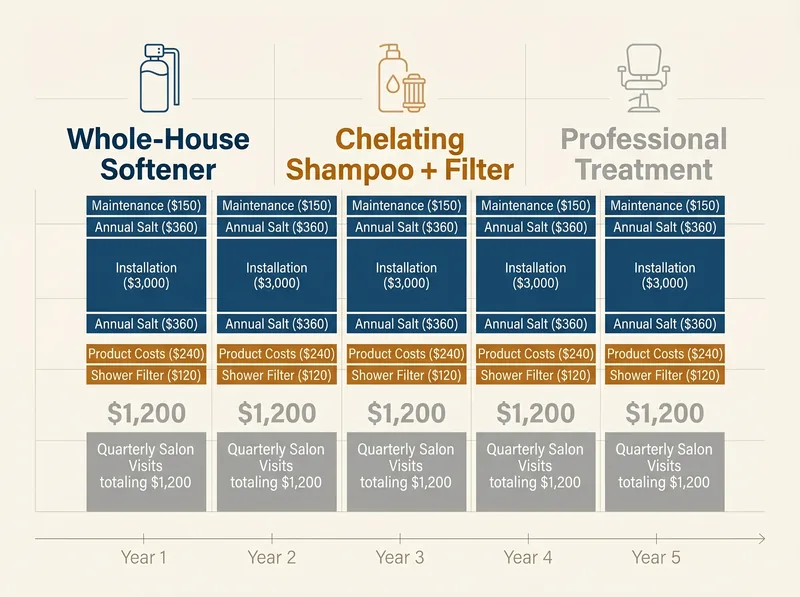 Five-year cost analysis: whole-house softener vs. targeted hair care alternatives
The Real Cost: Installation, Maintenance, and Hidden Expenses
Let’s talk numbers. The upfront cost for a whole-house water softener installation ranges from $1,500 to $4,000 depending on system capacity, brand, and installation complexity. In the Gulf region, expect to pay toward the higher end due to specialized plumbing requirements and the need for systems rated for high TDS (total dissolved solids) water.
That’s just the beginning. Salt costs run $20-50 per month depending on water usage and hardness levels. A family of four typically uses 40-80 pounds of salt monthly. You’ll also need annual maintenance ($100-200) to check resin bed condition, clean the brine tank, and ensure the system regenerates properly. Over five years, you’re looking at $4,800-7,200 total cost of ownership.
Then there are the hidden costs. Softened water contains improved sodium levels, typically 20-50 mg/L additional sodium depending on your incoming water hardness. If you’re on a sodium-restricted diet or have hypertension, you’ll need a separate reverse osmosis system for drinking water (add another $300-800). Your water heater will last longer with soft water, but your soap usage actually increases because soft water lathers more easily, most people overshoot and waste product.
Installation isn’t always straightforward either. If you’re in an apartment or rented villa, you can’t install a whole-house system without landlord approval and likely won’t recoup the investment when you move. If your water comes from a building-wide tank system (common in the Gulf), you may need special permissions or find that installation isn’t feasible at all.
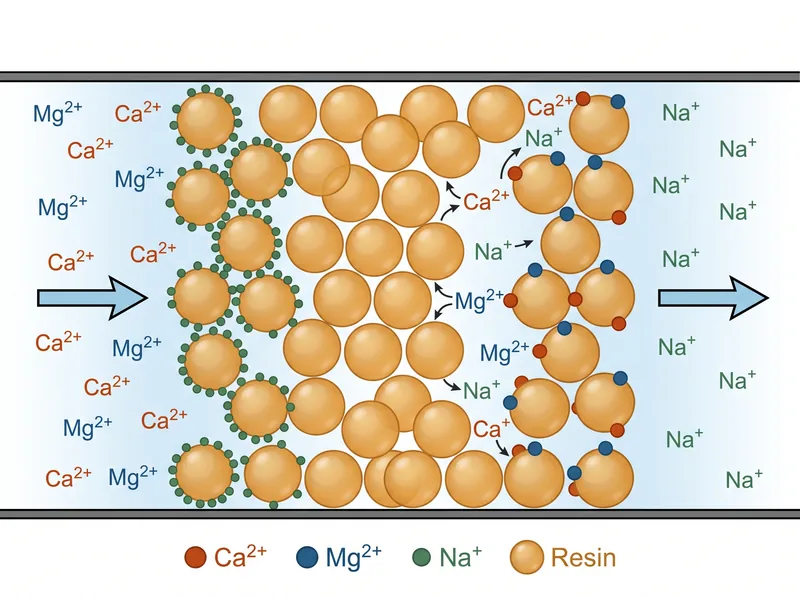 How ion exchange resin swaps calcium and magnesium for sodium ions
The Hair Benefit: What the Science Actually Shows
Does soft water improve hair health? Yes. Significantly? That depends on your starting point and what other factors are affecting your hair.
A study published in the International Journal of Trichology found that hard water exposure leads to increased surface roughness, decreased tensile strength, and reduced color retention in hair fibers. Participants using softened water showed measurable improvements in hair smoothness and reduced breakage over 12 weeks. But here’s the catch: the study also found that using a chelating shampoo twice weekly produced similar results without requiring water softening.
The mechanism is straightforward. Hard water minerals form a film on the hair cuticle that prevents moisture penetration and makes hair feel coarse. Remove those minerals from your water supply, and the film stops forming. Your hair gradually returns to its natural texture as existing deposits wash away. Conditioners work better. Styling products distribute more evenly. Hair color lasts longer.
But if you’ve been dealing with hard water for months or years, your hair already has significant mineral buildup. Switching to soft water prevents new deposits but doesn’t remove existing ones. That’s why people who install water softeners often don’t see dramatic improvements for 4-8 weeks, the time it takes for old buildup to gradually wash away. A chelating treatment accelerates this process, which is why combining a softener with a chelating shampoo like Regrowth+ produces faster results than either solution alone.
The other factor: if your hair loss or damage has multiple causes, hormonal changes, nutritional deficiencies, heat damage, chemical treatments, soft water only addresses the mineral buildup component. It won’t fix androgenetic alopecia. It won’t reverse damage from bleaching. It won’t compensate for iron deficiency. You need a complete approach, and spending $3,000 on water softening might not be the highest-impact intervention for your specific situation.
The Alternatives: Targeted Solutions That Cost 90% Less
Before you write a check for a whole-house system, consider these targeted alternatives that specifically address hair and scalp health without treating water you’ll use for toilets, lawn irrigation, and dishwashing.
Chelating shampoos work by using ingredients like EDTA (ethylenediaminetetraacetic acid) or citric acid to bind with mineral deposits and lift them from the hair shaft. Used 2-3 times per week, they prevent buildup and gradually remove existing deposits. Cost: $20-40 for a 3-month supply. That’s $160 per year versus $1,200+ annually for a water softener’s operating costs. For renters or people who aren’t ready for a major investment, this is the logical first step.
Shower filters are another option, though they’re not all created equal. Most basic carbon filters remove chlorine but don’t address hardness minerals. Look for filters that specifically claim calcium and magnesium reduction, these typically use KDF (kinetic degradation fluxion) media or vitamin C filtration. Effectiveness varies, and they need replacement every 3-6 months, but the total annual cost is $60-120. That’s still a fraction of a water softener’s expense.
Monthly clarifying treatments at a salon can also help. A professional chelating treatment costs $40-80 and removes mineral buildup more aggressively than at-home products. If you do this quarterly, you’re spending $160-320 annually, still far less than softener maintenance. The downside: you’re treating the symptom, not preventing it. New buildup starts accumulating immediately after treatment.
The combination approach works best for most people: a chelating shampoo for regular maintenance, a shower filter for chlorine and partial hardness reduction, and quarterly professional treatments if needed. Total annual cost: $300-500. That’s what you’d spend on salt alone for a water softener, and it gives you 80% of the hair benefit without the upfront investment or permanent installation.
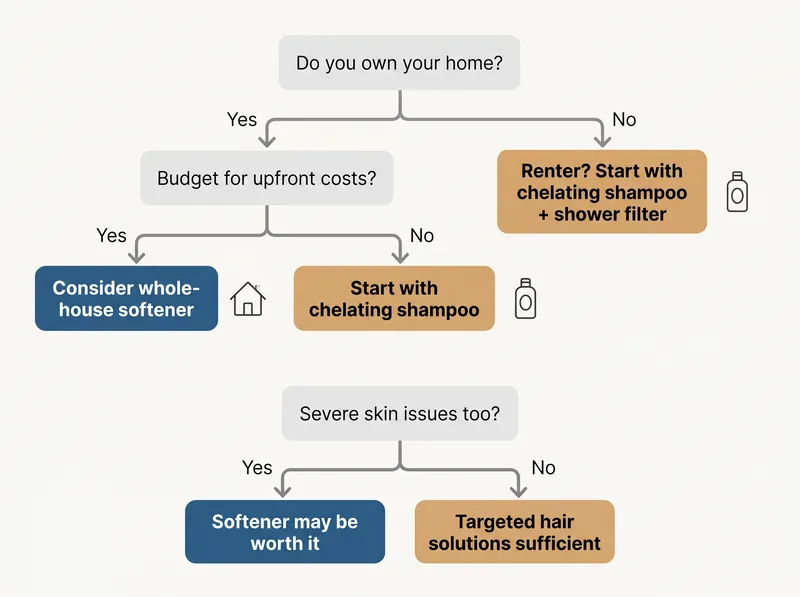 Decision framework: which solution matches your situation and budget
When a Water Softener Actually Makes Sense
So when should you consider the full system? There are legitimate scenarios where a whole-house water softener is the right choice, just not as many as the companies selling them would like you to believe.
You own your home and plan to stay long-term. If you’re renting or expect to move within 3-5 years, the math doesn’t work. You won’t recoup the installation cost, and you can’t take the system with you. But if you own your property and plan to stay for a decade, the cost amortizes to $40-60 monthly, comparable to the combination approach of chelating shampoo plus shower filter plus occasional professional treatments.
You have severe skin issues beyond hair concerns. If you’re dealing with eczema, psoriasis, or chronic dry skin that worsens with hard water, a whole-house system treats the root cause for your entire body. Hard water changes the skin barrier and exacerbates inflammatory conditions. If your dermatologist has recommended soft water for medical reasons, the investment becomes healthcare rather than cosmetic spending.
Your water hardness exceeds 300 mg/L. At extreme hardness levels (common in some Gulf areas with heavy desalination), point-of-use solutions struggle to keep up. Shower filters clog quickly. Chelating shampoos need to be used daily to prevent buildup. At that point, treating the water supply becomes more practical than constantly fighting the symptoms. Check your local water quality report or test your water with a TDS meter to know your baseline.
You’re already planning plumbing upgrades. If you’re renovating, replacing a water heater, or doing major plumbing work, adding a water softener to the project costs less than a standalone installation. The plumber is already there, the walls are already open, and you can integrate the system into your new infrastructure. The incremental cost might be $800-1,200 rather than $3,000+.
You have multiple people in the household with hair and skin concerns. If everyone in your family is dealing with hard water damage, the per-person cost of a whole-house system starts to make sense. A family of four spending $40 monthly each on chelating shampoos and shower filters ($160 total) is paying nearly as much as a softener’s operating costs while getting inferior results.
The Decision Framework: How to Choose Your Solution
Start with the lowest-cost intervention and escalate only if needed. This is the approach I recommend to patients, and it works for 70% of people dealing with hard water hair damage.
Step one: Try a chelating shampoo for 6-8 weeks. Use it 2-3 times per week, following with a moisturizing conditioner. Track your results. Is your hair less tangled? Does it feel softer? Are you seeing less breakage? If yes, you’ve solved the problem for $30. If you see partial improvement but not enough, move to step two.
Step two: Add a shower filter. Install a KDF or vitamin C filter and continue using the chelating shampoo. Give it another 4-6 weeks. The combination of preventing new buildup (filter) and removing existing deposits (shampoo) works for most people with moderate hard water exposure. Total investment so far: $100-150.
Step three: Get a professional chelating treatment. If you’re still seeing issues after 3 months of the shampoo-plus-filter approach, book a salon appointment for a professional mineral removal treatment. This will show you what your hair can look like with zero mineral buildup. If the difference is dramatic and you love the results, then you know the problem is purely mineral-related and a water softener would give you those results permanently.
Step four: Consider the whole-house system. If you’ve confirmed that hard water is your primary issue, you have the budget, you own your home, and you’re committed to long-term maintenance, then a water softener makes sense. Get quotes from 3-4 installers, ask about warranty coverage, and factor in the total 5-year cost of ownership. But you’re making this decision from an informed position, having already tested lower-cost alternatives.
This framework prevents the most common mistake: jumping straight to the most expensive solution without confirming it’s necessary. I’ve seen patients spend $4,000 on a water softener only to discover their hair loss was actually due to telogen effluvium from stress, not hard water. Start small, test your assumptions, and escalate only when you have evidence the problem requires the bigger intervention.
References
- Hardness of Water - US Geological Survey
- A Clinical Study to Evaluate the Efficacy of a Hair Serum in Promoting Hair Growth in Healthy Adult Volunteers - International Journal of Trichology
- Water Quality and Hair Health - American Academy of Dermatology
- Ion Exchange Water Softening - US Environmental Protection Agency