You’re losing more hair than usual. Not just a few extra strands, clumps in the shower, handfuls when you run your fingers through. You check your scalp. No bald patches yet, but the density isn’t what it was three months ago.
Here’s the thing most people miss: the stress that triggered this shedding probably happened weeks or even months before you noticed the hair loss. Your body has a delayed-reaction system, and understanding that timeline is the key to both diagnosing what’s happening and knowing when recovery will actually start.
This is telogen effluvium, the medical term for stress-induced hair shedding. It’s not about your hair follicles dying. It’s about them being forced into early retirement by a hormonal cascade that starts with cortisol and ends with a shower drain full of hair. The mechanism is well-documented, the timeline is predictable, and recovery is almost always complete. But you need to know what you’re dealing with.
Let’s walk through the biology, the timeline, and what actually helps versus what just wastes your time and money. This article contains affiliate links. See our affiliate disclosure for details.
The Cortisol-to-Telogen Pathway: How Stress Changes Hair Growth
Your hair follicles don’t respond to stress directly. They respond to cortisol, the hormone your adrenal glands release when your body perceives a threat. And here’s the problem: your adrenal glands can’t tell the difference between a physical threat (like an injury) and a psychological one (like chronic work pressure or a major life change).
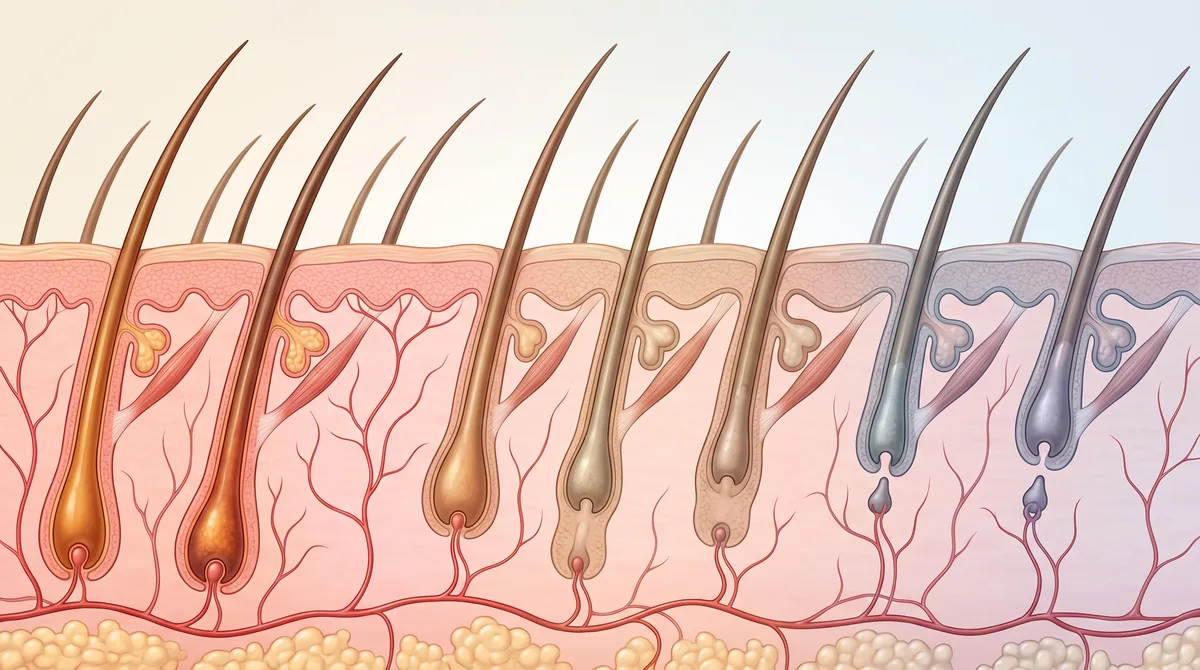
When cortisol levels stay improved for weeks or months, research shows it changes the hair growth cycle by forcing follicles to shift prematurely from the anagen phase (active growth) into the telogen phase (resting). Normally, about 85-90% of your hair is in anagen at any given time. But chronic stress can push that percentage down to 70% or lower.
The mechanism involves cortisol binding to receptors in the dermal papilla, the structure at the base of each follicle that controls growth signals. When cortisol floods these receptors, it suppresses the production of growth factors and triggers inflammatory cytokines. The follicle interprets this as a signal to conserve resources and shut down growth.
This isn’t a bug. It’s a feature. In evolutionary terms, hair growth is metabolically expensive. When your body thinks it’s under threat, it redirects resources away from non-essential functions (like growing hair) and toward survival functions (like maintaining muscle and organ function). The problem is that modern chronic stress, financial pressure, relationship strain, work deadlines, doesn’t resolve quickly. Your body stays in threat mode for months.
And that’s when the shedding starts. But not immediately.
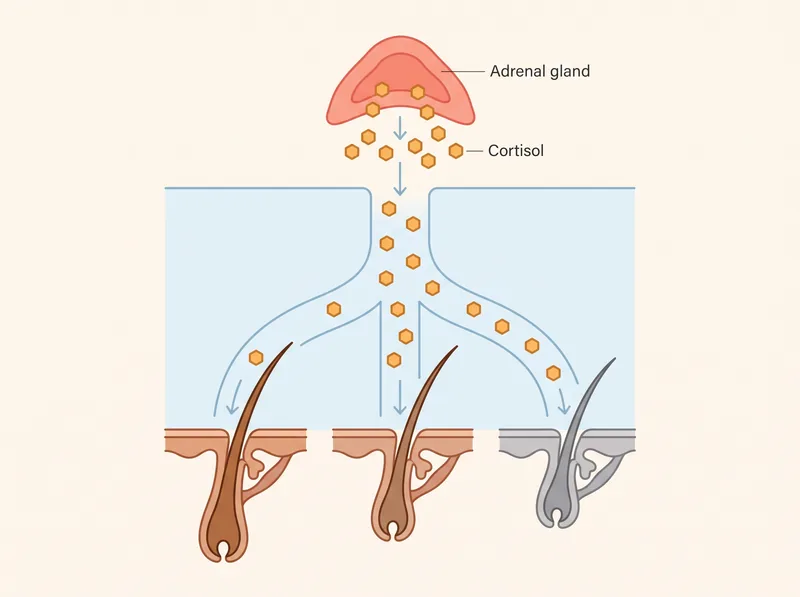 The cortisol-to-follicle pathway: how chronic stress hormones shift hair from growth phase to shedding phase
The 2-4 Month Delay: Why You’re Shedding Now for Stress That Happened Then
This is the part that confuses most people. You’re experiencing heavy shedding right now, so you assume the cause is something happening right now. You scan your current life for stressors. You blame your new shampoo, your diet, the water. You miss the actual trigger entirely.
The hair growth cycle has a built-in lag. When a follicle shifts from anagen to telogen, the hair doesn’t fall out immediately. It stays anchored in the follicle for 2-4 months while the follicle rests. Only after that resting period does the hair detach and shed. The American Academy of Dermatology confirms this timeline across thousands of documented cases.
So if you experienced a major stressor in March, a job loss, a move to the Gulf, a serious illness, a traumatic event, you likely won’t see increased shedding until June or July. By then, the original stressor might be resolved, which makes the hair loss feel random and unexplained.
This delayed pattern is actually diagnostic. If you can identify a significant stress event 2-4 months before your shedding started, you’re almost certainly dealing with telogen effluvium rather than androgenetic alopecia (pattern hair loss) or another condition. The timeline is your clue.
And here’s the other piece most people don’t realize: the shedding you’re seeing now represents hair that was already committed to falling out months ago. Nothing you do today will stop those hairs from shedding. They’re already detached at the root. What you do now affects the next growth cycle, the hairs that are just starting to grow back.
Peak Shedding and the Panic Phase
The shedding doesn’t happen all at once. It builds. You might notice a few extra hairs in week one, then more in week two, until you hit peak shedding around month 3-4 after the triggering event. That’s when most people panic.
During peak shedding, you can lose 300-500 hairs per day instead of the normal 50-100. Your brush fills up. Your pillow has strands. The shower drain clogs. You start avoiding washing your hair because the visual is too distressing. You Google ‘am I going bald’ at 2am.
Here’s what’s actually happening: your scalp had about 100,000-150,000 hairs before this started. Even if you lose 500 hairs a day for three months, that’s only about 45,000 hairs total, less than a third of your original density. It feels catastrophic because you’re seeing the loss in real-time, but the math shows you’re not heading toward baldness. You’re heading toward temporary thinning.
The panic phase is also when people make expensive mistakes. They buy every supplement on the market. They switch shampoos three times. They start minoxidil without understanding that it can cause an initial shedding phase that compounds the problem. They spend money on treatments that can’t affect hair that’s already committed to shedding.
What actually helps during peak shedding? Managing the underlying stress (if it’s ongoing), ensuring your scalp environment is clean and balanced, and waiting. The shedding will plateau, then decline. The timeline is predictable. Your job is not to panic and make it worse.
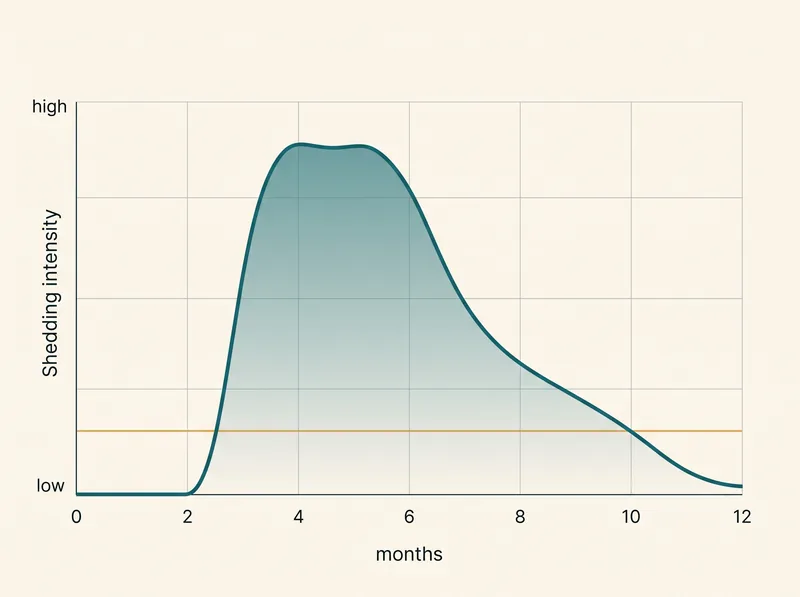 Typical telogen effluvium timeline: shedding peaks 2-4 months after the triggering stress event, then gradually normalizes over 6-12 months
Recovery Timeline: When New Growth Actually Starts
Recovery begins before you see it. The follicles that shifted into telogen 3-4 months ago are already starting to re-enter anagen. New hairs are growing. But they’re short, too short to notice for the first 2-3 months of regrowth.
Here’s the typical recovery timeline from the point where shedding peaks: Month 1-2 after peak shedding, the shedding rate gradually declines back toward normal. You’re still losing more than baseline, but it’s improving. Month 3-4 after peak shedding, you start seeing baby hairs along your hairline and part, short, fine regrowth that sticks up at odd angles. Month 6-9 after peak shedding, the new growth reaches a length where it starts adding visible density. Month 9-12 after peak shedding, your hair density returns to near-baseline.
That’s 9-12 months from the start of shedding, or roughly 12-16 months from the original stress event. It’s a long timeline. And it’s why so many people give up or assume their hair loss is permanent, they don’t wait long enough to see the full recovery.
Clinical studies on telogen effluvium recovery show that 95% of cases resolve completely within 6-12 months, assuming the triggering stressor is removed or managed. The 5% that don’t fully recover usually involve ongoing chronic stress, underlying nutritional deficiencies, or a misdiagnosis (it wasn’t telogen effluvium to begin with).
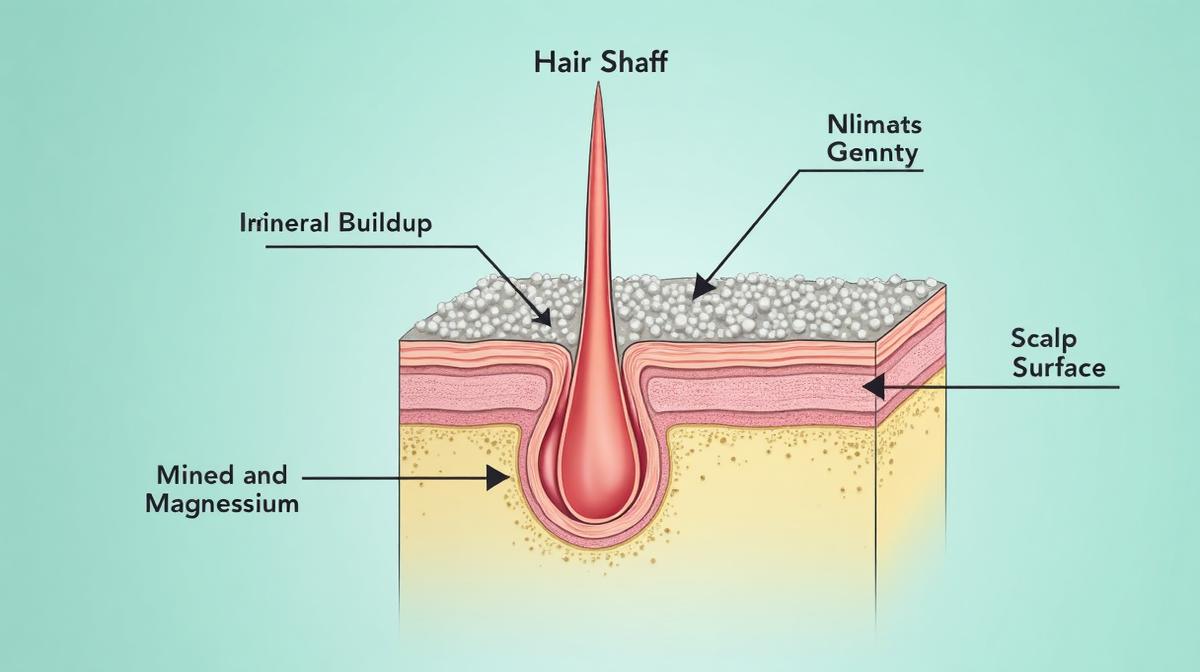
The regrowth phase is also when environmental factors matter most. If you’re in the Gulf and dealing with hard water, mineral buildup on your scalp can slow regrowth by clogging follicles and creating a hostile environment for new hair. A chelating shampoo like Regrowth+ can help clear that buildup and support healthier regrowth conditions, especially during the critical 3-6 month recovery window.
Chronic Stress vs Acute Stress: Why the Pattern Matters
Not all stress triggers the same hair loss pattern. Acute stress, a single traumatic event like a car accident, surgery, or sudden bereavement, typically causes a single episode of telogen effluvium. You shed heavily for 3-4 months, then recover over the next 6-9 months. It’s a one-time event.
Chronic stress is different. It’s ongoing, low-grade improvion of cortisol over months or years. Work pressure that never lets up. Relationship conflict that doesn’t resolve. Financial strain that persists. This type of stress can cause chronic telogen effluvium, a pattern where you never fully recover because the stressor never fully resolves.
With chronic telogen effluvium, you might see a baseline reduction in hair density that persists as long as the stress persists. Your hair doesn’t fall out in clumps, but it never returns to its original thickness. You’re stuck in a state of partial recovery.
This is where stress management becomes non-negotiable. You can’t supplement your way out of chronic cortisol improvion. You can’t shampoo your way out of it. The only solution is addressing the root cause, whether that’s changing your work situation, seeking therapy for anxiety, improving sleep quality, or making lifestyle changes that reduce your body’s stress response.
Regular exercise has been shown to lower baseline cortisol and improve hair follicle circulation, which is why it’s one of the few interventions that actually addresses both the hormonal trigger and the recovery environment.
What Actually Helps (and What Doesn’t)
Let’s be direct. Most of the products marketed for stress-related hair loss don’t address the mechanism. Biotin supplements won’t lower your cortisol. Caffeine shampoos won’t reverse telogen shift. Scalp massages feel good but don’t change your hormonal state.
What does help: managing the underlying stress through therapy, meditation, exercise, or medication if needed. Ensuring adequate protein intake (your body needs amino acids to rebuild hair shafts during recovery). Correcting any nutritional deficiencies that compound the problem, low ferritin is a common hidden factor that slows recovery even after stress resolves. Maintaining a clean scalp environment, especially if you’re dealing with hard water or product buildup that can impede regrowth.
What doesn’t help: panic-buying supplements with no evidence base. Switching shampoos every two weeks. Starting aggressive treatments like minoxidil during active shedding (it can make shedding worse initially). Avoiding washing your hair (dirty scalps don’t grow hair better, they grow it worse).
The hardest part of telogen effluvium recovery is accepting that you can’t speed it up. The follicles will re-enter anagen on their own timeline. Your job is to remove obstacles (ongoing stress, nutritional deficits, scalp buildup) and create conditions that support healthy regrowth. Then wait.
And if you’re six months into recovery and not seeing improvement? That’s when you see a dermatologist. Blood work can reveal underlying issues like thyroid dysfunction or autoimmune markers that might be masquerading as stress-related hair loss.
Environmental Load: When Stress Isn’t the Only Factor
Stress rarely acts alone. If you moved to the Gulf and started experiencing hair loss, it’s tempting to blame the stress of relocation. But the environmental factors in the Gulf, hard water, high mineral content, heat, humidity, create their own follicle stress independent of psychological stress.
Think of it as a load-bearing model. Your follicles can handle some stress. They can handle some environmental damage. But when both hit simultaneously, cortisol improvion plus mineral buildup, heat damage, and water quality issues, the combined load exceeds what your follicles can tolerate. That’s when you see accelerated shedding and slower recovery.
This is why people who move to the Gulf often experience worse hair loss than they would from the same stress level in a different environment. The stress triggered the telogen shift, but the environmental factors are preventing optimal regrowth. You’re trying to recover in a hostile environment.
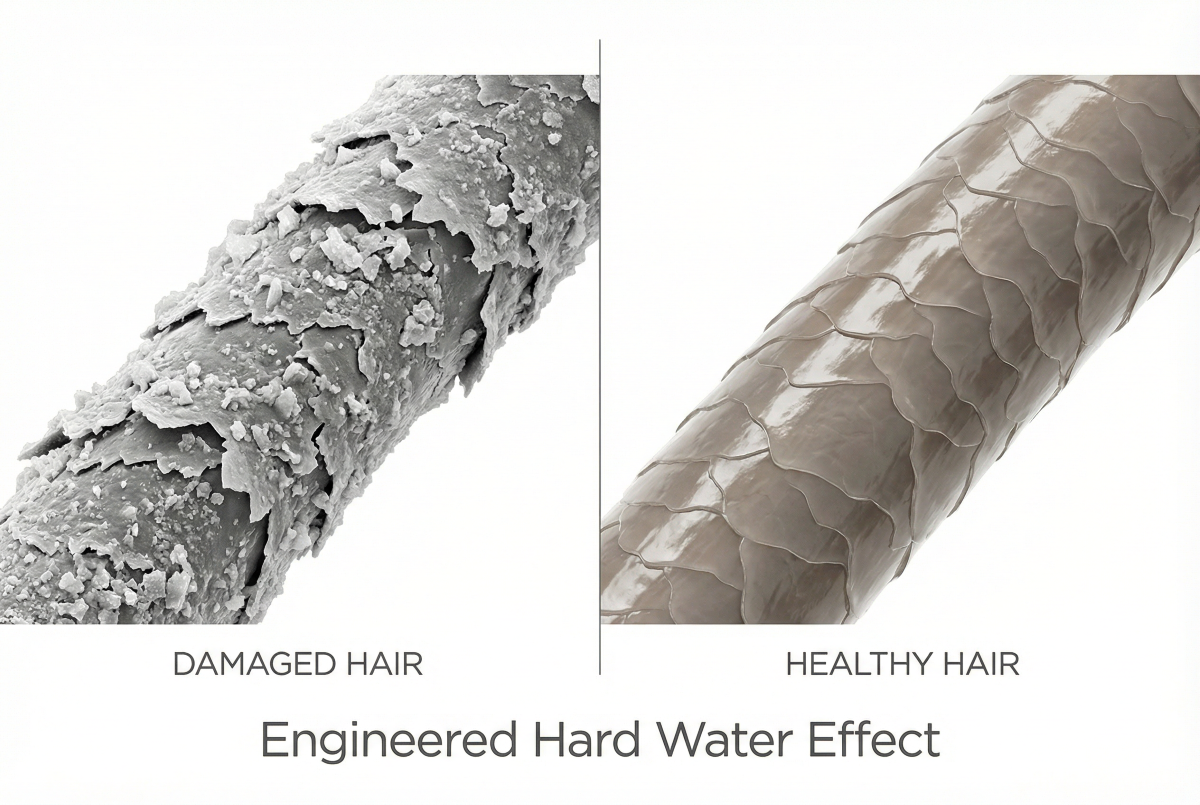
The solution isn’t just stress management. It’s also environmental management. Using a chelating shampoo to remove mineral buildup. Protecting hair from heat and sun damage. Ensuring your water quality isn’t sabotaging your scalp health. Understanding how hard water affects hair structure is part of the recovery equation.
This multi-factor model is why cookie-cutter advice fails. Someone recovering from stress-related hair loss in a temperate climate with soft water has a different recovery path than someone recovering in the Gulf with hard water and high heat. The biology is the same, but the environmental context changes what you need to do.
References
- The Impact of Psychological Stress on Hair Growth: Evidence-Based Review - PubMed
- Telogen Effluvium: Diagnosis and Treatment - American Academy of Dermatology
- Recovery Patterns in Telogen Effluvium: A Clinical Study - PubMed
- Cortisol and Hair Follicle Function: Molecular Mechanisms - PubMed Central