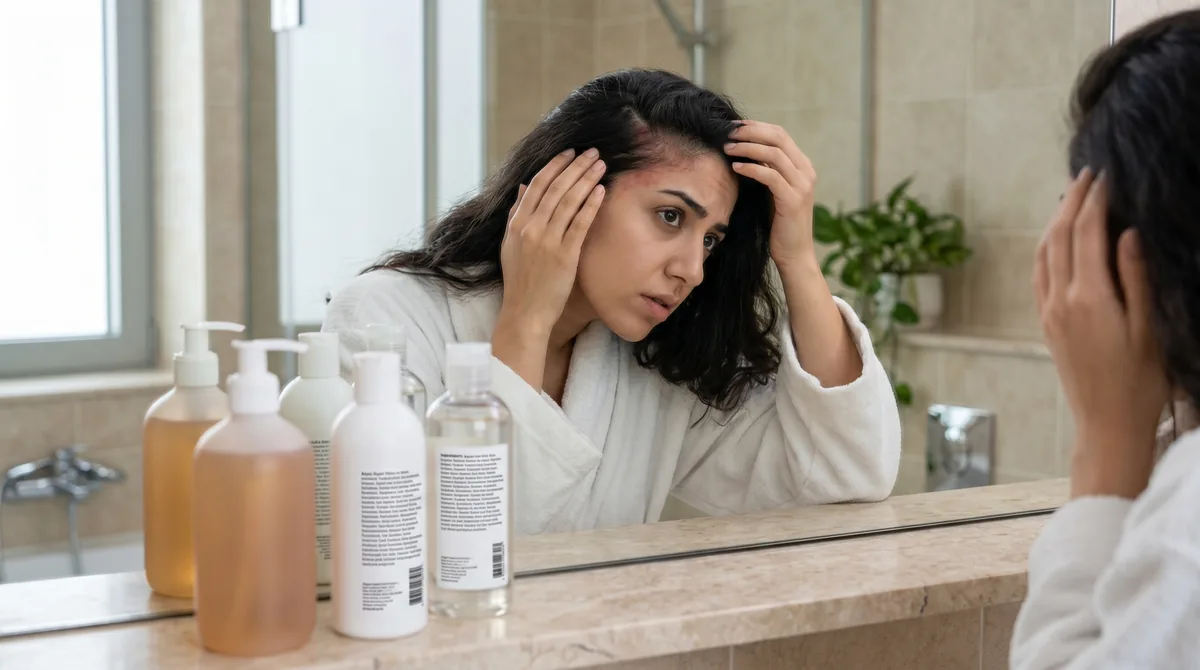
Your scalp itches within hours of washing. The redness won’t quit. You’ve switched shampoos three times, but the irritation follows you. Here’s what nobody mentions: the problem isn’t always the shampoo type. It’s the fragrance.
Fragrance allergens in hair products trigger more contact dermatitis cases than almost any other cosmetic ingredient category. But here’s the catch, when you see “fragrance” or “parfum” on a shampoo label, you’re not seeing one ingredient. You’re seeing a placeholder for potentially hundreds of undisclosed compounds, many of them known allergens.
The European Union flags 26 specific fragrance ingredients as high-risk allergens requiring disclosure above certain concentrations. But most shampoo formulas contain dozens more that never make it to the label. And if you’re in the Gulf region washing with hard water, your scalp barrier is already compromised, making you far more reactive to these hidden compounds than the average consumer.
This article contains affiliate links. See our affiliate disclosure for details.
What ‘Fragrance’ on a Label Actually Hides
When you see “fragrance” or “parfum” listed on a shampoo ingredient deck, you’re looking at a regulatory loophole. In most countries, including the Gulf region, fragrance formulas are considered proprietary trade secrets. Manufacturers aren’t required to disclose the individual compounds that make up that scent.
A single “fragrance” listing can represent anywhere from 50 to 200 different chemical compounds. Some are synthetic. Some are natural isolates from plants. Many are known sensitizers, ingredients that trigger allergic reactions in susceptible individuals.
The Personal Care Products Council maintains that fragrance ingredients undergo safety testing. But “safe for most people” doesn’t mean safe for everyone. And it certainly doesn’t account for people with already-compromised skin barriers.
Here’s the problem: you can’t avoid what you can’t identify. If you’re reacting to a specific fragrance allergen, say, linalool or limonene, you won’t know it’s in the product unless the concentration crosses the EU disclosure threshold. Below that threshold? It’s invisible.
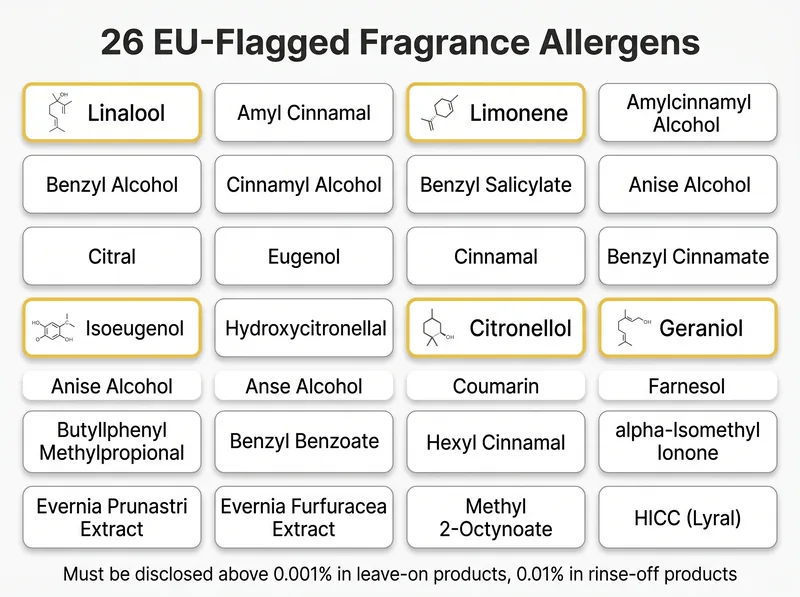 The 26 fragrance allergens that EU regulations require disclosure above certain concentrations, but most formulas contain far more undisclosed compounds.
The 26 EU-Flagged Fragrance Allergens
The European Union requires disclosure of 26 specific fragrance ingredients when they exceed 0.001% in leave-on products or 0.01% in rinse-off products like shampoo. These aren’t arbitrary picks, they’re the compounds most frequently implicated in allergic contact dermatitis from cosmetics.
The most common culprits include linalool (found in lavender and many floral scents), limonene (citrus scents), citronellol (rose scents), geraniol (geranium and rose), and eugenol (clove and cinnamon notes). But the list extends to 26 compounds total, including oak moss extracts, tree moss absolutes, and synthetic musks.
Even “natural” or “botanical” shampoos aren’t exempt. Linalool and limonene occur naturally in essential oils. A shampoo scented with “pure lavender oil” still contains linalool, it’s just plant-derived instead of synthetic. Your immune system can’t tell the difference.
And here’s the kicker: these 26 allergens are just the ones regulators have singled out. The fragrance industry uses over 3,000 different ingredients. Many haven’t been studied for long-term sensitization potential. You’re essentially beta-testing them every time you wash your hair.
How Fragrance Allergens Trigger Scalp Dermatitis
Allergic contact dermatitis from fragrance isn’t an immediate reaction like a bee sting. It’s a delayed-type hypersensitivity, your immune system recognizes the allergen as a threat, mounts a response, and the inflammation shows up 24 to 72 hours later.
The fragrance molecule penetrates the scalp’s outer layer (the stratum corneum), binds to skin proteins, and forms what immunologists call a hapten-protein complex. Your immune system sees this complex as foreign and attacks it. The result? Redness, itching, flaking, and sometimes weeping or crusting.
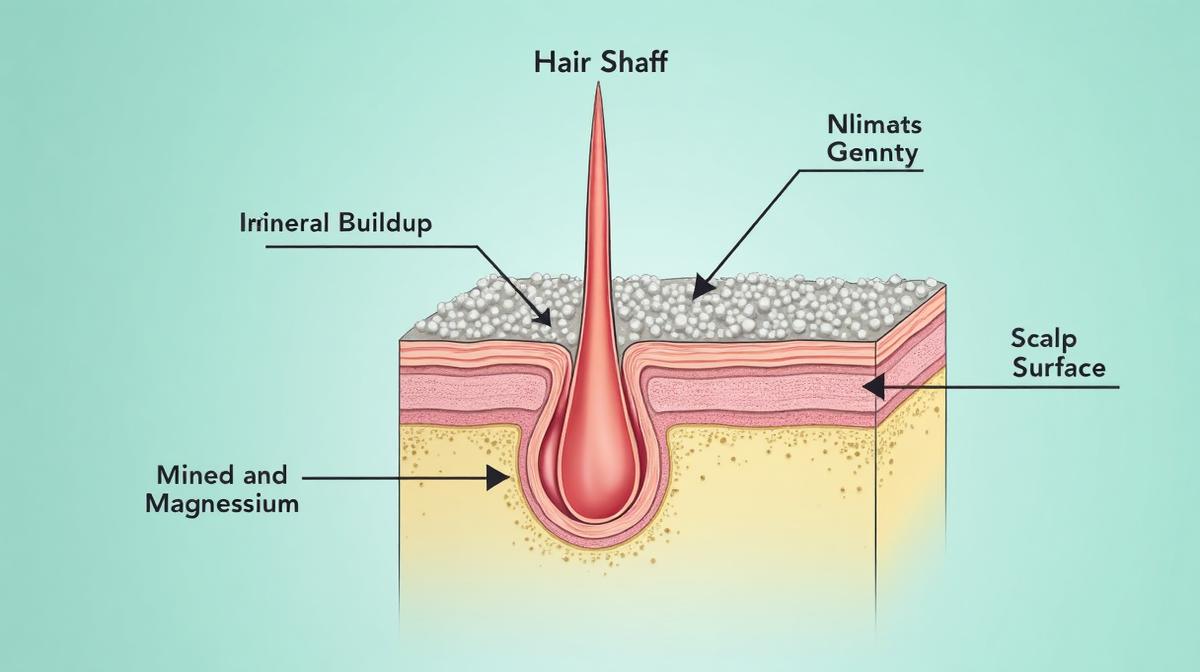
But here’s where Gulf residents face a compounding problem: hard water mineral buildup changes the scalp’s lipid barrier. Calcium and magnesium deposits create microscopic gaps between skin cells. Those gaps allow fragrance molecules to penetrate more deeply and trigger stronger immune reactions.
Think of it as a one-two punch. The hard water weakens your defense. The fragrance allergen slips through. Your scalp reacts more intensely than it would in a region with soft water. This is why expats in the Gulf often develop scalp sensitivities they never experienced before moving.
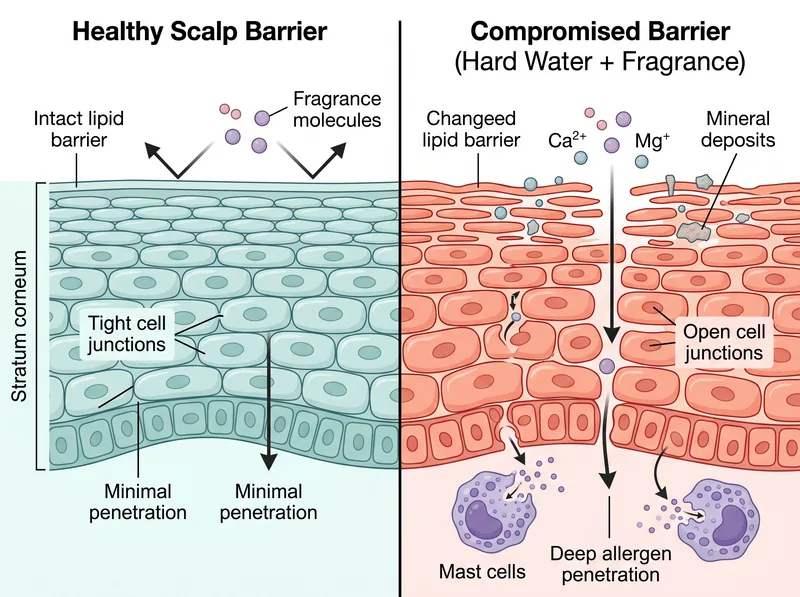 A compromised scalp barrier from hard water mineral buildup allows fragrance allergens to penetrate more deeply, triggering stronger immune reactions.
Why Hard Water Makes Fragrance Reactions Worse
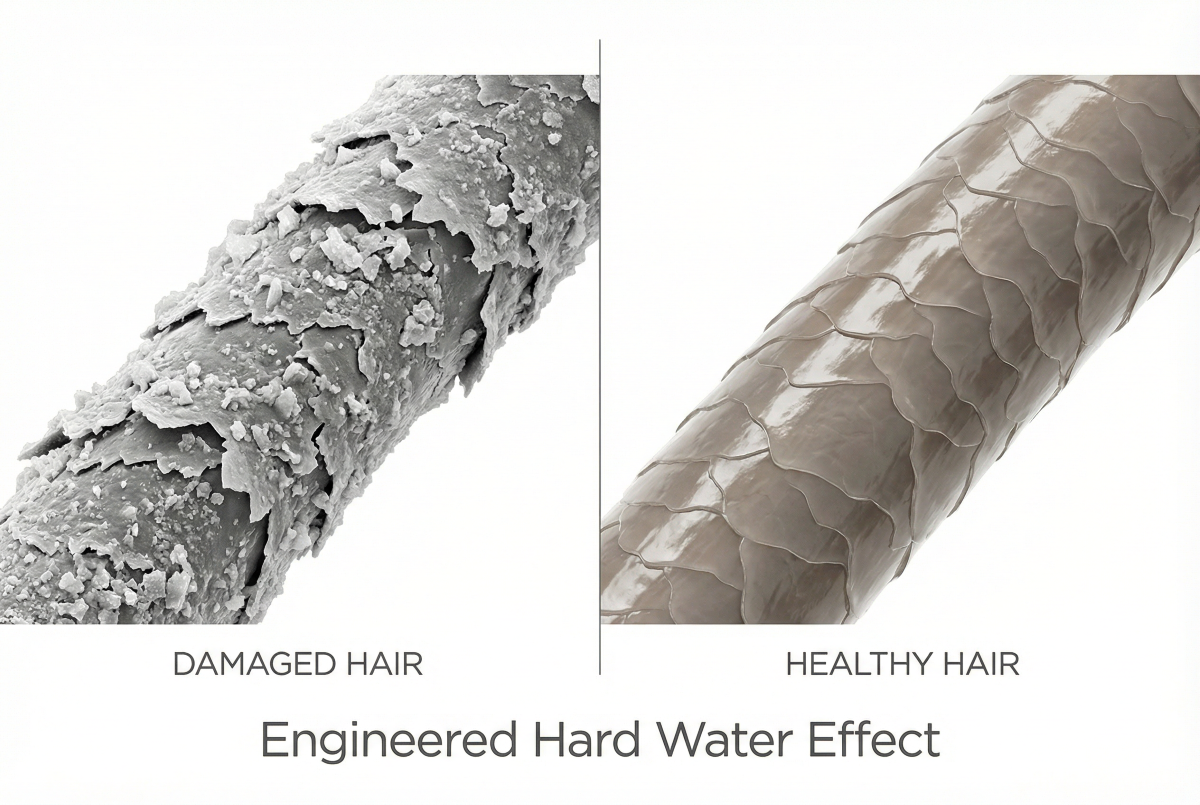
Hard water doesn’t just cause mineral buildup on hair strands, it fundamentally alters scalp barrier function. The calcium and magnesium ions in Gulf water supplies change the skin’s natural lipid matrix, the protective layer that keeps irritants out and moisture in.
When that barrier is compromised, your scalp becomes what dermatologists call “hyperreactive.” Ingredients that would normally sit on the surface and rinse away can now penetrate into the epidermis. Fragrance allergens that might cause mild irritation in someone with an intact barrier can trigger full-blown contact dermatitis in someone with hard water damage.
There’s also a mechanical component. Hard water leaves mineral deposits on the scalp. Those deposits create a rough, uneven surface that physically abrades the skin during washing. The micro-trauma from scrubbing against mineral buildup creates additional entry points for allergens.
This is why a chelating shampoo like Regrowth+ becomes critical for Gulf residents with fragrance sensitivities. By removing the mineral buildup, you restore barrier integrity, and reduce your reactivity to fragrance compounds that remain in your routine.
Fragrance-Free vs Unscented: The Label Confusion
Here’s a labeling trick that catches everyone: “unscented” doesn’t mean fragrance-free. An unscented shampoo can still contain fragrance ingredients, they’re just added to mask the base smell of the formula, not to create a pleasant scent.
“Fragrance-free” means no fragrance compounds were added for any purpose. “Unscented” means the product doesn’t smell like anything recognizable, but it might contain masking fragrances to neutralize chemical odors from other ingredients.
If you’re trying to eliminate fragrance allergens, you need to look for “fragrance-free” on the label. Better yet, scan the ingredient list for the 26 EU allergens by name. Even fragrance-free products can contain trace amounts from other botanical extracts.
And don’t assume “hypoallergenic” guarantees fragrance-free. That term has no regulatory definition. A shampoo can be labeled hypoallergenic and still contain linalool, limonene, or any other fragrance allergen. The only way to know is to read the full ingredient deck.
Patch Testing and Diagnosis
If you suspect fragrance allergy, the gold standard diagnostic tool is patch testing. A dermatologist applies small amounts of suspected allergens to your back, covers them with adhesive patches, and checks for reactions after 48 and 96 hours.
The American Academy of Dermatology recommends patch testing for anyone with persistent scalp dermatitis that doesn’t respond to standard treatments. The test can identify specific fragrance allergens so you know exactly what to avoid.
But here’s the frustration: even with a positive patch test, avoiding the allergen is harder than it sounds. If you’re allergic to linalool and it’s hidden under “fragrance” on a label, you won’t know it’s there unless the concentration requires disclosure.
This is why many dermatologists recommend switching to completely fragrance-free products rather than trying to avoid specific allergens. It’s the only way to guarantee elimination when labeling laws don’t require full disclosure.
Building a Fragrance-Free Hair Routine
Transitioning to fragrance-free hair care isn’t just about swapping shampoo. You need to audit your entire routine, conditioner, leave-in treatments, styling products, even the fabric softener you use on towels.
Start with a fragrance-free chelating shampoo to remove mineral buildup and restore barrier function. This is especially critical in the Gulf where hard water damage is near-universal. Once your scalp barrier is intact, you’ll be less reactive to trace fragrance exposure from environmental sources.
For conditioner, look for formulas labeled “fragrance-free” and check the ingredient list for the 26 EU allergens. Avoid anything with essential oils, lavender, tea tree, peppermint, rosemary. These are natural fragrance sources and contain the same allergenic compounds as synthetic versions.
Give your scalp at least 6 to 8 weeks to calm down after eliminating fragrance. Allergic contact dermatitis doesn’t resolve overnight. The inflammation needs time to subside, and your skin barrier needs time to repair. If you’re not seeing improvement by week 8, revisit your dermatologist, there may be a secondary trigger.
References
- Fragrance Allergy and Contact Dermatitis - American Academy of Dermatology
- Prevalence of Fragrance Allergy in the General Population - PubMed
- Contact Dermatitis: Diagnosis and Treatment - Mayo Clinic
- Fragrance Ingredients in Personal Care Products - Personal Care Products Council
- Patch Testing for Allergic Contact Dermatitis - American Academy of Dermatology