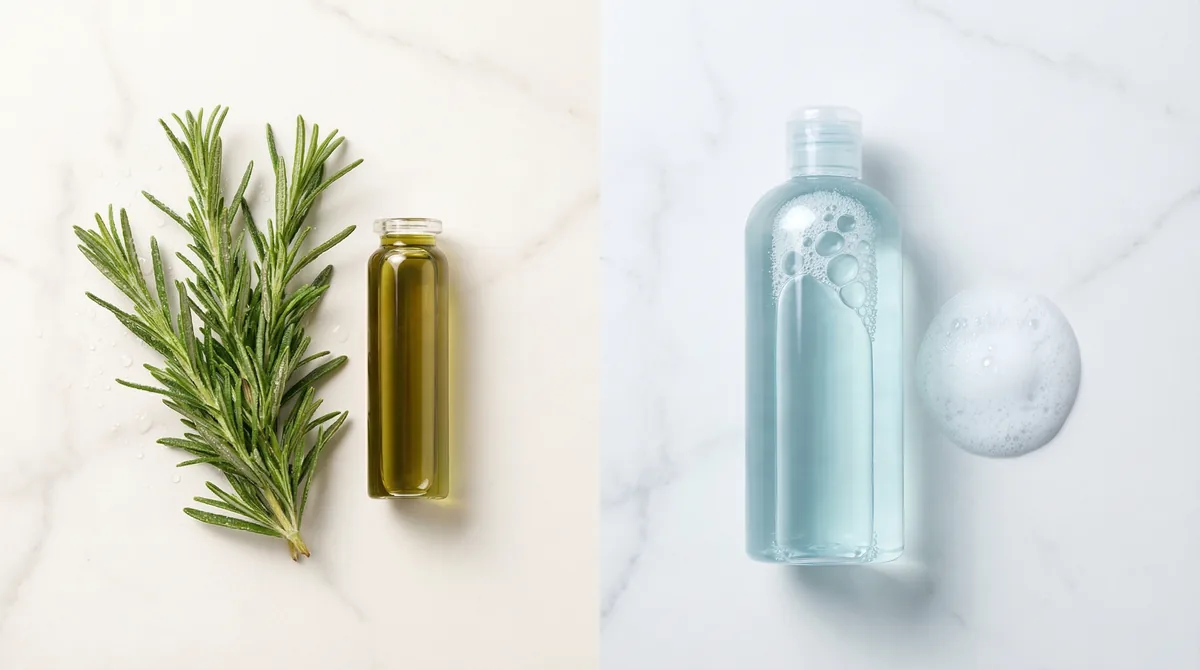
You’ve probably noticed the rosemary shampoo trend. Bottles with botanical labels filling store shelves. Influencers claiming miracle results. But here’s what nobody’s telling you: most rosemary shampoos aren’t actually that different from regular shampoo. They contain a tiny amount of rosemary extract, buried in a formula identical to the conventional shampoo sitting next to it on the shelf.
This article contains affiliate links. See our affiliate disclosure for details.
The real difference isn’t about rosemary versus no rosemary. It’s about formulation philosophy. Regular shampoos are designed to clean your hair using the cheapest, most effective detergents available, with fragrance and conditioning agents added to mask the harshness. Rosemary shampoos (the legitimate ones, anyway) are built around a different goal: stimulating your scalp while protecting your hair from environmental damage.
That distinction matters enormously if you’re dealing with hair loss in the Gulf region, where hard water and heat create a perfect storm for follicle stress. Let’s break down what actually separates these two categories, beyond the marketing claims and the botanical illustrations on the label.
The Active Ingredient Gap: What’s Actually in the Bottle
Regular shampoo’s primary job is simple: remove oil, dirt, and product buildup from your hair and scalp. The workhorse ingredients are sulfates (sodium lauryl sulfate or sodium laureth sulfate), which are incredibly efficient at stripping away sebum and debris. They’re cheap, effective, and harsh. Most conventional formulas contain 10-15% sulfate concentration, along with silicones to add slip, synthetic fragrances to smell pleasant, and preservatives to extend shelf life.
Rosemary shampoo (when properly formulated) takes a different approach. The active component is rosemary oil or rosemary extract, which contains two compounds with documented biological activity: carnosic acid and rosmarinic acid. Research published in Skinmed demonstrated that rosemary oil performed comparably to 2% minoxidil in promoting hair growth after six months of use, with significantly less scalp itching.
But concentration matters. A legitimate rosemary shampoo should contain at least 2-3% rosemary oil or a standardized extract equivalent. Many commercial products contain less than 0.5%, which is enough to claim ‘contains rosemary’ on the label but too little to produce measurable effects. Check the ingredient list: rosemary (Rosmarinus officinalis) should appear in the first five ingredients, not buried at the bottom after the preservatives.
The other critical difference is what’s NOT in rosemary shampoo. Quality formulations typically skip harsh sulfates in favor of gentler surfactants like coco-glucoside or decyl glucoside, which clean effectively without stripping your scalp’s natural protective barrier. This matters because aggressive cleansing changes the scalp microbiome and can actually worsen inflammation and hair loss over time.
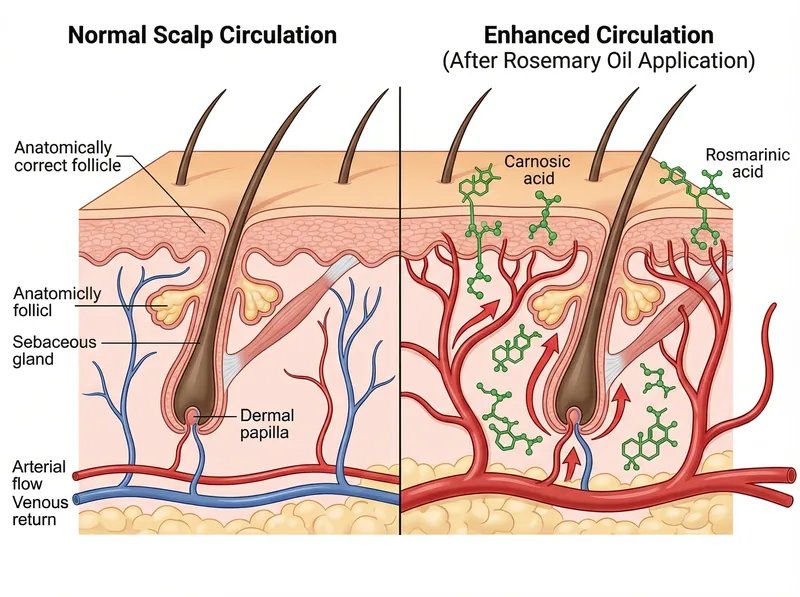 Rosemary’s active compounds penetrate the scalp to increase microcirculation and nutrient delivery to hair follicles
How Rosemary Shampoo Affects Your Scalp Differently
Your scalp isn’t just skin. It’s a complex system with hair follicles, sebaceous glands, blood vessels, and a delicate microbial community. Regular shampoo treats this system like a dirty floor that needs aggressive scrubbing. Rosemary shampoo (done right) treats it like a garden that needs nourishment and protection.
The mechanism is surprisingly well-documented. Carnosic acid in rosemary oil increases microcirculation in the scalp by dilating blood vessels and improving nutrient delivery to hair follicles. Studies in Phytotherapy Research found that topical application of rosemary extract increased blood flow by up to 22% within 30 minutes, an effect that persisted for several hours after application.
Regular shampoo doesn’t do this. It cleans, conditions, and that’s it. There’s no biological interaction with your follicles, no stimulation of growth factors, no anti-inflammatory activity. You get clean hair, but you don’t get the secondary benefits that make rosemary formulations interesting for people dealing with thinning or slow growth.
The anti-inflammatory properties are particularly relevant for Gulf residents. High mineral content in water creates oxidative stress on the scalp, leading to chronic low-grade inflammation that weakens follicles over time. Rosmarinic acid acts as a potent antioxidant, neutralizing free radicals and reducing inflammatory markers like TNF-alpha and IL-6. Regular shampoo has no answer to this problem (it often makes it worse by further irritating already-stressed tissue).
The Hard Water Problem: Why Formulation Matters More Here
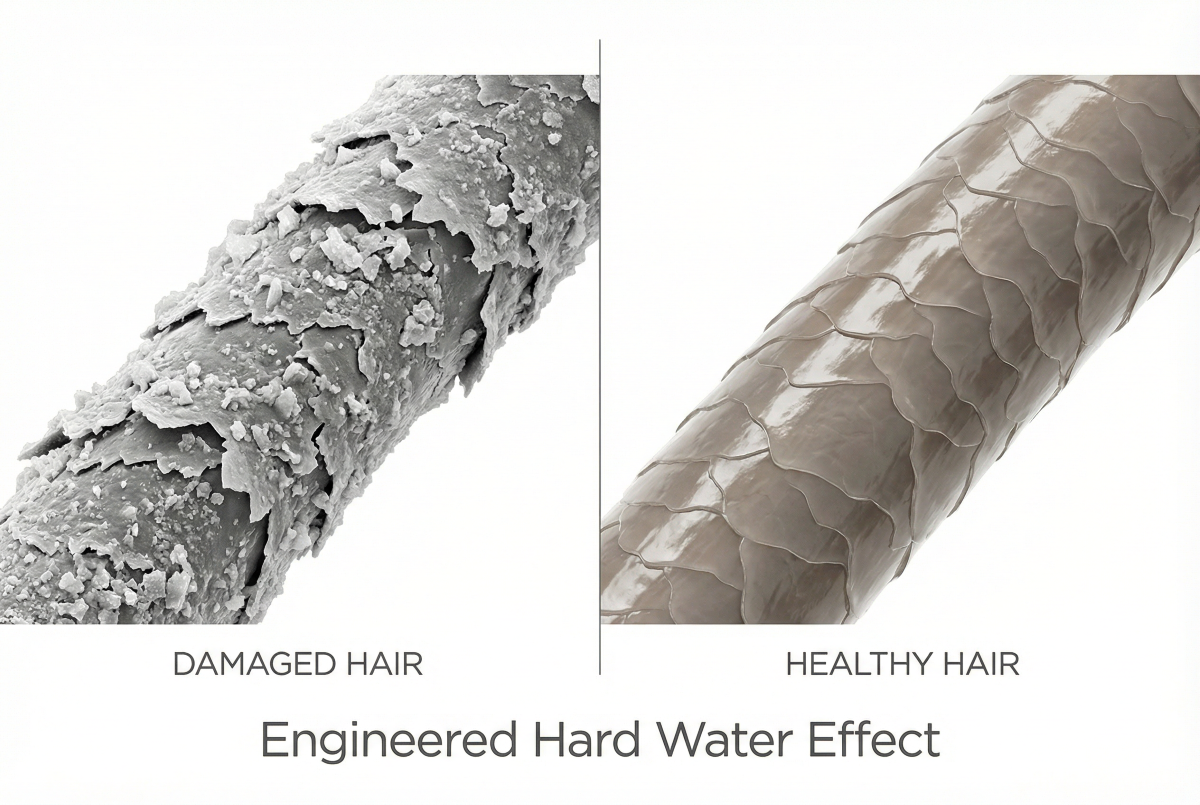
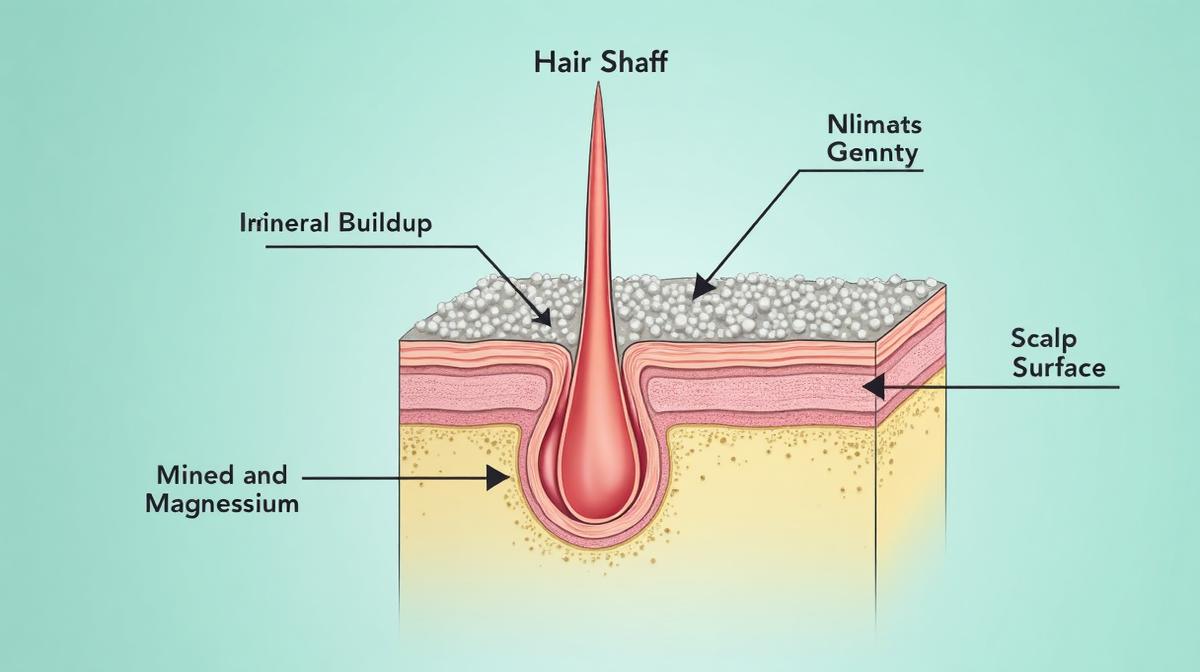
If you’re washing your hair with Gulf water, the type of shampoo you use becomes exponentially more important. Hard water in the region contains 200-400 mg/L of dissolved minerals (primarily calcium and magnesium), compared to 50-100 mg/L in most Western countries. These minerals don’t just sit on your hair. They bind to the negative charges on your hair cuticle and create a coating that blocks moisture, tangles easily, and looks perpetually dull.
Regular shampoo makes this worse. Sulfates react with hard water minerals to form insoluble compounds (soap scum) that deposit on your hair shaft. You’ve experienced this: hair that feels waxy or stiff after washing, that doesn’t respond to conditioner, that looks flat and lifeless no matter what you do. That’s not your hair’s fault. It’s chemistry.
Quality rosemary shampoos often incorporate chelating agents or use surfactant systems that don’t react with minerals. Some formulations include ingredients like EDTA or citric acid that actively bind to calcium and magnesium, preventing them from depositing on your hair. Others use sulfate-free cleansers that simply don’t form the problematic compounds in the first place. For Gulf residents, this isn’t a luxury feature. It’s essential.
This is where a product like Regrowth+ chelating shampoo becomes relevant. It combines rosemary oil with a mineral-removing system specifically designed for hard water conditions. The formulation addresses both the cleaning challenge (removing existing mineral buildup) and the growth-stimulation goal (delivering active botanicals to the scalp). Regular shampoo can’t do both because it wasn’t designed to solve both problems.
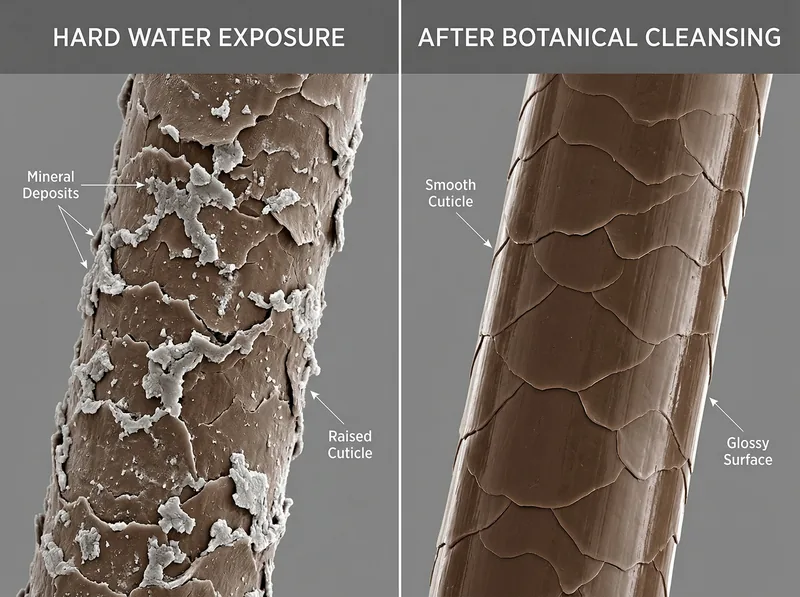 Mineral buildup from hard water creates a barrier that blocks nutrients, while botanical cleansers help maintain a cleaner hair surface
Cost Analysis: Is Rosemary Shampoo Worth the Premium?
Let’s talk money. Regular shampoo costs $5-12 for a 500ml bottle. Rosemary shampoo ranges from $15-35 for the same volume. That’s a 3-5x price difference. Is it justified?
It depends on what you’re comparing. If you’re buying a mass-market rosemary shampoo that contains 0.1% rosemary extract and the same sulfate base as regular shampoo, you’re paying for marketing, not efficacy. That’s not worth the premium. But if you’re buying a properly formulated product with meaningful concentrations of active ingredients, gentler surfactants, and hard water protection, the cost difference reflects genuine formulation complexity.
There’s also a hidden cost calculation most people miss. Regular shampoo in hard water requires more product per wash (because it doesn’t lather well), more frequent washing (because mineral buildup makes hair look dirty faster), and additional treatments to combat dryness and damage. Over six months, you might use 3-4 bottles of regular shampoo plus weekly clarifying treatments plus intensive conditioners. A quality rosemary shampoo that prevents buildup and maintains scalp health might actually cost less per wash when you factor in reduced product usage and fewer corrective treatments.
The bigger question is opportunity cost. If you’re dealing with progressive hair thinning, every month you spend using ineffective products is a month of continued follicle miniaturization. Hair loss isn’t reversible once follicles fully atrophy. Spending an extra $20 on a shampoo that actually addresses the root cause (poor scalp circulation, inflammation, mineral damage) is cheap compared to the cost of more aggressive treatments later.
What to Look for When Choosing Rosemary Shampoo
Not all rosemary shampoos are created equal. Here’s your quality checklist:
First, check ingredient concentration. Rosemary oil or rosemary extract should appear in the top five ingredients. If it’s listed after preservatives or fragrance, the concentration is too low to matter. Look for products that specify the percentage (2-3% rosemary oil is the clinical threshold) or use terms like ‘standardized extract’ which indicates consistent active compound levels.
Second, examine the surfactant system. Avoid products with sodium lauryl sulfate or sodium laureth sulfate as primary cleansers if you have hard water or sensitive scalp. Better options include coco-betaine, decyl glucoside, or sodium cocoyl isethionate. These clean effectively without the harsh stripping action that damages your scalp barrier.
Third, look for hard water protection. Ingredients like EDTA (ethylenediaminetetraacetic acid), citric acid, or sodium gluconate indicate the formula includes chelating agents. For Gulf residents, this is non-negotiable. Your shampoo needs to actively combat mineral deposition, not just ignore it.
Fourth, check for supporting ingredients that enhance rosemary’s effects. Rosemary works synergistically with other botanicals like peppermint oil (which also increases scalp circulation), saw palmetto extract (which blocks DHT), and biotin (which supports keratin synthesis). A well-designed formula combines multiple mechanisms rather than relying on rosemary alone.
Finally, ignore marketing claims and focus on formulation. ‘Clinically proven’ means nothing without published studies. ‘Natural’ doesn’t equal effective (arsenic is natural). ‘Sulfate-free’ is good but not sufficient. Read the actual ingredient list and research the components. A $30 bottle with proper actives beats a $15 bottle of green-tinted regular shampoo with a rosemary illustration on the label.
The Realistic Timeline: When to Expect Results
Here’s what nobody tells you about switching to rosemary shampoo: it gets worse before it gets better. The first two weeks are rough. If you’re transitioning from regular shampoo (especially if you’ve been using silicone-heavy products), your hair will feel weird. Possibly greasy. Definitely different. This is normal. Your scalp is adjusting to a gentler cleansing system, and existing mineral buildup is gradually being removed.
Week 3-4 is when you notice the first real changes. Your hair feels cleaner for longer. It’s easier to style. The texture improves. You’re not seeing growth yet (hair grows 0.5 inches per month under ideal conditions, so new growth isn’t visible this early), but you’re seeing the foundation being built: healthier scalp, reduced inflammation, better moisture retention.
Month 2-3 is when growth-related changes become measurable. If rosemary shampoo is going to work for you, this is when you’ll see increased density in areas of diffuse thinning, reduced shedding during washing, and stronger hair that breaks less easily. Clinical trials measuring rosemary oil against minoxidil found significant improvement at the three-month mark, with continued gains through six months.
Month 6 is the real evaluation point. By now, you’ve completed multiple hair growth cycles, and the cumulative effects of improved scalp health are fully visible. If you’re not seeing meaningful improvement by month 6, rosemary shampoo alone isn’t sufficient for your situation, and you need to consider additional interventions (topical minoxidil, oral finasteride, or addressing underlying factors like nutritional deficiencies or hormonal imbalances).
One critical point: rosemary shampoo maintains and improves existing follicles. It doesn’t resurrect completely dead follicles. If you have areas of complete baldness where follicles have been gone for years, no shampoo will bring them back. The earlier you start, the better your results. Don’t wait until you have significant loss to address the problem.
References
- Rosemary oil vs minoxidil 2% for the treatment of androgenetic alopecia: a randomized comparative trial - Skinmed
- Carnosic acid and carnosol induce an antioxidant response in endothelial cells - ScienceDirect - Phytotherapy Research
- Effect of rosemary oil on scalp microcirculation and hair growth parameters - PubMed Central
- Hard water minerals and their effects on hair and scalp health - American Academy of Dermatology