Your scalp isn’t sterile. Right now, billions of bacteria, fungi, and microorganisms are living on every square centimeter of your skin. And that’s exactly how it should be.
This invisible system, your scalp microbiome, controls everything from how much oil your skin produces to whether you develop inflammation, itching, or dandruff. When it’s balanced, you don’t even notice it’s there. But when something changes this delicate system, the effects show up fast: excess oil, flaking, irritation, and eventually hair thinning.
Here’s what most people don’t realize: the minerals in hard water don’t just coat your hair. They fundamentally change the chemistry of your scalp surface, creating conditions where harmful bacteria thrive and beneficial species die off. The result? A changeed microbiome that can’t do its job.
This isn’t about killing bacteria with harsh products. It’s about understanding what these organisms actually do, why they need specific conditions to function, and how environmental factors in the Gulf region create the perfect storm for microbiome changeion.
What Lives on Your Scalp (And Why It Matters)
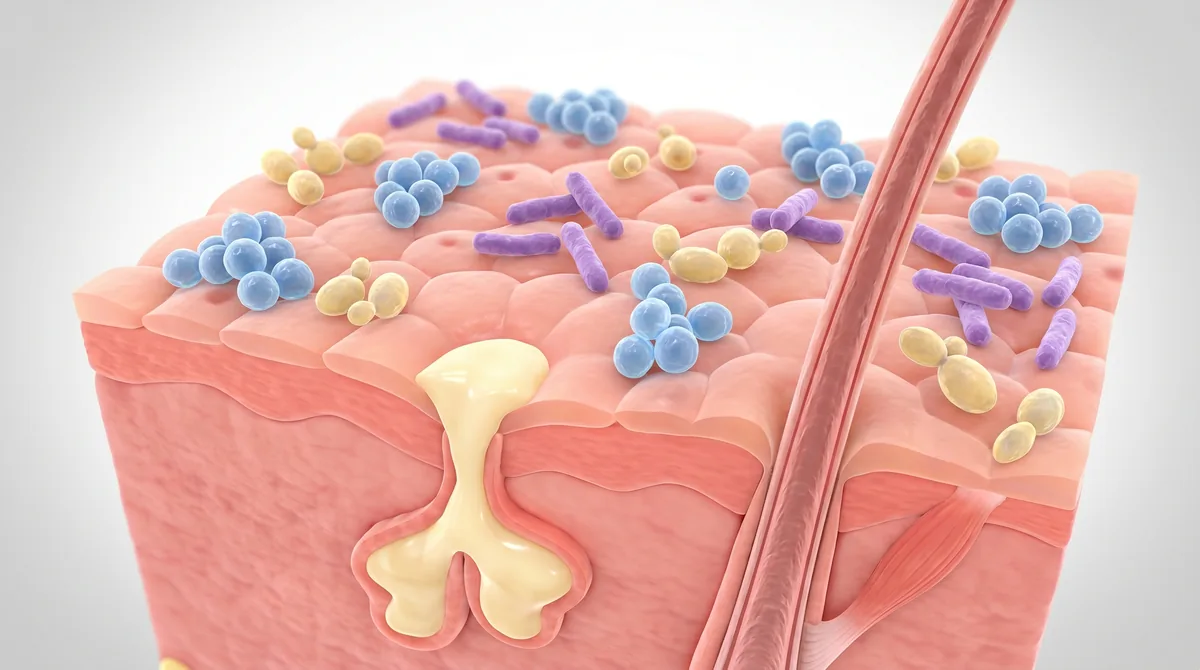
Your scalp microbiome consists of three primary groups: bacteria, fungi, and archaea. But three species dominate the landscape and control most of what happens on your skin.
Staphylococcus epidermidis is your scalp’s primary defender. This bacterium produces antimicrobial peptides that prevent pathogenic organisms from colonizing your skin. It also helps regulate your immune response, preventing the overreaction that leads to inflammation and itching. When S. epidermidis populations drop, your scalp becomes vulnerable to infection and irritation.
Cutibacterium acnes (formerly Propionibacterium acnes) lives deep in your hair follicles and sebaceous glands. Despite its association with facial acne, on the scalp it performs critical functions: breaking down sebum into fatty acids that maintain your skin’s acidic pH (around 5.5), and producing substances that inhibit the growth of harmful bacteria. It’s anaerobic, meaning it thrives in the oxygen-poor environment of your follicles.
Malassezia is a yeast, not a bacterium, but it’s the most abundant fungal organism on your scalp. It feeds exclusively on the lipids in sebum, breaking down triglycerides into fatty acids. In normal populations, Malassezia is harmless. But when it overgrows, often due to excess oil production or pH changes, it triggers the inflammatory response that causes seborrheic dermatitis and dandruff.
These three organisms exist in constant competition for resources: the oils your sebaceous glands produce, the nutrients in your skin cells, and the physical space on your scalp surface. When they’re balanced, they keep each other in check. When that balance breaks, one species dominates and problems begin.
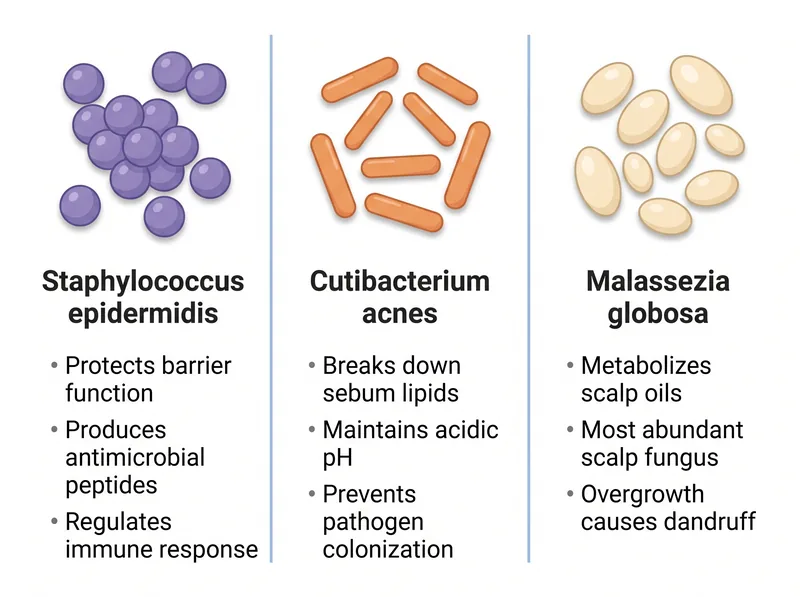 The three dominant microbial groups on your scalp work together to regulate oil production, pH balance, and immune response.
How Hard Water Changes the Microbial System
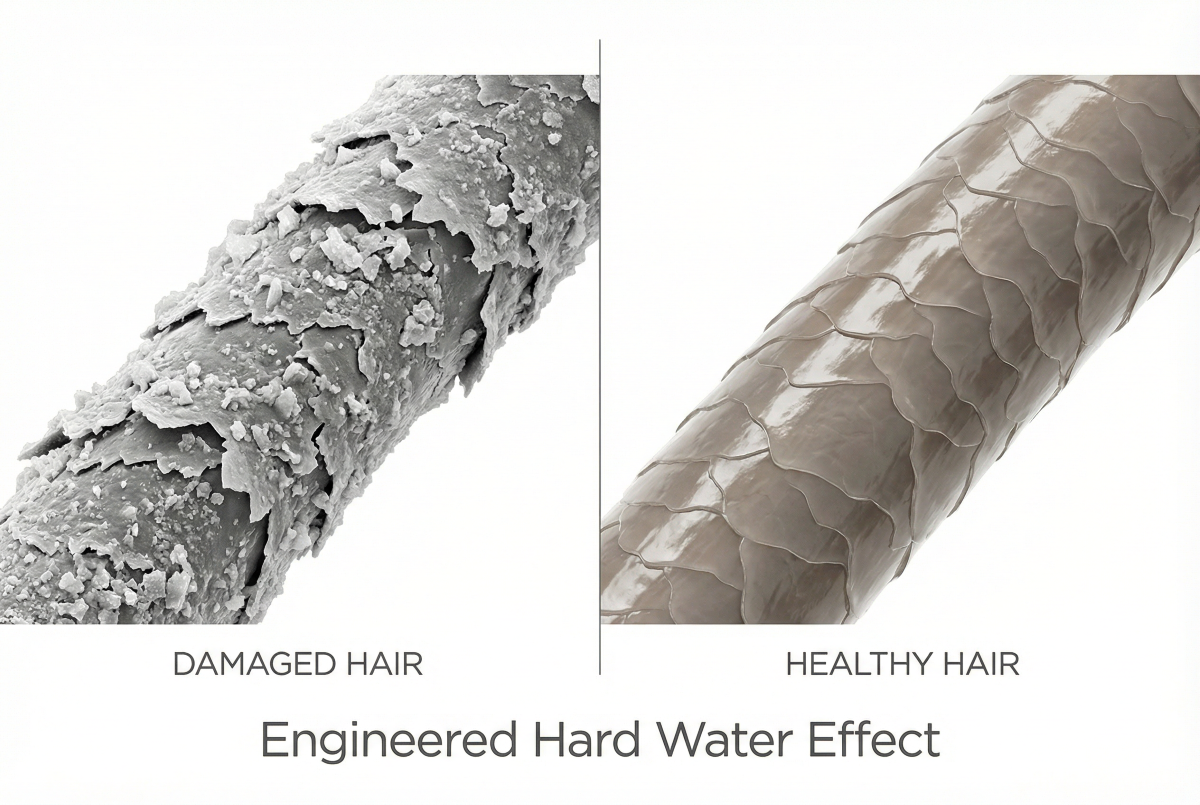
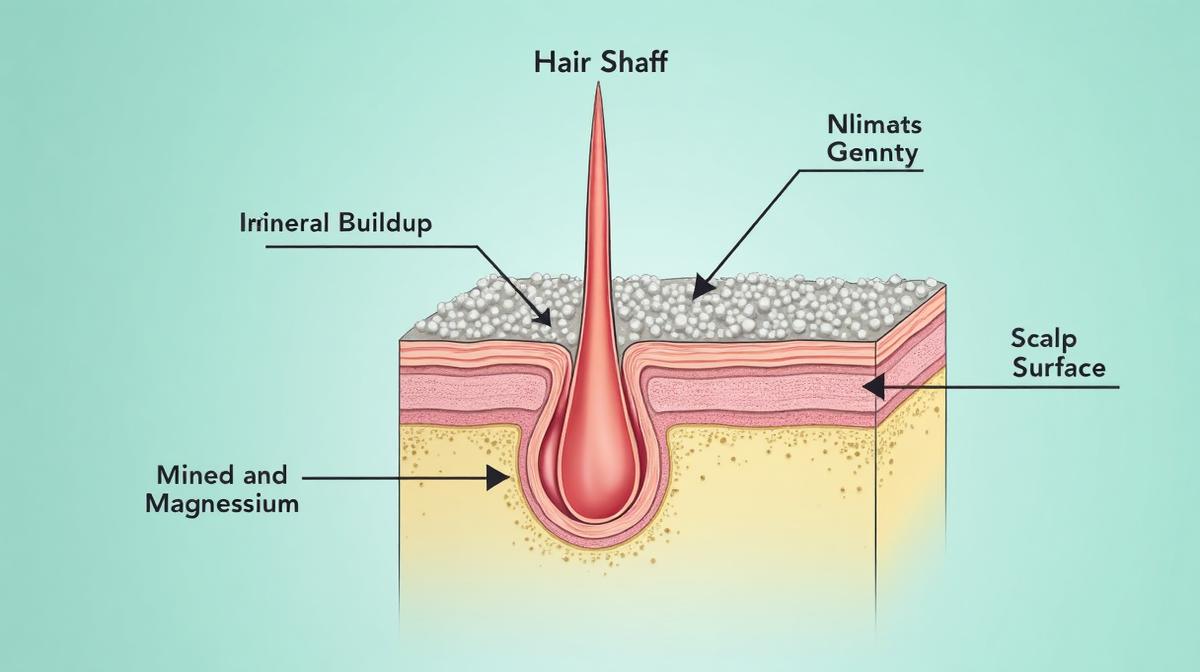
The Gulf region’s water contains some of the highest mineral concentrations in the world, often exceeding 400 parts per million of dissolved calcium and magnesium. When you shower, these minerals don’t just rinse away. They bond to your scalp surface, forming a crystalline layer that changes everything about your skin’s chemistry.
First, mineral deposits raise your scalp’s pH. Normal scalp pH sits around 5.5, which is slightly acidic. This acidity isn’t accidental, it’s maintained by the fatty acids that Cutibacterium and Malassezia produce when they metabolize sebum. But calcium carbonate deposits are alkaline, with a pH around 8.0. When they accumulate on your scalp, they neutralize the acid mantle, pushing your skin’s pH toward 6.5 or higher.
That pH shift has immediate consequences. Research shows that Staphylococcus epidermidis populations decline sharply when skin pH rises above 6.0, while pathogenic species like Staphylococcus aureus thrive in more alkaline conditions. You’ve just flipped the competitive advantage from beneficial bacteria to harmful ones.
Second, mineral buildup physically blocks your sebaceous glands. Sebum can’t flow normally to the surface, so it accumulates in the follicle. This creates an oxygen-depleted, lipid-rich environment where Cutibacterium acnes can overgrow. Meanwhile, surface-dwelling bacteria that need oxygen and a thin sebum layer start dying off.
Third, the minerals themselves serve as a nutrient source for certain bacterial species. Calcium and magnesium support the growth of biofilm-forming bacteria that create protective matrices on your scalp surface. These biofilms are nearly impossible to remove with regular shampooing and provide shelter for pathogenic organisms.
The result? Your microbiome shifts from a diverse, balanced system to one dominated by a few opportunistic species. And once that shift happens, it’s self-reinforcing. The new dominant species change your scalp’s chemistry in ways that make it even harder for beneficial bacteria to recover.
The Sebum-Bacteria Feedback Loop
Your sebaceous glands don’t produce oil randomly. They respond to signals from your microbiome in a continuous feedback loop that regulates how much sebum reaches your scalp surface.
Here’s how it works normally: Cutibacterium and Malassezia break down sebum triglycerides into free fatty acids. These fatty acids signal your sebaceous glands to slow production, you’ve got enough oil. The fatty acids also maintain that acidic pH that keeps beneficial bacteria dominant. It’s a self-regulating system.
But when hard water minerals change this loop, the signals break down. Mineral deposits block sebum flow, so less oil reaches the surface. Your skin interprets this as a shortage and ramps up production. Now you’re making more oil, but it’s trapped beneath a mineral layer where it can’t be properly metabolized.
The trapped sebum creates ideal conditions for Malassezia overgrowth. This yeast reproduces rapidly in lipid-rich environments, and its population can increase tenfold within days. As Malassezia populations explode, they produce more oleic acid, a breakdown product that penetrates your skin and triggers inflammation in susceptible individuals.
Your immune system responds to this inflammation by increasing sebum production even further. It’s trying to flush out the irritant. But more sebum just feeds more Malassezia growth. You’re stuck in a cycle: excess oil, yeast overgrowth, inflammation, more oil.
This is why people in the Gulf often describe their scalp as ‘suddenly oily’ or notice that their hair gets greasy faster than it used to. It’s not that your sebaceous glands are malfunctioning. They’re responding rationally to a changeed microbiome that’s sending the wrong signals.
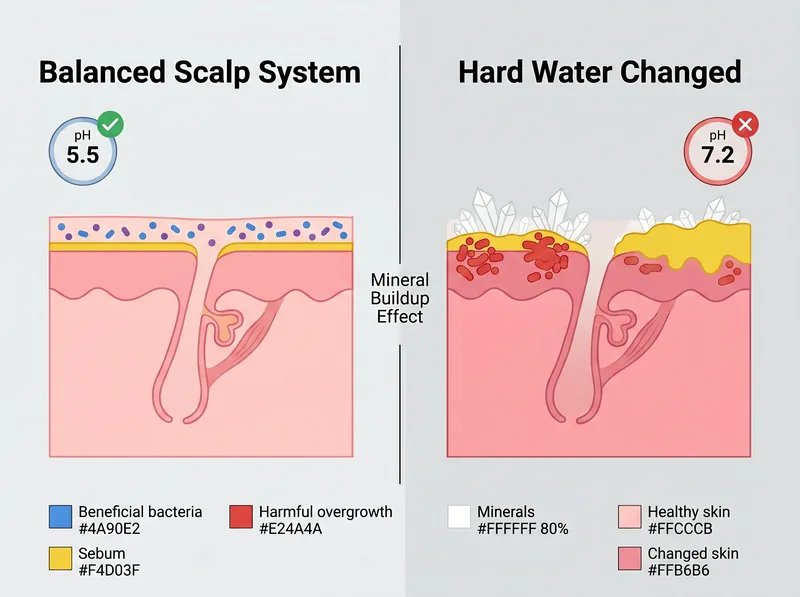 Hard water mineral deposits change scalp pH and create conditions that favor harmful bacterial overgrowth while suppressing beneficial species.
Why Your Scalp Gets Inflamed (The Immune Connection)
Your scalp’s immune system doesn’t react to bacteria themselves, it reacts to the chemical signals they produce. And when your microbiome is changeed, those signals change dramatically.
Beneficial bacteria like Staphylococcus epidermidis produce short-chain fatty acids and antimicrobial peptides that actively suppress inflammation. They communicate with your skin’s immune cells, essentially telling them ‘everything’s fine, no need to react.’ This is called immune tolerance, and it’s why a healthy microbiome doesn’t trigger constant irritation despite hosting billions of organisms.
But when pathogenic species take over, they produce different metabolites: lipopolysaccharides, proteases, and pro-inflammatory cytokines. Your immune system recognizes these as danger signals and responds with inflammation, redness, heat, itching, and increased blood flow to the area.
Malassezia overgrowth is particularly problematic because this yeast produces oleic acid that penetrates the stratum corneum (your skin’s outer layer) and activates inflammatory pathways. Studies show that about 50% of people are genetically sensitive to this oleic acid trigger, which is why dandruff and seborrheic dermatitis affect roughly half the population at some point.
The inflammation itself becomes part of the problem. It increases skin cell turnover, which means more dead cells accumulating on your scalp surface, the visible flaking you see as dandruff. It also changes your skin barrier function, making it easier for irritants and allergens to penetrate and cause further immune reactions.
This chronic low-grade inflammation doesn’t just cause itching and flaking. It affects your hair follicles directly. Inflammatory cytokines can push follicles into premature resting phase, shortening the growth cycle and leading to increased shedding. Over time, this contributes to the diffuse thinning that many people in the Gulf experience.
Restoring Baseline Microbiome Conditions
You can’t ‘fix’ your microbiome by adding beneficial bacteria. Probiotic scalp products sound appealing, but they don’t work, the bacteria don’t colonize your skin permanently, and they’re washed away with your next shower. The real solution is creating conditions where your native beneficial bacteria can outcompete harmful species naturally.
That means removing the mineral buildup that changeed the system in the first place. A chelating treatment like Regrowth+ uses EDTA to bind calcium and magnesium ions, breaking down the crystalline deposits on your scalp surface. This removes the alkaline layer that’s been raising your pH and blocking your sebaceous glands.
Once the minerals are gone, your scalp’s natural acid mantle can re-establish itself. The fatty acids that Cutibacterium produces will accumulate on the surface again, lowering pH back toward 5.5. This creates conditions where Staphylococcus epidermidis thrives and pathogenic species struggle to compete.
But here’s what’s critical: this isn’t an overnight process. Your microbiome took weeks or months to shift into its changeed state, and it takes time to shift back. Most people notice reduced oiliness and itching within 1-2 weeks of regular chelating treatment, but full microbiome rebalancing typically requires 4-6 weeks of consistent use.
During this transition period, avoid products that further change the system. Harsh sulfates strip away too much sebum, triggering rebound oil production. Silicones and heavy conditioning agents coat the scalp and prevent proper sebum flow. Antibacterial shampoos kill beneficial bacteria along with harmful ones, leaving your scalp vulnerable to recolonization by opportunistic species.
The goal isn’t sterility. It’s balance. You want a diverse microbial community where no single species dominates, where beneficial bacteria produce the metabolites that maintain healthy pH and immune tolerance, and where your sebaceous glands can regulate oil production based on accurate feedback signals.
What This Means for Your Daily Routine
Understanding your scalp microbiome changes how you should think about hair care. You’re not just washing hair, you’re maintaining an system that directly controls your scalp health and hair growth.
First, recognize that ‘clean’ doesn’t mean bacteria-free. That squeaky-clean feeling from harsh shampoos often indicates you’ve stripped away too much of your protective acid mantle and beneficial bacteria. Your scalp should feel neutral after washing, not tight or dry.
Second, understand that oil production is a response, not a cause. If your scalp is producing excess sebum, something’s triggering that response, usually either mineral buildup blocking normal flow or inflammation from microbiome changeion. Washing more frequently just perpetuates the cycle. Address the underlying cause instead.
Third, give your microbiome time to stabilize after any change. If you start a chelating treatment, use a new shampoo, or move to a new location with different water quality, your bacterial populations will shift. You might experience a temporary adjustment period with increased oiliness or dryness before things balance out.
Pay attention to your scalp’s signals. Itching usually indicates inflammation from microbiome changeion or immune reaction. Flaking suggests increased cell turnover from either fungal overgrowth or barrier damage. Excess oil means your sebaceous glands are responding to blocked flow or inflammatory signals. These aren’t separate problems, they’re all connected through your microbiome.
And remember that your scalp’s needs change with seasons, stress levels, diet, and environmental factors. The microbiome that’s balanced in winter might shift in summer when you’re producing more sebum. The routine that worked in your home country might not work in the Gulf’s hard water environment. Flexibility matters more than rigid adherence to a single routine.
References
- The role of Malassezia in atopic dermatitis affecting the head and neck of adults - PubMed
- Skin pH and its impact on the skin microbiome - PubMed Central
- Oleic acid induces skin inflammation through Langerhans cells - PubMed
- The skin microbiome: current perspectives and future challenges - American Academy of Dermatology