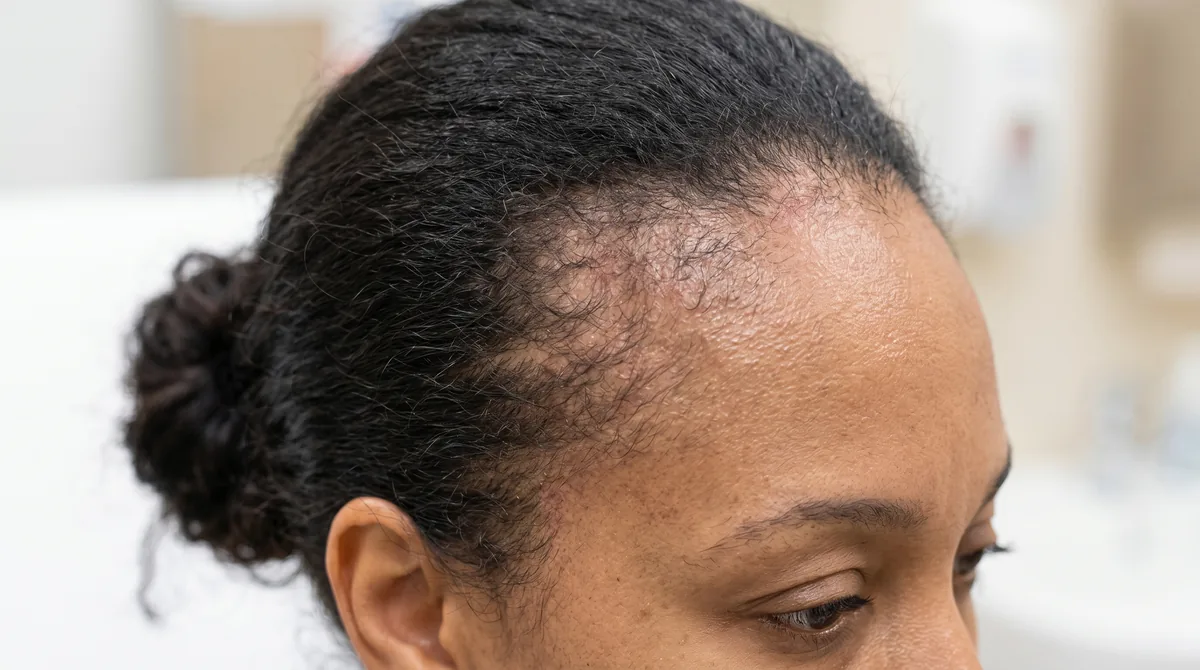
You’ve noticed it for months. Maybe longer. Your hairline isn’t where it used to be. The edges are thinner, the temples receding. You thought it was stress, or genetics, or just getting older. But here’s the thing: if you’ve been wearing tight braids, sleek ponytails, or heavy extensions for years, the problem isn’t inside your body. It’s on top of your head.
Traction alopecia is hair loss caused by repeated pulling force on the hair follicle. It’s one of the most common forms of hair loss in women who regularly wear tight hairstyles, and it’s almost entirely preventable. But once the damage progresses past a certain point, it becomes permanent. The follicle scars over. The hair never grows back.
The good news? Early-stage traction alopecia is reversible. If you catch it before the follicle dies, you can restore your hairline. But you need to act now, and you need to understand what’s actually happening under your scalp. This isn’t about vanity. It’s about preserving the long-term health of your hair follicles before the damage becomes irreversible.
What Traction Alopecia Actually Does to Your Follicles
Your hair follicle is anchored in the scalp by a complex network of connective tissue, blood vessels, and nerves. When you pull your hair tight, you’re not just stretching the hair shaft. You’re applying constant mechanical stress to the follicle root, the dermal papilla, and the surrounding tissue.
Here’s what happens in three stages. Stage one: the follicle enters a stress response. Blood flow decreases. The growth phase shortens. You start shedding more than usual, but the follicle is still alive and capable of recovery. Stage two: chronic tension causes the follicle to miniaturize. The hair shaft gets thinner. The follicle shrinks. Inflammation becomes chronic. Stage three: the follicle scars over completely. Fibrotic tissue replaces the living follicle. The hair stops growing permanently.
The hairline and temples are most vulnerable because the skin is thinner there and the follicles are more superficial. A 2007 study in the Journal of the American Academy of Dermatology found that traction alopecia affects up to 31.7% of women who regularly wear tight hairstyles, with the frontal hairline being the most commonly affected area.
The damage is cumulative. One tight ponytail won’t destroy your hairline. But years of daily tension, especially if you’re also dealing with hard water mineral buildup or chemical treatments, creates a compounding stress load that the follicle can’t recover from.
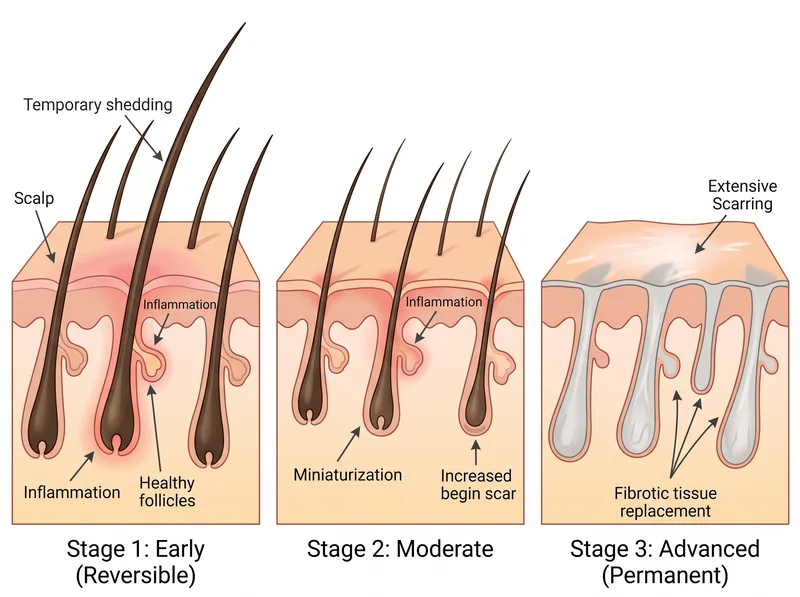 The three stages of traction alopecia: early reversible damage, moderate follicle miniaturization, and late-stage scarring with permanent loss.
Early Warning Signs You’re Damaging Your Hairline
Most people don’t notice traction alopecia until it’s already moderate-stage. But there are early signs if you know what to look for. Here’s what to watch for:
Tenderness or soreness along the hairline after removing a hairstyle. That’s acute inflammation. Your scalp shouldn’t hurt when you take your hair down. Small bumps or pustules along the hairline, especially where braids or twists start. That’s folliculitis, an inflammatory response to chronic tension. Itching or burning sensation at the roots, particularly at the temples and frontal hairline. Baby hairs that break off easily or don’t grow past a certain length. That’s a sign the follicle is already miniaturizing.
The single most reliable early sign is the ‘fringe sign’: a band of thin, broken hairs along the frontal hairline, creating a fringe-like appearance. Research published in the Journal of Clinical and Aesthetic Dermatology identifies this as a pathognomonic sign of early traction alopecia, meaning it’s specific enough to diagnose the condition on sight.
If you see any of these signs, you’re in stage one. The damage is reversible, but only if you stop the mechanical stress immediately and give the follicle time to recover.
Which Hairstyles Cause the Most Damage
Not all hairstyles apply the same amount of tension. The highest-risk styles share three characteristics: they pull the hair taut from the root, they’re worn continuously for days or weeks, and they concentrate tension on specific areas of the scalp.
Tight cornrows and box braids, especially when done with synthetic extensions that add weight. The tension is constant, and the weight of the extensions amplifies the pulling force. Sleek, high ponytails secured with elastic bands, particularly when worn daily. The tension is concentrated at the hairline and crown. Weaves and sew-ins that are braided too tightly at the base, especially if the wefts are heavy. Buns and topknots that pull the hair back tightly, especially when secured with bobby pins that create additional pressure points.
The risk multiplies when you combine tight styling with chemical treatments. Relaxers, texturizers, and keratin treatments weaken the hair shaft’s tensile strength. When you apply mechanical tension to chemically weakened hair, the damage accelerates. The hair breaks at the root instead of just thinning.
Even protective styles can cause traction alopecia if they’re installed too tightly. The term ‘protective’ refers to shielding the hair from environmental damage and manipulation, not from tension. A protective style that’s too tight is worse than leaving your hair loose.
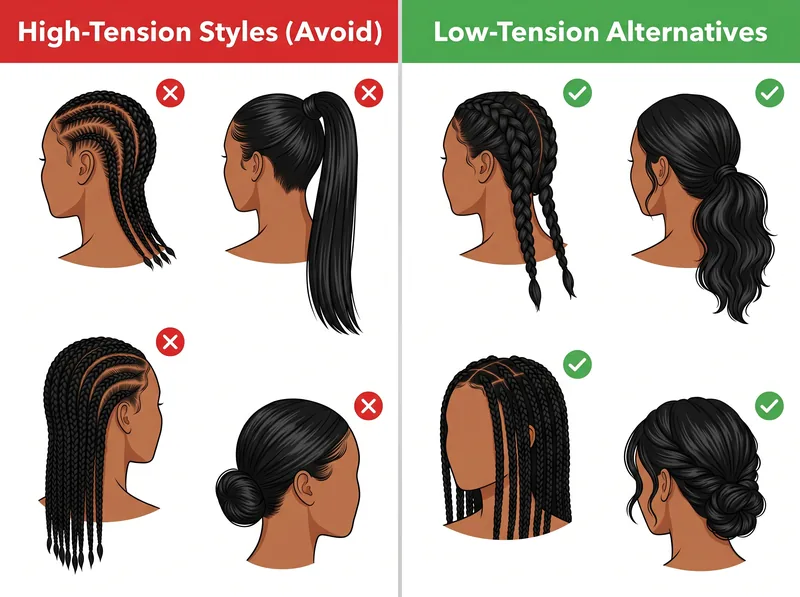 High-risk styles that cause traction versus protective alternatives that maintain hair health while still looking polished.
Reversal Protocol: What Actually Works
If you’re in stage one or early stage two, you can reverse the damage. But it requires a complete reset of your styling habits and a targeted follicle recovery protocol. Here’s what the evidence supports:
First, eliminate all tension for at least six months. That means no tight ponytails, no braids, no weaves, no slicked-back styles. Wear your hair loose, in loose twists, or in low-tension styles that don’t pull at the hairline. This isn’t optional. The follicle needs a mechanical rest period to exit the stress response and resume normal growth cycling.
Second, address scalp inflammation. A 2019 study in the International Journal of Trichology found that topical minoxidil 2% combined with anti-inflammatory treatments showed significant regrowth in early-stage traction alopecia patients. Minoxidil extends the growth phase and increases blood flow to the follicle. The anti-inflammatory component reduces fibrotic tissue formation.
Third, improve your scalp environment. If you’re in the Gulf region, you’re likely dealing with hard water mineral deposits that create an additional inflammatory burden on already-stressed follicles. A gentle chelating cleanser like Regrowth+ removes mineral buildup without adding chemical irritation to mechanical irritation. The goal is to reduce total scalp stress load, not just address one factor.
Fourth, consider supplementation if you have underlying deficiencies. Low ferritin and iron impair follicle recovery even when mechanical stress is removed. Get your bloodwork checked: ferritin should be above 50 ng/mL for optimal hair growth, not just above the clinical deficiency threshold.
Low-Tension Styling Alternatives That Still Look Polished
You don’t have to sacrifice style to protect your hairline. The key is distributing tension across the entire head instead of concentrating it at vulnerable points, and avoiding styles that require constant pulling to maintain.
Loose Dutch braids or French braids that start mid-scalp instead of at the hairline. The braid itself provides structure without requiring tight roots. Halo braids or crown braids that don’t pull the edges. These styles keep hair off the face without stressing the frontal hairline. Medium-tension box braids or twists installed with a ‘feed-in’ technique that gradually adds hair instead of starting with a tight knot at the root. Low ponytails secured with scrunchies or spiral hair ties instead of elastic bands. The wider surface area distributes pressure more evenly.
For professional settings where a sleek look is required, try a low bun with face-framing pieces left out. Use a light styling cream instead of gel to smooth flyaways. The goal is texture and hold without tension. Pin the bun loosely with U-shaped pins instead of bobby pins, which create pressure points.
If you wear extensions, choose lightweight options and insist that your stylist install them loosely. You should never feel pain or tightness during or after installation. If it hurts, it’s too tight, and the damage has already started.
When the Damage Becomes Permanent
There’s a point of no return with traction alopecia. Once the follicle scars over completely, no topical treatment, supplement, or medication will bring it back. The only option at that stage is surgical hair transplantation, and even that has limitations because the surrounding tissue is already damaged.
How do you know if you’ve crossed that line? Late-stage traction alopecia presents with a shiny, smooth scalp where hair used to grow. No baby hairs, no vellus hairs, just bare skin. The texture is different, slightly taut and glossy, because fibrotic scar tissue has replaced the normal scalp architecture. A dermatoscope examination will show complete absence of follicular openings.
If you’re at this stage, a dermatologist can confirm with a scalp biopsy. The biopsy will show fibrotic streamers replacing the follicles, collapsed follicular sheaths, and chronic inflammation in the dermis. At that point, the conversation shifts from reversal to management: preventing further loss in adjacent areas and considering cosmetic options for the areas that won’t recover.
This is why early intervention matters. The window for reversal is real but limited. Most people wait too long because the loss is gradual and easy to rationalize. But once you’re in stage three, the biology is irreversible.
References
- Traction alopecia: the root of the problem - Journal of the American Academy of Dermatology
- Central centrifugal cicatricial alopecia and traction alopecia in African American women - Journal of Clinical and Aesthetic Dermatology
- Traction alopecia: A neglected entity in 2019 - International Journal of Trichology
- Hair cosmetics: An overview - International Journal of Trichology