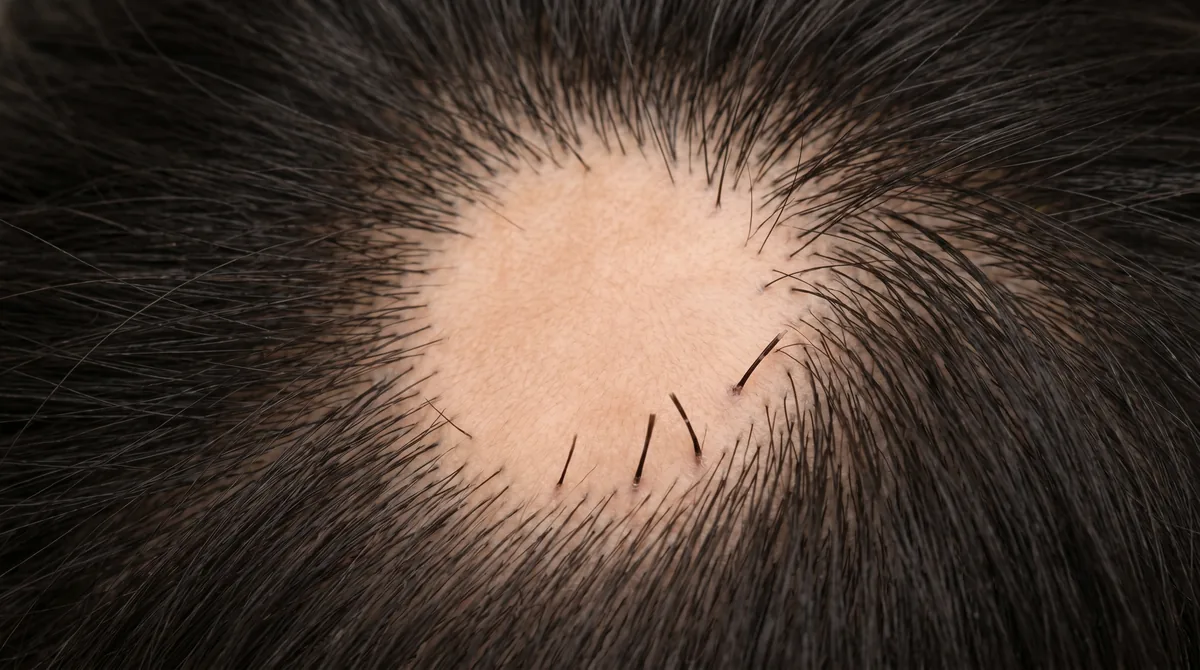
You wake up one morning, run your hand through your hair, and feel something wrong. A smooth patch where hair used to be. No breakage. No thinning. Just… gone. The skin underneath is perfectly smooth, almost shiny. And around the edges, you notice something strange: short hairs that look like they’ve been snapped off at the base.
This isn’t hard water damage. It’s not stress-related shedding. It’s alopecia areata, an autoimmune condition where your immune system mistakes your hair follicles for foreign invaders and attacks them. And it’s far more common than most people realize, affecting roughly 2% of the global population at some point in their lives.
Here’s what makes this condition so unsettling: it can appear suddenly, without warning. One day your hair is fine. The next, you’ve got a coin-sized bald patch. For many people in the Gulf region, the first instinct is to blame environmental factors, the water, the heat, the dust. But alopecia areata has nothing to do with your environment. It’s your own immune system turning against you.
This article contains affiliate links. See our affiliate disclosure for details.
What Alopecia Areata Actually Is (And Why It Happens)
Alopecia areata is an autoimmune disorder. That means your immune system, which normally protects you from viruses, bacteria, and other threats, mistakenly identifies your hair follicles as dangerous and launches an attack against them.
The follicles aren’t destroyed. They’re just forced into a resting state by the immune assault. That’s why the patches are smooth and why the skin looks completely normal underneath. The follicle is still there, dormant, waiting for the immune attack to stop.
We don’t fully understand why this happens. Research published in Nature Reviews Disease Primers shows that alopecia areata involves a breakdown in what’s called ‘immune privilege’, a protective mechanism that normally shields hair follicles from immune surveillance. When that privilege is lost, T-cells (a type of immune cell) swarm the follicle and shut down hair production.
There’s a genetic component. If you have a family member with alopecia areata, your risk is higher. But genes aren’t destiny. Many people with the genetic susceptibility never develop the condition. Environmental triggers, viral infections, severe stress, hormonal shifts, can flip the switch in genetically predisposed individuals.
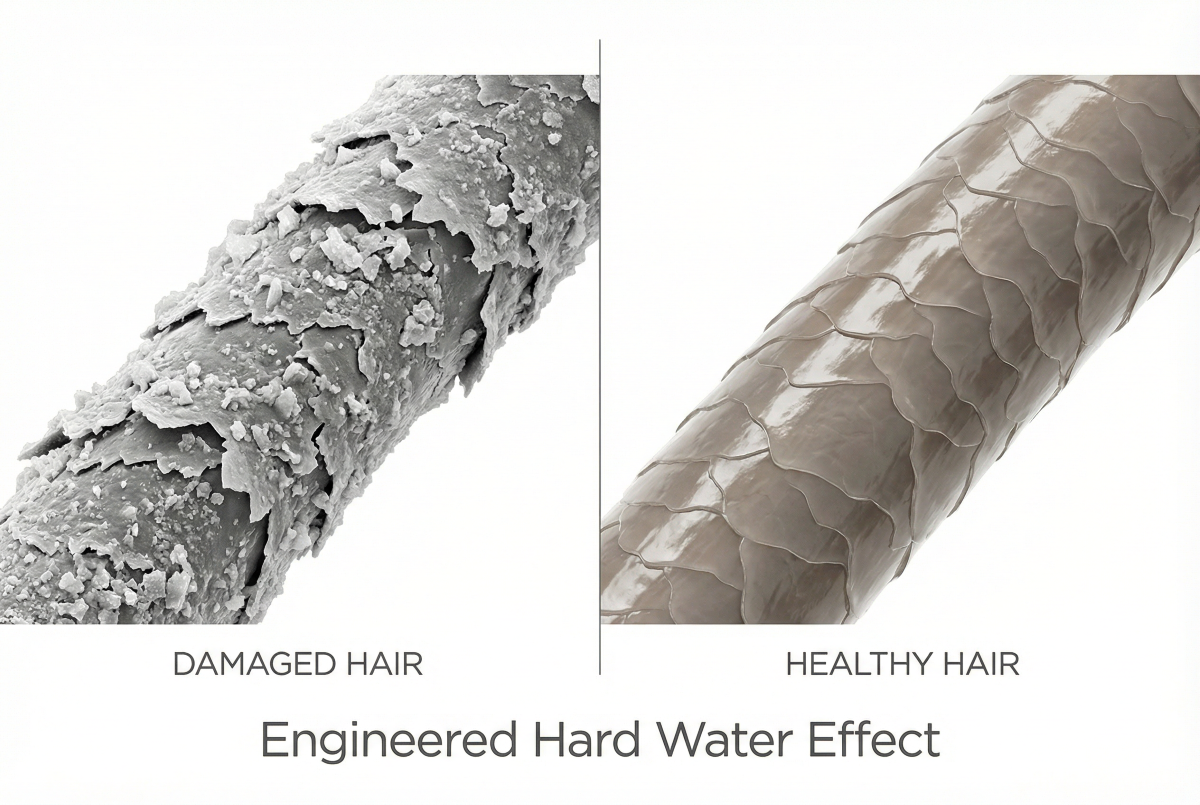
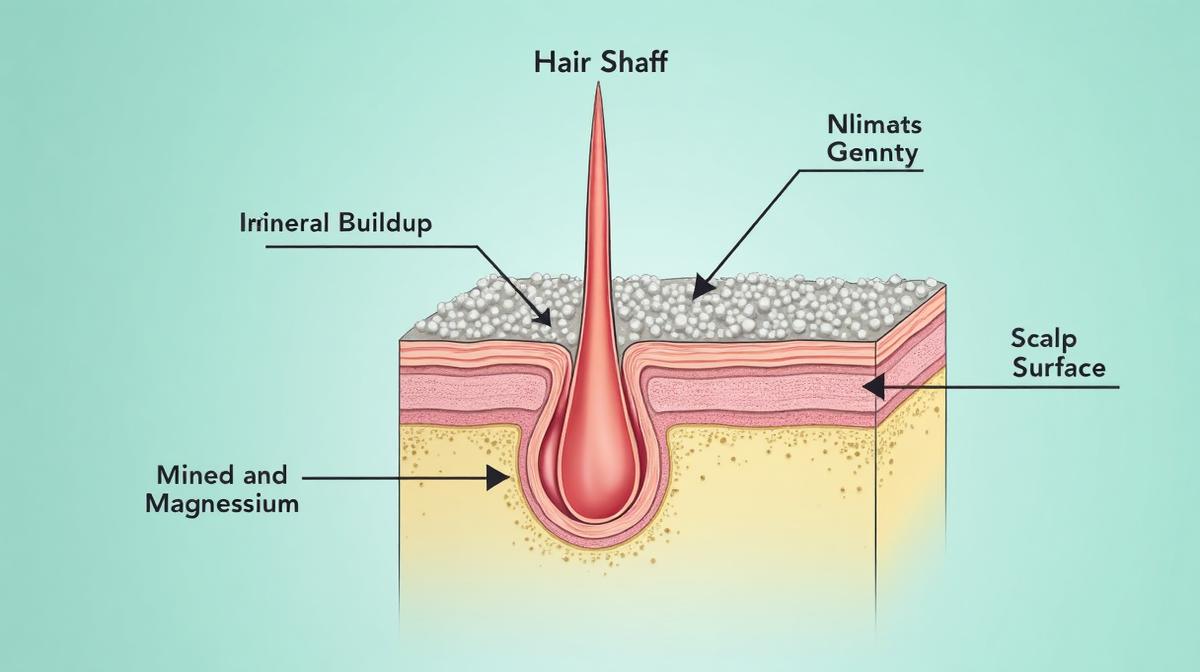
And here’s the thing: alopecia areata doesn’t care about your hair care routine. It doesn’t matter if you use the gentlest shampoo or avoid heat styling. This isn’t damage you caused. It’s not something you could’ve prevented by using a chelating shampoo like Regrowth+ to remove mineral buildup. The cause is internal, not external.
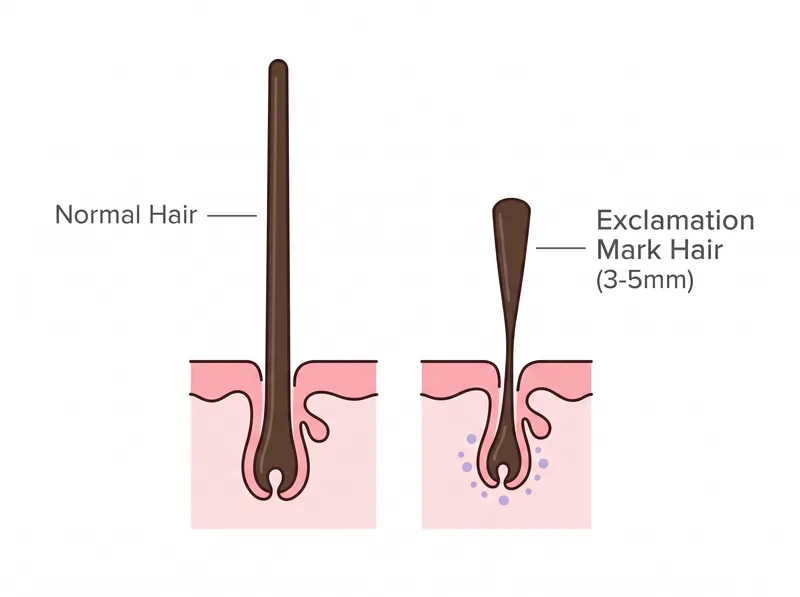 Exclamation mark hairs are diagnostic for alopecia areata, they’re thicker at the tip and taper toward the scalp, indicating follicle attack.
The Telltale Signs That Distinguish It From Other Hair Loss
Alopecia areata has a specific presentation that makes it relatively easy to distinguish from other types of hair loss, if you know what to look for.
The patches are smooth and round. They’re usually coin-sized, though they can be larger. The skin within the patch is completely normal, no redness, no scaling, no scarring. That rules out fungal infections and scarring alopecias.
Then there are the exclamation mark hairs. These are short, broken hairs found at the edges of the patches. They’re wider at the tip and taper down to a thin, fragile base, like an exclamation point. When you gently tug on them, they come out easily. This is the diagnostic hallmark of active alopecia areata.
The pattern matters too. Unlike male pattern baldness, which follows a predictable recession at the temples and crown, alopecia areata appears in random patches. It can affect the scalp, eyebrows, beard, or any hair-bearing area. Some people develop just one patch. Others develop multiple patches that merge over time.
In severe cases, the condition progresses to alopecia totalis (complete scalp hair loss) or alopecia universalis (loss of all body hair). But most cases remain patchy and limited.
One more clue: the speed. Alopecia areata develops quickly, sometimes within days. If you’re noticing gradual thinning over months, that’s more consistent with androgenetic alopecia or telogen effluvium. Alopecia areata announces itself suddenly.
How Dermatologists Diagnose It (And Why You Need One)
You can’t diagnose alopecia areata on your own. You need a dermatologist.
The diagnosis is usually clinical, meaning the dermatologist examines your scalp and identifies the characteristic features. The smooth patches. The exclamation mark hairs. The lack of scarring or inflammation. In most cases, that’s enough.
Sometimes a scalp biopsy is performed to rule out other conditions. The biopsy will show a specific pattern of immune cell infiltration around the hair follicle, lymphocytes clustering in what’s called a ‘swarm of bees’ pattern. That confirms the autoimmune diagnosis.
Trichoscopy, a magnified examination of the scalp, can reveal additional features like yellow dots (dilated follicular openings) and black dots (broken hairs within the follicle). These findings support the diagnosis.
Blood tests aren’t used to diagnose alopecia areata, but they’re often ordered to check for other autoimmune conditions. Alopecia areata is associated with a higher risk of thyroid disease, vitiligo, and lupus. Your dermatologist may screen for these to ensure nothing else is going on.
Why does professional diagnosis matter? Because patchy hair loss can have other causes, fungal infections, trichotillomania (hair-pulling disorder), secondary syphilis, even scarring alopecias that require urgent treatment. Getting it wrong means delaying the right treatment.
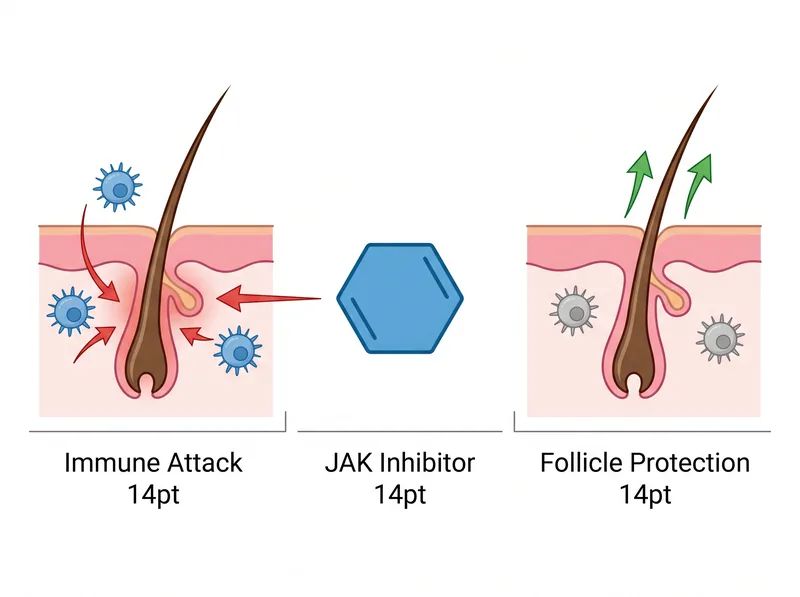 JAK inhibitors work by blocking the inflammatory signals that tell immune cells to attack hair follicles.
Treatment Options: What Works, What Doesn’t, and What’s New
There’s no cure for alopecia areata. But there are treatments that can suppress the immune attack and allow hair to regrow. The challenge is that what works for one person may not work for another, and regrowth doesn’t guarantee the condition won’t return.
For mild cases, one or two small patches, dermatologists often start with corticosteroid injections directly into the affected areas. The American Academy of Dermatology notes that this is the most common first-line treatment. The injections suppress local immune activity and can stimulate regrowth within 4-8 weeks. They’re repeated every 4-6 weeks until the patch fills in.
Topical corticosteroids (steroid creams) are less effective but sometimes used for children or people who can’t tolerate injections. They’re not strong enough to penetrate deeply, so results are modest.
For more extensive cases, dermatologists may prescribe topical immunotherapy, applying a chemical irritant (like diphencyprone) to the scalp to provoke an allergic reaction. The idea is to redirect the immune system away from the follicles. It sounds counterintuitive, but it works in about 40-60% of cases. The downside? It causes redness, itching, and sometimes blistering.
Oral corticosteroids can induce regrowth quickly, but they come with significant side effects, weight gain, mood changes, increased infection risk. They’re reserved for severe, rapidly progressing cases and aren’t meant for long-term use.
Then there are the JAK inhibitors, the new frontier. Drugs like baricitinib and ritlecitinib block the Janus kinase (JAK) pathway, which is central to the immune attack on follicles. A landmark study published in the New England Journal of Medicine showed that baricitinib produced significant regrowth in patients with severe alopecia areata, something that hadn’t been achieved with older treatments.
Baricitinib was approved by the FDA in 2022 specifically for severe alopecia areata. Ritlecitinib followed in 2023. These are oral medications taken daily, and they represent the first systemic treatments designed specifically for this condition. They’re expensive, they require monitoring for side effects (infections, blood count changes), and they don’t work for everyone. But for people with extensive hair loss who’ve failed other treatments, they’re a genuine breakthrough.
What doesn’t work? Minoxidil alone. Biotin supplements. Essential oils. These might help with other types of hair loss, but they don’t address the immune attack driving alopecia areata.
What to Expect: Prognosis and the Reality of Regrowth
The prognosis for alopecia areata is unpredictable. That’s the hardest part.
About 50% of people with a single patch will see complete regrowth within a year, even without treatment. The immune attack can spontaneously resolve. Hair grows back, and the condition never returns.
But for others, it becomes chronic. New patches appear as old ones fill in. Or the patches expand and merge. Or the hair regrows white (because the immune attack can damage melanocytes, the pigment-producing cells).
Factors that suggest a poorer prognosis: early onset (childhood), extensive hair loss at presentation, nail changes (pitting or ridging), and the presence of other autoimmune diseases. If you’ve lost more than 50% of your scalp hair, the likelihood of complete regrowth drops significantly.
Even with successful treatment, there’s no guarantee the hair will stay. Alopecia areata can relapse. A patch that regrew beautifully can disappear again months or years later. That’s the nature of autoimmune conditions, they wax and wane.
The emotional toll is real. Hair loss affects identity, self-esteem, and social interactions. For many people, the unpredictability is harder to cope with than the hair loss itself. Support groups and counseling can be invaluable.
When to See a Dermatologist (And What to Ask)
If you notice a smooth, round patch of hair loss, especially with exclamation mark hairs, see a dermatologist immediately. Early intervention improves the chances of regrowth.
Don’t wait to see if it resolves on its own. While spontaneous regrowth is possible, early treatment can stop the patches from expanding and may prevent new ones from forming.
When you see the dermatologist, come prepared with questions. Ask about the expected timeline for regrowth. Ask about the risks and benefits of different treatments. Ask whether you should be screened for other autoimmune conditions. Ask what happens if the first treatment doesn’t work.
Be honest about your expectations and lifestyle. If you’re not willing to commit to monthly injections, say so. If you’re concerned about the cost of JAK inhibitors, bring it up. There are treatment options at different levels of intensity and expense.
And understand that dermatology is iterative. The first treatment might not work. You might need to try several approaches before finding what works for you. That’s normal. It doesn’t mean you’re a difficult case, it means alopecia areata is a complex condition.
References
- Alopecia areata: Disease characteristics, clinical evaluation, and new perspectives on pathogenesis - Nature Reviews Disease Primers
- Oral baricitinib for severe alopecia areata - New England Journal of Medicine
- Alopecia areata: Diagnosis and treatment - American Academy of Dermatology
- Alopecia areata: Clinical presentation and management - Mayo Clinic