Your hair doesn’t just grey in your 50s. It thins, it coarsens (or sometimes softens), it loses volume at the crown, and it stops behaving the way it did for decades. These aren’t cosmetic quirks. They’re structural changes driven by hormonal shifts, follicle miniaturization, and declining sebum production.
Here’s the thing: most of what you’re experiencing is biological and non-negotiable. But not all of it. Some changes, like increased vulnerability to environmental damage, are modifiable if you understand the mechanism. This article breaks down what’s happening to your hair at the follicle level, what you can control, and why protection becomes more critical, not less, as you age.
This article contains affiliate links. See our affiliate disclosure for details.
The Biology: Why Hair Density and Diameter Both Decline
Hair density, the number of active follicles per square centimeter, peaks in your early 20s and declines steadily after 30. By your 50s, you’ve lost 20-30% of your follicle population. Some follicles stop cycling entirely (they enter permanent telogen). Others miniaturize, producing progressively thinner shafts with each cycle.
But it’s not just about losing follicles. The hairs that remain are thinner. Research published in the British Journal of Dermatology found that hair shaft diameter decreases by approximately 15-20% between ages 20 and 60, with the steepest decline occurring after menopause in women and after age 50 in men.
The mechanism: follicle miniaturization is driven by a combination of genetic programming (androgenetic aging), declining growth factor signaling (IGF-1, VEGF), and reduced blood flow to the dermal papilla. The papilla shrinks, the anagen phase shortens, and each successive hair grows thinner and shorter than the one before.
You can’t reverse miniaturization once it’s established. But you can slow its progression by maintaining scalp circulation, reducing inflammation, and protecting the follicles you still have. That’s where understanding the hair growth cycle becomes critical.
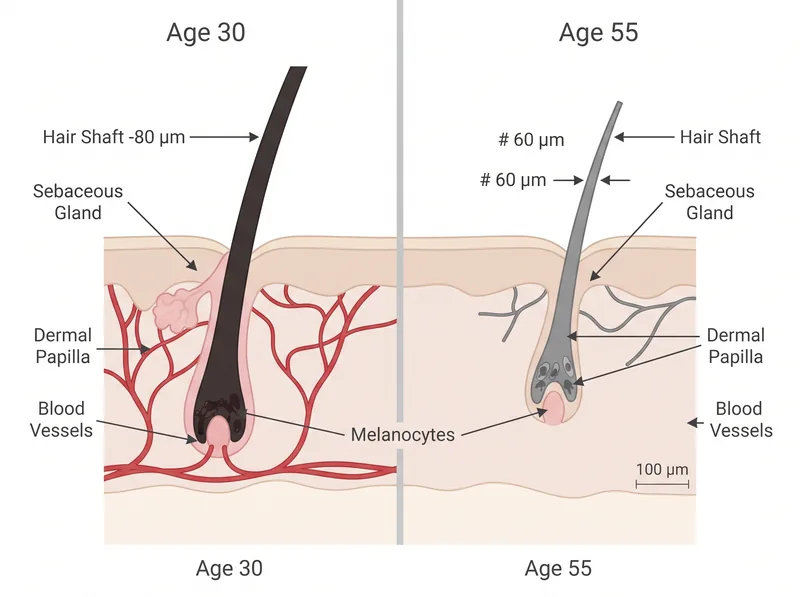 Follicle miniaturization reduces both hair diameter and the duration of the growth phase, leading to thinner, shorter strands over time.
Texture Shifts: The Sebum Production Drop
If your hair feels drier, coarser, or less manageable than it did a decade ago, it’s not your imagination. Sebaceous gland activity declines sharply after menopause in women and more gradually in men, but the endpoint is the same: less natural oil coating each strand.
Sebum isn’t just about shine. It’s a protective barrier that seals the cuticle, repels water (preventing hygral fatigue from repeated swelling and contraction), and shields the cortex from oxidative damage. When sebum production drops by 40-55% between ages 30 and 60, your hair loses its primary defense mechanism.
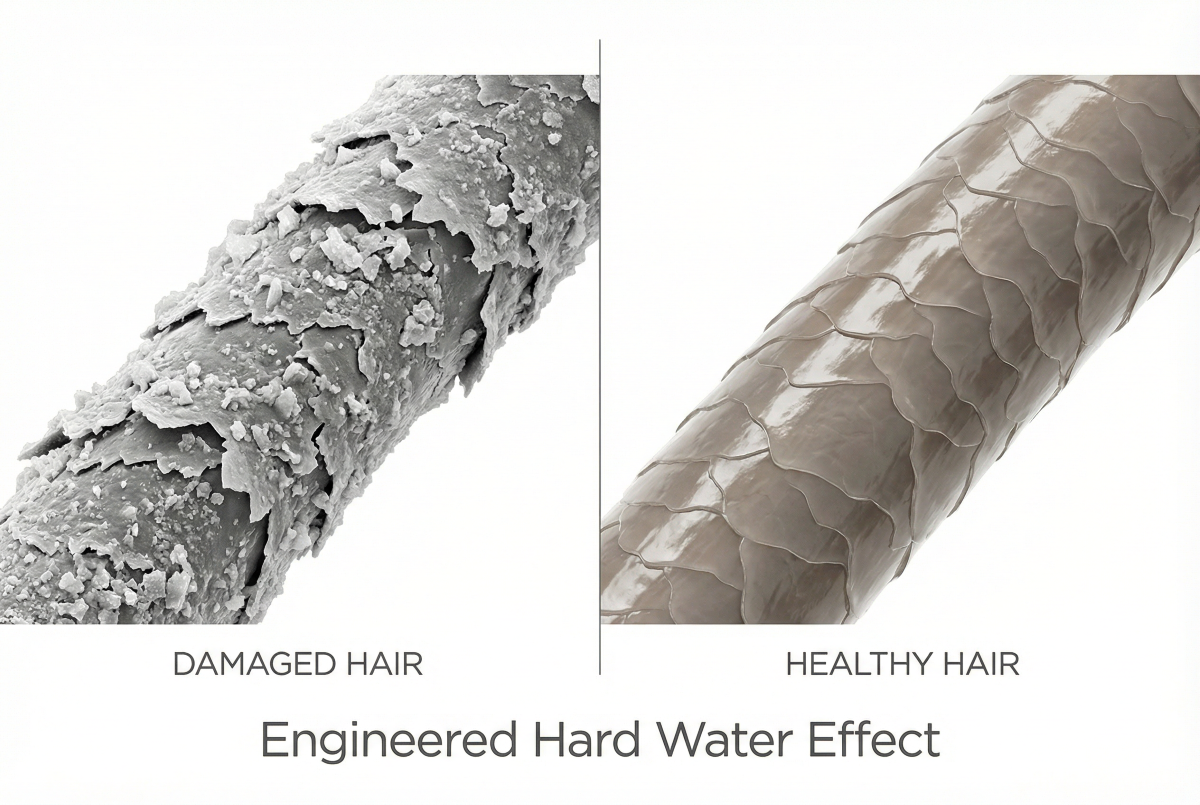
The result: increased porosity. The cuticle lifts more easily, moisture escapes faster, and environmental insults, UV radiation, chlorine, hard water minerals, penetrate deeper. Your hair becomes simultaneously drier (less sebum) and more hygroscopic (absorbs water too readily, then loses it).
This is why the same shampoo you used in your 30s might now leave your hair feeling stripped. Your sebum baseline has shifted. You need gentler surfactants and more intentional moisture replacement. But here’s the catch: you also can’t over-condition, because aging hair has less structural integrity to support heavy product buildup.
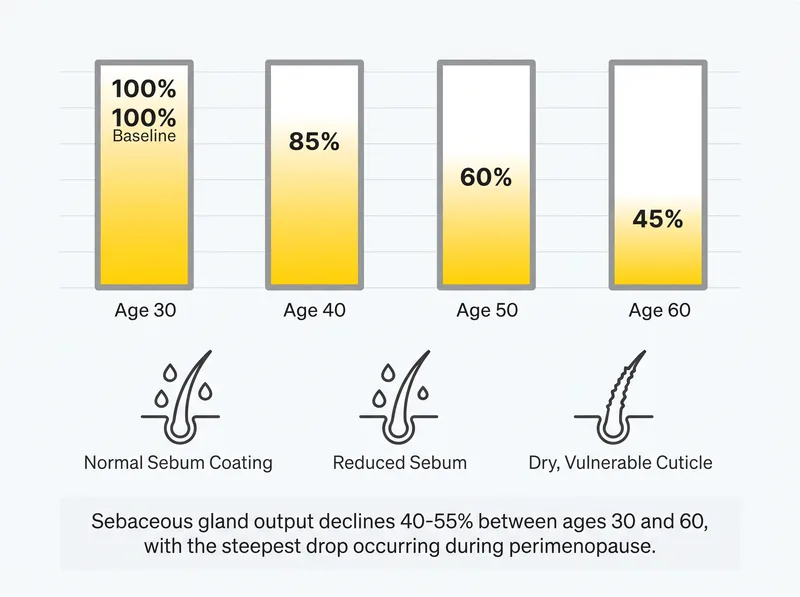 Sebum production drops significantly after menopause, leaving hair more vulnerable to environmental damage and moisture loss.
Greying Acceleration: Melanocyte Exhaustion
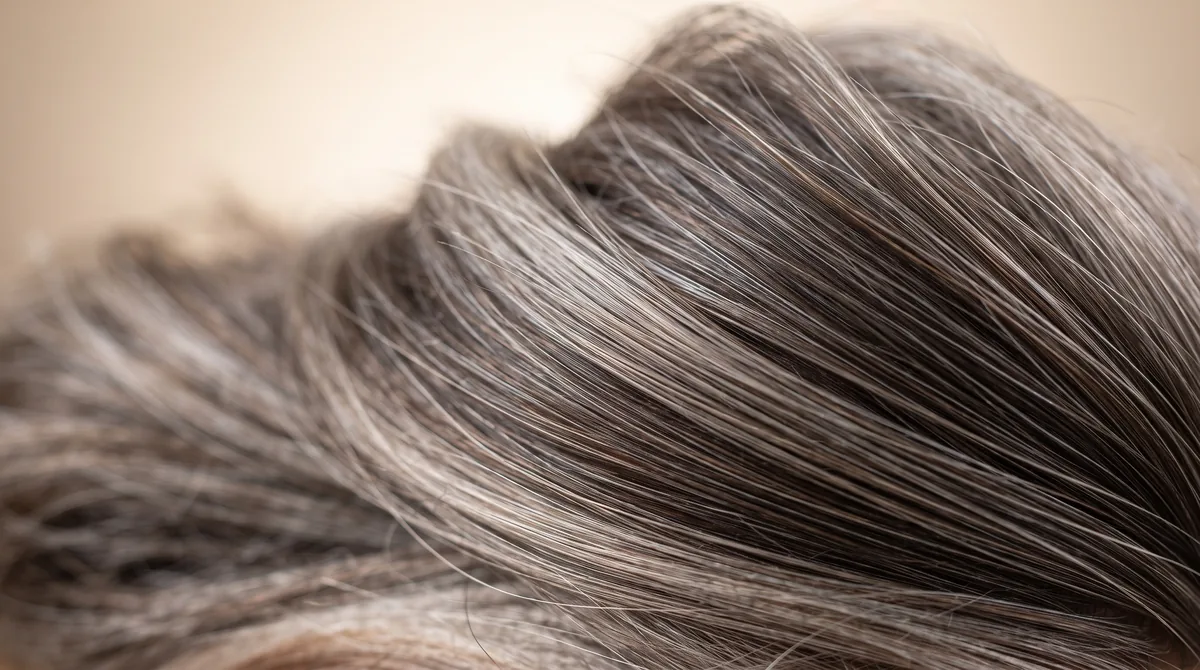
Greying isn’t a separate phenomenon from the changes above, it’s part of the same follicle aging process. Melanocytes (the pigment-producing cells in the hair bulb) have a finite lifespan. They divide a set number of times, then stop. When they stop, your hair grows in grey (or white, if no melanin is produced at all).
The timeline varies by genetics and ethnicity, but the 50s are when greying typically accelerates. A study in PLOS ONE found that by age 50, approximately 50% of people have 50% grey hair (the ‘50-50-50 rule’). Some people grey earlier, some later, but the biological mechanism is universal: melanocyte stem cell depletion.
Grey hair isn’t just pigment-free, it’s structurally different. It tends to be coarser (larger diameter), more wiry, and more resistant to styling because the cortex structure changes when melanin synthesis stops. The hair may also become more porous, because melanin granules normally fill small gaps in the cortex.
Can you reverse greying? No. Despite what supplement companies claim, there’s no evidence that B vitamins, catalase, or any other oral supplement can reactivate exhausted melanocytes. Once they’re gone, they’re gone. What you can do is manage the texture difference between grey and pigmented hair, which often requires different styling approaches.
Hormonal Shifts: Estrogen, Testosterone, and Follicle Sensitivity
Menopause doesn’t just cause hot flashes. It fundamentally alters the hormonal environment of your scalp. Estrogen levels drop sharply, removing a protective factor that extends anagen (the growth phase) and inhibits 5-alpha-reductase (the enzyme that converts testosterone to DHT).
The result: your hair becomes more sensitive to androgens. Even if your testosterone levels are normal or declining, the ratio of estrogen to testosterone shifts unfavorably. Follicles that were previously shielded by estrogen now respond to DHT, leading to progressive miniaturization, especially at the crown and frontal hairline.
Men experience a similar but more gradual shift. Testosterone declines after 40, but DHT sensitivity increases with age due to changes in androgen receptor density. The net effect is the same: more follicles miniaturizing, fewer follicles producing terminal (thick) hairs.
This is why hair loss treatments for women often focus on blocking DHT or supporting estrogen-like effects at the follicle level. It’s also why hormone replacement therapy (HRT) can sometimes slow hair loss in menopausal women, though the evidence is mixed and HRT carries its own risks.
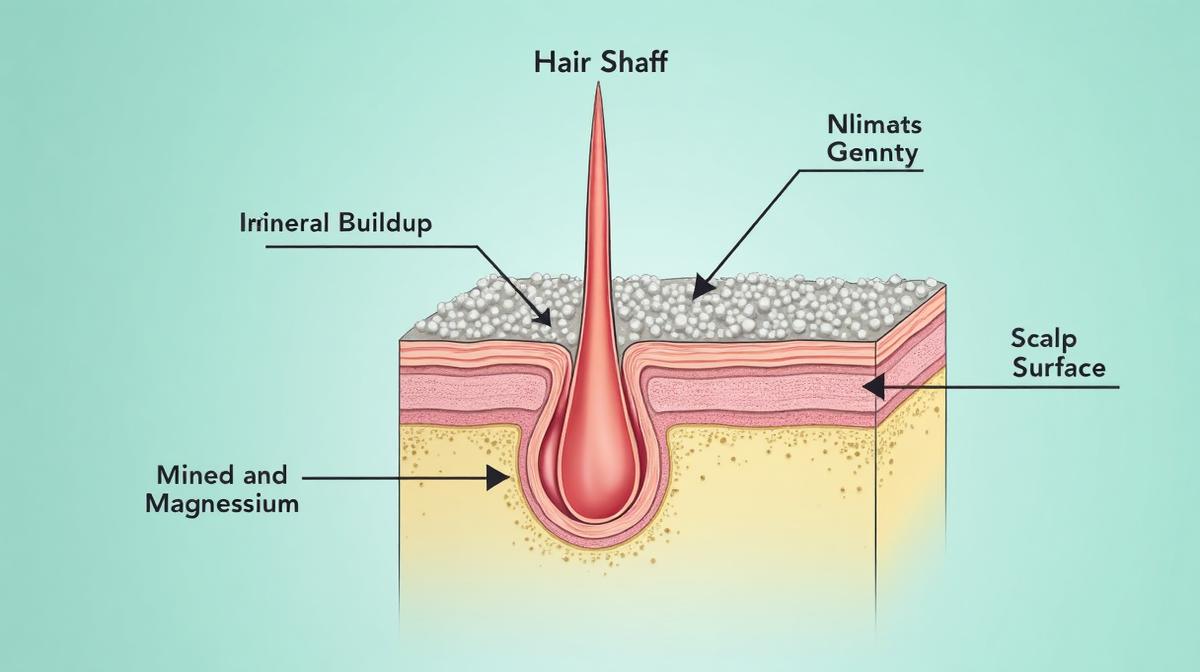
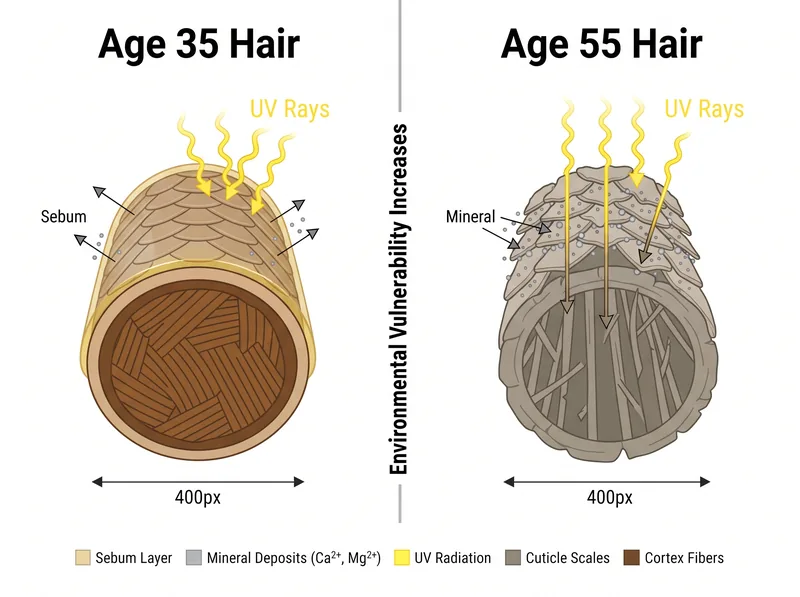 Aging hair with reduced sebum protection is significantly more vulnerable to mineral buildup from hard water and oxidative stress from UV exposure.
Environmental Vulnerability: Why Protection Matters More, Not Less
Here’s the part most people miss: aging hair is more vulnerable to environmental damage, not less. The combination of reduced sebum, increased porosity, and thinner shaft diameter means your hair in your 50s can’t tolerate the same insults it shrugged off in your 30s.
Hard water is a prime example. Mineral deposits (calcium, magnesium) adhere to the cuticle more readily when there’s no sebum barrier to repel them. Over time, this buildup creates a rough, dull coating that makes hair feel straw-like and prevents moisture from penetrating. In the Gulf region, where water hardness often exceeds 300 ppm, this isn’t a minor issue, it’s a structural assault.
UV radiation is another accelerant. Research in Photochemistry and Photobiology shows that UV exposure degrades the disulfide bonds in the cortex, leading to increased porosity, reduced tensile strength, and accelerated protein loss. Aging hair, with its compromised cuticle and lower melanin content (melanin normally absorbs UV), is hit harder.
The solution isn’t to avoid water or sunlight. It’s to add back the protective barriers your hair has lost. That means chelating shampoos to remove mineral buildup (like Regrowth+, which is formulated specifically for hard water environments), leave-in conditioners with UV filters, and silk or satin pillowcases to reduce friction during sleep.
What You Can’t Change vs. What You Can
Let’s be clear: you can’t reverse follicle miniaturization. You can’t restart melanocyte production. You can’t increase your follicle count. These are biological realities driven by genetic programming and cumulative oxidative stress.
What you can do: slow the rate of decline. Maintain scalp health to support the follicles you have. Protect your hair from environmental damage that accelerates structural breakdown. Manage the texture changes so your hair looks and feels better, even if the underlying biology hasn’t changed.
Practical interventions that have evidence: minoxidil (extends anagen, increases follicle size, see our complete guide), low-level laser therapy (improves scalp circulation), scalp massage (may increase dermal papilla cell activity), and consistent use of chelating shampoos in hard water areas.
What doesn’t work: biotin supplements (unless you have a diagnosed deficiency, which is rare), collagen powders (no evidence they reach the follicle), ‘hair growth’ shampoos that rely on caffeine or peptides alone (the contact time is too short for meaningful absorption). Focus on protection and maintenance, not miracle cures.
Styling and Product Adjustments for Aging Hair
Your hair in your 50s requires different handling than it did in your 30s. Thinner shafts break more easily. Drier cuticles tangle more readily. Reduced elasticity means less tolerance for heat styling and chemical treatments.
Heat styling: if you’re still using a flat iron at 450°F, stop. Aging hair can’t tolerate that level of thermal damage. Lower the temperature to 300-350°F, use a heat protectant with silicones (they create a temporary barrier), and limit heat exposure to once or twice a week maximum.
Chemical treatments: permanent color, relaxers, and perms all change disulfide bonds in the cortex. Aging hair has fewer bonds to begin with, so the structural damage is proportionally greater. If you color your hair, switch to demi-permanent formulas that don’t require high-volume developer. If you chemically straighten, extend the interval between treatments and use bond-building treatments during processing.
Product weight: aging hair has less structural integrity, so it can’t support heavy oils and butters the way younger hair can. Switch to lightweight leave-ins, avoid silicone buildup (use a clarifying shampoo monthly), and focus on humectants (glycerin, hyaluronic acid) rather than occlusive oils for moisture retention.
References
- Age-associated hair follicle miniaturization in women - British Journal of Dermatology
- The 50-50-50 rule: Graying prevalence across populations - PLOS ONE
- UV radiation and hair protein degradation - Photochemistry and Photobiology
- Menopause and hair loss: hormonal mechanisms - Mayo Clinic