You’ve probably noticed your hair doesn’t behave the same way it did before moving to the Gulf. It feels rougher. Looks duller. Tangles more easily. You’ve tried different products, adjusted your routine, maybe even switched shampoos three times. Nothing seems to work.
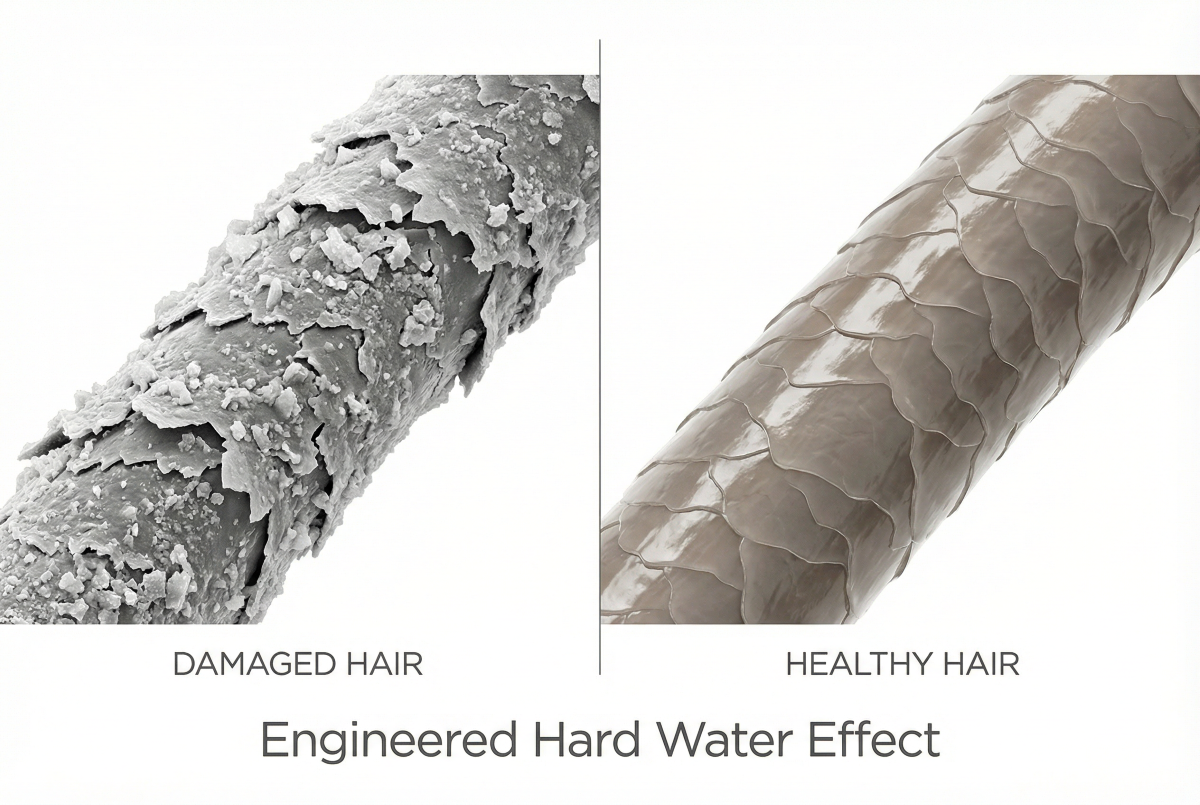
Here’s what’s actually happening: your hair’s cuticle layer, the outermost protective coating, is damaged. And in the Gulf region specifically, hard water mineral deposits are lodging themselves under and between those cuticle scales, forcing them to lift and stay raised. That rough, straw-like texture you’re feeling? That’s your cuticle screaming for help.
The cuticle isn’t just cosmetic. It’s the structural layer that determines whether your hair shines or dulls, whether it breaks or bends, whether products penetrate or sit on the surface doing nothing. Understanding how it works, and how it gets damaged, changes everything about how you approach hair care.
What the Hair Cuticle Actually Is
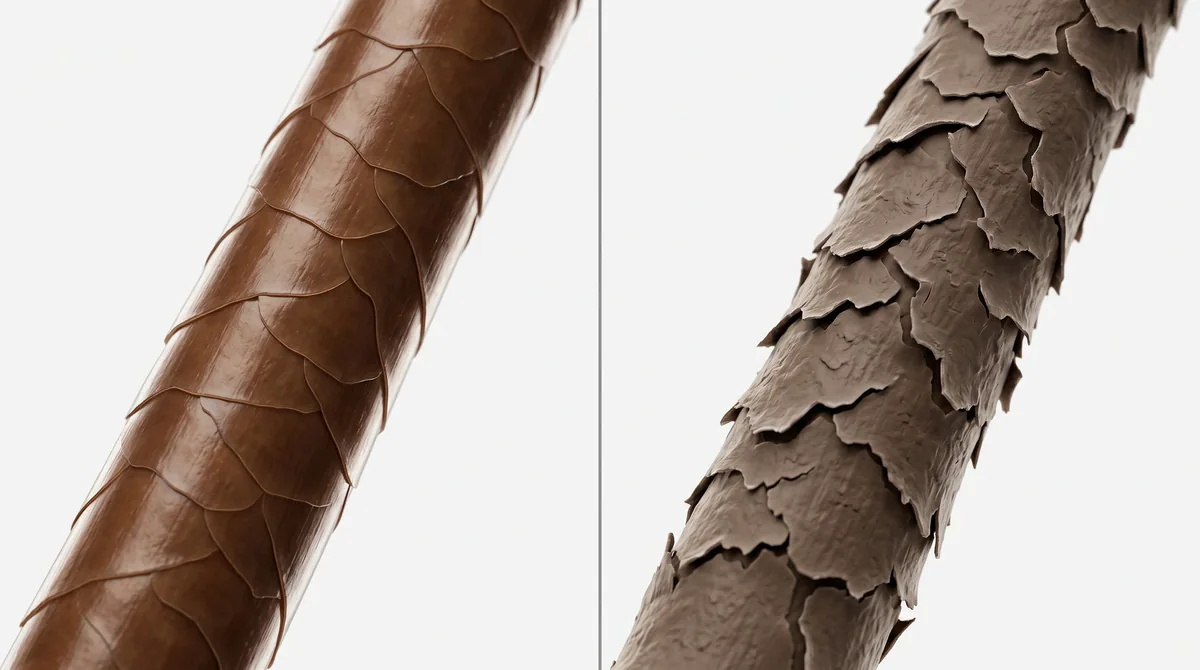
The cuticle is the outermost layer of your hair shaft, made up of overlapping scales that lie flat like roof shingles when healthy. Each strand has 6-10 layers of these scales, and they’re composed primarily of keratin protein reinforced with lipids (fats) that make them water-resistant.
When cuticle scales lie flat, they create a smooth surface that reflects light evenly, that’s what we perceive as shine. The tight overlap also creates a protective barrier that keeps the inner cortex (where your hair’s strength and color live) safe from environmental damage.
But here’s the thing: the cuticle is dead tissue. It can’t repair itself through biological processes the way your skin can. Once a cuticle scale is lifted, chipped, or broken off entirely, that damage is permanent unless you physically smooth it back down or fill the gaps with conditioning agents.
Think of it like this: your hair grows from the root already fully formed. The cuticle you see today was created weeks or months ago inside the follicle. From the moment it emerges from your scalp, it’s exposed to environmental damage with no ability to self-heal. Every chemical treatment, heat styling session, and mineral deposit accumulation adds up over time.
How Cuticle Damage Happens (And Why the Gulf Makes It Worse)
Cuticle damage occurs through five primary mechanisms: mechanical friction, chemical alteration, thermal degradation, mineral deposition, and oxidative stress. Most people experience multiple types simultaneously, which is why damage accelerates over time.
Mechanical damage is straightforward, brushing, towel-drying, friction against pillowcases. Each time you manipulate your hair, you risk lifting cuticle edges. Wet hair is especially vulnerable because water causes the cuticle to swell and the scales to lift slightly, making them easier to catch and tear.
Chemical treatments (bleach, relaxers, perms) work by intentionally breaking down the cuticle structure to access the cortex underneath. That’s why chemically treated hair always has some degree of permanent cuticle damage. Heat styling does something similar: temperatures above 300°F (150°C) literally melt the lipid layer that holds cuticle scales flat, causing them to lift and separate.
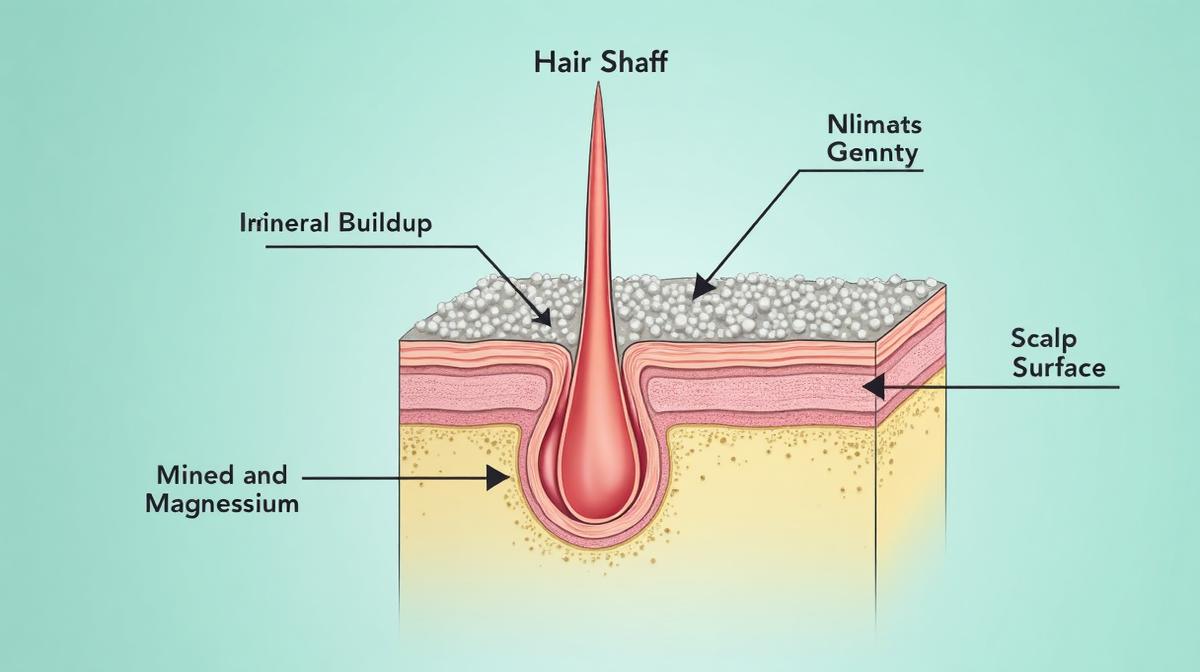
But in the Gulf region, there’s an additional factor most people don’t know about: hard water mineral deposition. The water here contains extremely high concentrations of calcium, magnesium, and silica, often 300-600 parts per million compared to 50-100 ppm in soft water regions. These minerals don’t just coat your hair; they actually lodge themselves under and between cuticle scales during washing.
Here’s why that’s devastating: minerals are crystalline and rigid. Once they wedge themselves under a cuticle scale, they physically prevent it from lying flat again. The scale remains permanently raised until you mechanically remove the mineral deposit. This is why residents describe their hair as feeling ‘rough’ or ‘straw-like’ even when using expensive conditioners, the minerals are literally holding the cuticle open.
A chelating shampoo like Regrowth+ works by using specific binding agents (like EDTA or citric acid) that grab onto mineral deposits and dissolve them, allowing cuticle scales to return to their natural flat position. It’s not about ‘nourishing’ or ‘repairing’, it’s about removing the physical obstacle that’s preventing your cuticle from closing.
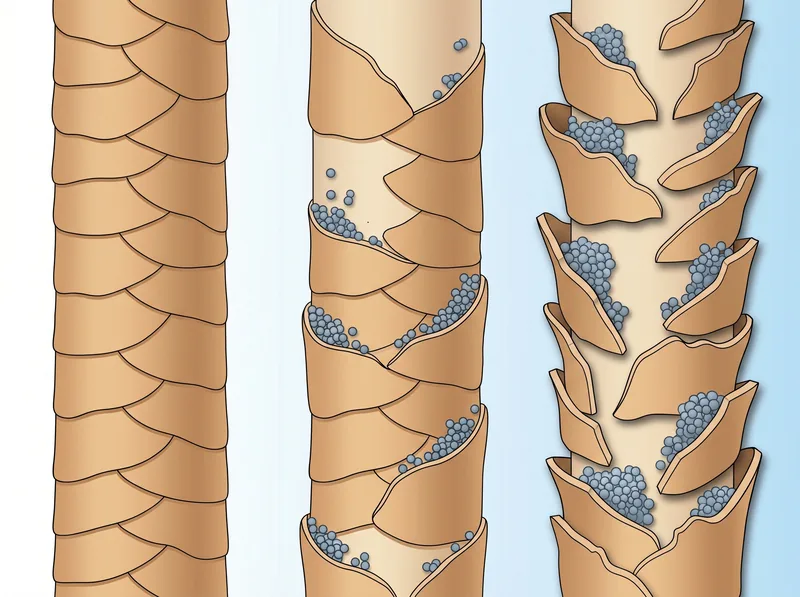 Mineral deposits from hard water accumulate under cuticle scales, forcing them to lift and remain permanently raised
The Cuticle-Shine Connection
Shine is entirely a function of light reflection, and light reflection is entirely a function of surface smoothness. That’s it. There’s no magic ingredient that ‘adds’ shine, products can only help flatten the cuticle so it reflects light more efficiently.
When cuticle scales lie flat and overlap tightly, they create a smooth, mirror-like surface. Light hits it and bounces off at a consistent angle, creating the appearance of gloss. When scales are raised, rough, or missing, light scatters in multiple directions, that’s what we perceive as dullness.
This is why damaged hair can never truly ‘shine’ without intervention. You can coat it with silicones (which temporarily fill gaps and create an artificial smooth surface), or you can use acidic rinses (which cause the cuticle to contract and lie flatter temporarily), but the underlying structural damage remains.
Interestingly, research published in the Journal of Cosmetic Science found that cuticle damage reduces light reflection by up to 60% compared to healthy hair. The study used electron microscopy to measure surface roughness and correlated it directly with perceived shine ratings from human observers. The takeaway: shine is an objective measure of cuticle health, not just a cosmetic preference.
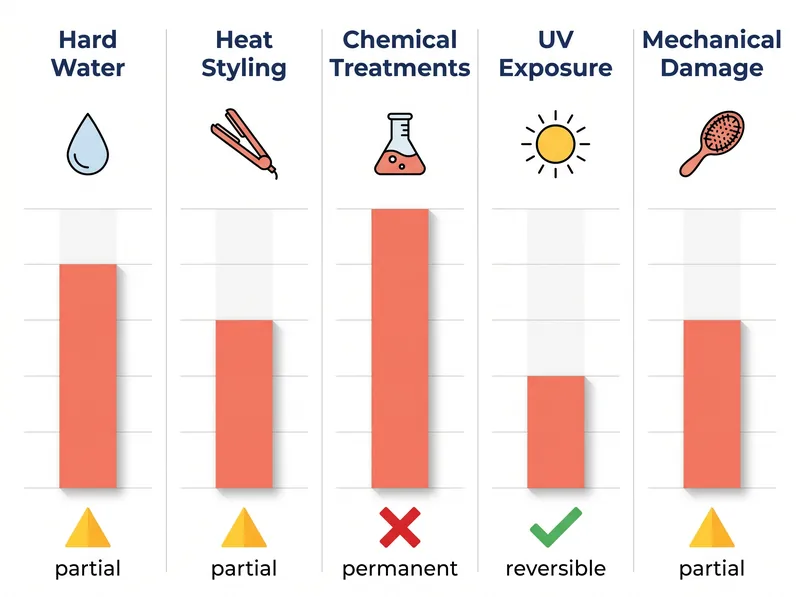 Environmental and chemical factors damage the cuticle through different mechanisms, some reversible, others permanent
What ‘Cuticle Repair’ Products Actually Do
Let’s be honest about this: you can’t biologically ‘repair’ a damaged cuticle. It’s dead tissue. Once a scale is chipped or lifted, it doesn’t grow back. What repair products actually do is one of three things: temporarily smooth the surface, fill gaps with conditioning agents, or bond broken fragments back together.
Silicones (dimethicone, cyclomethicone) are the most common smoothing agents. They coat the hair shaft with a thin, slippery layer that makes cuticle scales lie flatter and prevents them from catching on each other. This creates immediate shine and reduces friction, but it washes out over time and doesn’t address underlying damage.
Proteins (hydrolyzed keratin, wheat protein, silk amino acids) work differently. They’re small enough to penetrate into gaps between cuticle scales and temporarily ‘fill’ damaged areas. Think of them like spackle for your hair, they don’t rebuild the structure, but they make the surface appear smoother. The effect lasts until you wash them out.
Then there are bonding treatments, products that use chemistry to actually re-link broken disulfide bonds within the hair structure. These are more permanent but only work on specific types of chemical damage (like from bleach or relaxers). They won’t fix mechanical damage or mineral deposition.
The most effective approach for Gulf residents is actually removal, not repair. Because the primary damage mechanism here is mineral deposits holding cuticles open, using a chelating treatment to remove those deposits allows the cuticle to return to its natural position. That’s why people report immediate improvement after switching to chelating shampoos, they’re addressing the root cause, not just masking symptoms.
How to Tell If Your Cuticle Is Damaged
There are five clear signs of cuticle damage, and you’re probably experiencing at least three of them right now. First: lack of shine. If your hair looks dull even immediately after washing and conditioning, your cuticle scales aren’t lying flat enough to reflect light properly.
Second: rough texture. Run your fingers down a strand from root to tip. If it feels smooth, your cuticle is intact. If it feels rough, bumpy, or catches on your fingers, those are lifted cuticle scales. Now run your fingers from tip to root, if it feels significantly rougher in that direction, you have severe cuticle damage (the scales are lifting away from the shaft).
Third: excessive tangling. Healthy, smooth cuticles allow hair strands to glide past each other. Damaged cuticles catch on neighboring strands like Velcro. If you have to detangle multiple times per day or if brushing causes breakage, that’s a cuticle issue.
Fourth: high porosity. Damaged cuticles can’t regulate moisture properly. If your hair absorbs water quickly (gets soaking wet in seconds), dries very fast, or feels simultaneously dry and frizzy, your cuticle barrier is compromised. You can test this by dropping a clean strand in a glass of water, if it sinks within seconds, you have high porosity from cuticle damage.
Fifth: color fading (if you dye your hair). The cortex is where color molecules live, and the cuticle is what keeps them locked in. When the cuticle is damaged, color molecules escape through the gaps. If your color fades within 2-3 weeks, your cuticle can’t hold pigment anymore.
The Mineral Deposition Problem
This is the part most hair care advice completely misses, but it’s critical for anyone living in the Gulf region. Mineral deposits don’t just coat your hair, they physically wedge themselves into the cuticle structure and change how your hair behaves at a mechanical level.
When you wash your hair with hard water, dissolved minerals (primarily calcium carbonate and magnesium sulfate) are deposited onto the hair shaft. Initially, they form a thin film on the surface. But over time, with repeated exposure, these minerals crystallize and work their way under the edges of cuticle scales.
Here’s the mechanism: water causes the cuticle to swell slightly and lift. While it’s lifted, mineral particles (which are microscopic but still larger than the gaps between scales) get trapped underneath. When the hair dries and the cuticle contracts, those minerals are now lodged in place, preventing the scale from closing completely.
The result is a permanently raised cuticle that can’t be smoothed with conditioner or heat styling. The minerals are literally holding it open. This is why Gulf residents often describe their hair as feeling ‘crispy’ or ‘straw-like’ even when using high-end products, no amount of conditioning can overcome a physical blockage.
Research in the Journal of Colloid and Interface Science demonstrated that calcium deposits on hair increase surface roughness by 300-400% and reduce tensile strength (breakage resistance) by up to 40%. The study used atomic force microscopy to measure how minerals alter the hair surface at a nanoscale level.
The only solution is chelation, using a product with chelating agents (EDTA, citric acid, or phytic acid) that chemically bind to mineral deposits and pull them out of the cuticle structure. This isn’t a ‘deep clean’ or ‘clarifying’ treatment, it’s a specific chemical process that targets mineral bonds.
Protecting Your Cuticle Long-Term
Prevention is more effective than repair because cuticle damage is cumulative and largely irreversible. Here’s what actually works, based on the damage mechanisms we’ve covered.
First: minimize wet manipulation. Hair is weakest when wet because the cuticle swells and lifts. Never brush wet hair, use a wide-tooth comb and start from the ends. Don’t towel-dry aggressively; instead, squeeze water out gently or use a microfiber towel that doesn’t create friction.
Second: use heat protectants before any thermal styling. These products (usually silicone-based) create a barrier between the heat tool and your cuticle, preventing direct thermal damage. And keep temperatures below 350°F (175°C), anything higher starts breaking down the cuticle’s lipid layer.
Third: address mineral buildup proactively. If you live in the Gulf, you need a chelating treatment in your routine, not once a month as a ‘reset,’ but as a regular part of your wash routine. The minerals accumulate with every wash, so you need to remove them consistently before they wedge under cuticle scales.
Fourth: use acidic final rinses. After conditioning, rinse with diluted apple cider vinegar (1 tablespoon per cup of water) or use a pH-balanced leave-in treatment. Acidity causes the cuticle to contract and lie flatter, which improves shine and reduces tangling. This is a temporary effect but helpful for daily manageability.
Fifth: protect from UV exposure. Studies show that UV radiation degrades the cuticle’s lipid layer and causes oxidative damage to keratin proteins. In the Gulf’s intense sun, this happens faster than in temperate climates. Use leave-in products with UV filters or wear a hat when spending extended time outdoors.
And honestly? Accept that some damage is inevitable. The goal isn’t perfect hair, it’s minimizing the rate of damage so your hair stays healthy longer. Focus on the damage mechanisms you can control (heat, chemicals, minerals) and don’t stress about the ones you can’t (environmental exposure, natural aging).
References
- Effects of mineral deposition on hair fiber properties - Journal of Colloid and Interface Science
- Correlation between hair surface properties and visual appearance - Journal of Cosmetic Science
- UV radiation effects on hair cuticle structure - PubMed
- Hair shaft structure and function - American Academy of Dermatology