This article contains affiliate links. See our affiliate disclosure for details.
You’ve noticed your hair feels different since moving to the Gulf. Drier. Rougher. Maybe it’s breaking more than it used to. You’ve heard about hard water, but you’re not sure if that’s actually your problem or just something people blame when their hair acts up.
Here’s the thing: you can stop guessing. A $15 device called a TDS meter gives you a definitive answer in about 30 seconds. It measures Total Dissolved Solids (the minerals in your water) and tells you exactly how hard your water is. No lab required. No waiting for test results.
If your reading comes back above 300 ppm, you’ve found your culprit. The question then becomes what to do about it, which we’ll cover after you understand what those numbers actually mean. Let’s start with how water quality affects your hair and why TDS matters more than you think.
What a TDS Meter Actually Measures
A TDS meter measures electrical conductivity. Pure water doesn’t conduct electricity. But when minerals dissolve in water (calcium, magnesium, sodium, chlorides, sulfates), they create ions that carry electrical current. The more minerals, the higher the conductivity, the higher your TDS reading.
The number on the screen represents parts per million (ppm) of dissolved solids. A reading of 285 ppm means there are 285 milligrams of dissolved minerals in every liter of water. That’s roughly equivalent to grains per gallon (gpg), the other common hardness measurement, where 17.1 ppm equals 1 gpg.
What it doesn’t measure: bacteria, viruses, chlorine, or specific contaminants. It’s not a complete water safety test. It’s a mineral concentration test. For hair purposes, that’s exactly what matters. According to research from the US Geological Survey, water hardness directly correlates with mineral content, which affects everything from soap effectiveness to hair texture.
The device itself is dead simple. A probe at the bottom contains two electrodes. When you submerge it in water, it measures resistance between those electrodes and converts that to a TDS reading. Battery-powered. Pocket-sized. No calibration needed for basic home testing (though higher-end models offer it).
How to Test Your Water (The Right Way)
Don’t test water that’s been sitting in a glass overnight. Don’t test filtered water if you’re trying to understand your baseline tap water quality. And definitely don’t test bottled water and assume it matches what’s coming from your shower.
Here’s the protocol that gives you accurate, actionable results:
Run your tap for 30 seconds before collecting your sample. This flushes out water that’s been sitting in your pipes, which can have different mineral content than the water flowing from the main line. Fill a clean glass directly from the stream. Room temperature is fine; you don’t need to adjust for temperature unless you’re doing laboratory-grade testing.
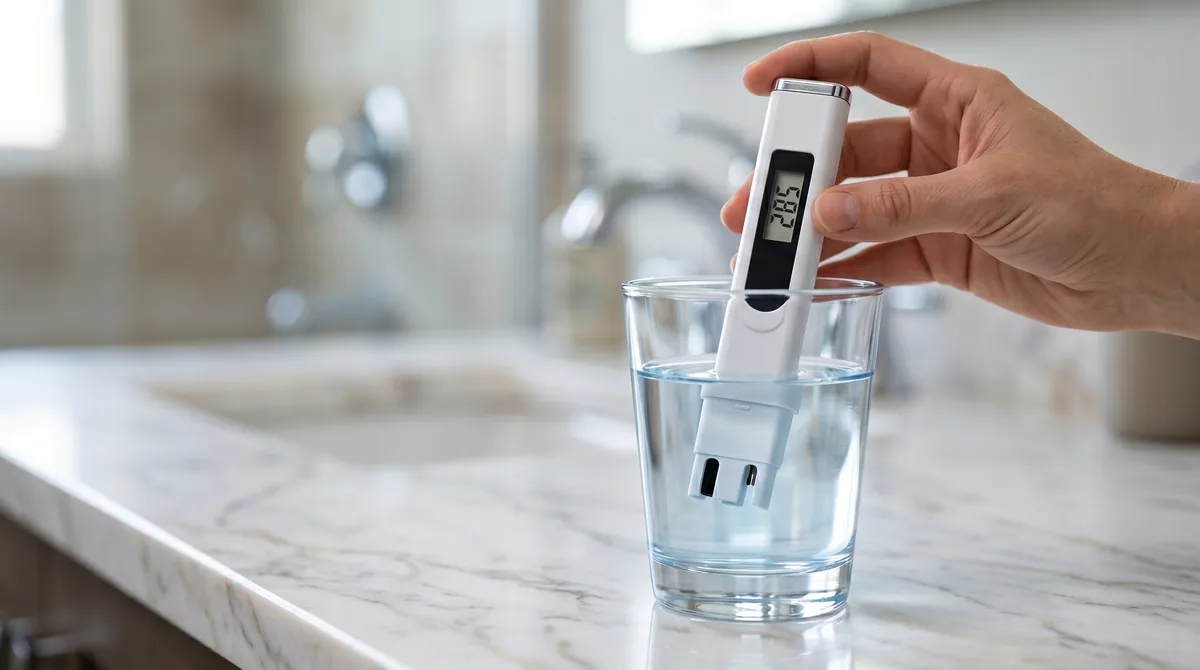
Remove the cap from your TDS meter and turn it on. Most models auto-calibrate to zero in air. Submerge the probe about 2 inches into the water, enough to cover both electrodes completely but not so deep you’re dunking the entire device. Swirl it gently for 2-3 seconds to eliminate air bubbles around the sensors.
Wait for the reading to stabilize. Usually takes 5-10 seconds. The number will fluctuate slightly, then settle. That’s your reading. Write it down. Test three times and average the results if you want to be thorough, though variance is typically minimal with tap water.
One critical note: test the water from the tap you actually use. Kitchen sink water can read differently than bathroom shower water if they’re fed by different pipes or if one has an inline filter you forgot about. For understanding hard water effects on hair, test your shower specifically.
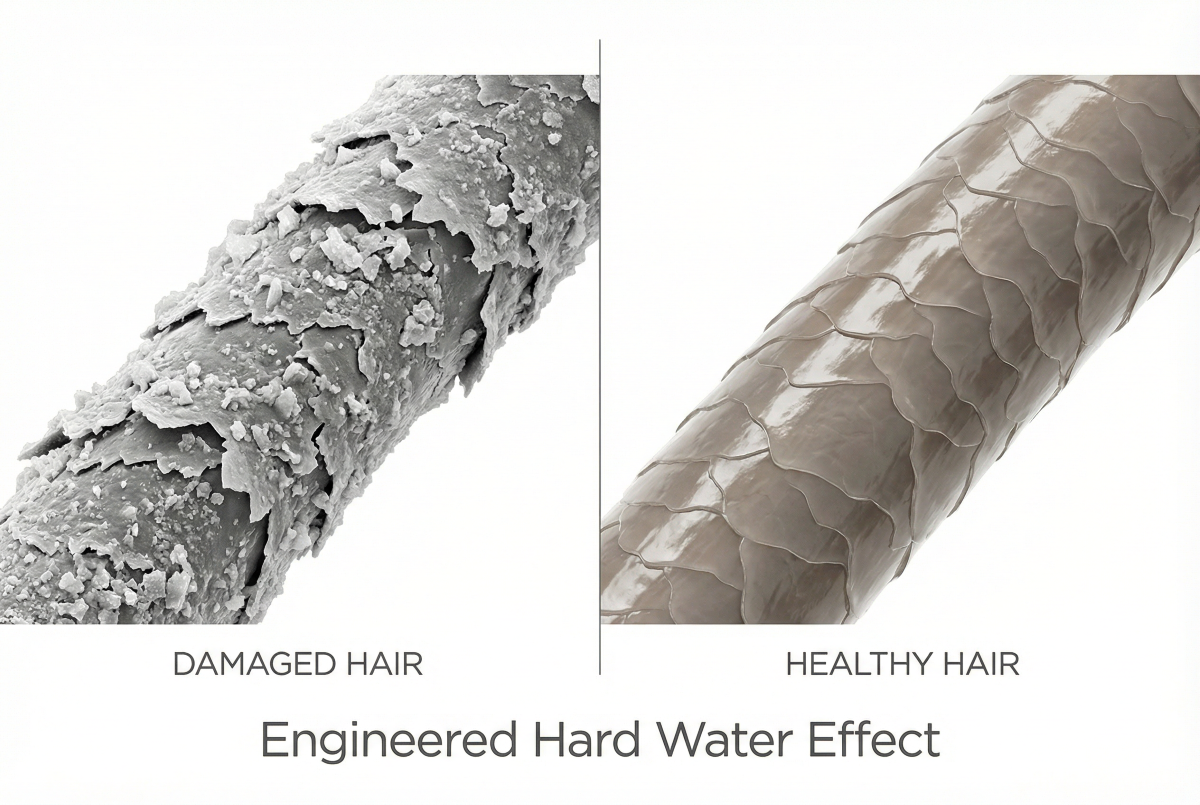
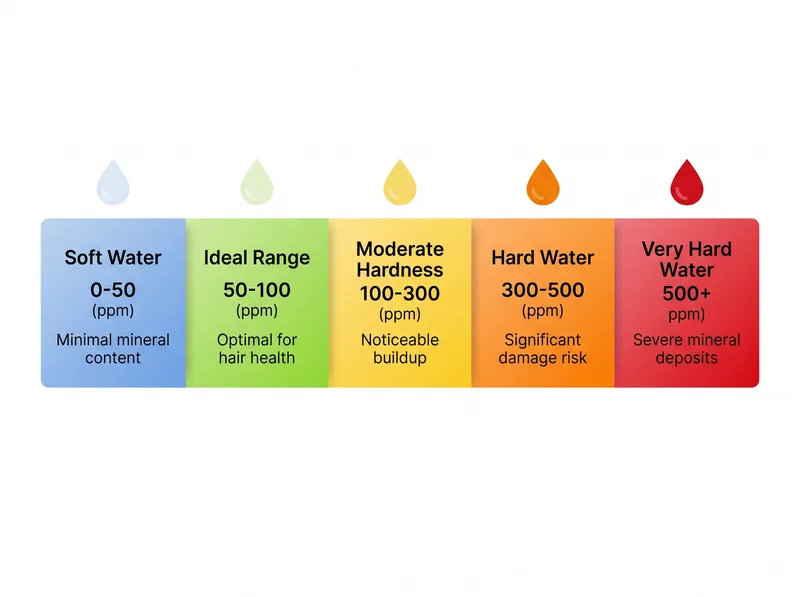 TDS reading ranges and their impact on hair health. Readings above 300 ppm indicate hard water that can damage hair structure.
What Your TDS Reading Actually Means
The numbers break down into five practical zones, each with different implications for your hair:
Under 50 ppm: Very soft water. Almost no mineral content. Rare in municipal systems, common in some filtration setups. Hair may feel slippery, difficult to rinse shampoo completely. Not necessarily ideal despite being ‘soft.’
50-100 ppm: Soft to ideal range. Enough minerals for water to feel normal, not enough to cause buildup. If you’re in this zone, hard water isn’t your hair problem. Look elsewhere (diet, products, hormones, stress).
100-300 ppm: Moderate hardness. This is the gray zone. Some people notice effects, others don’t. Variables include hair porosity, product types, and washing frequency. You might benefit from occasional chelating treatments, but it’s not an emergency. Many municipal water systems in temperate regions fall here.
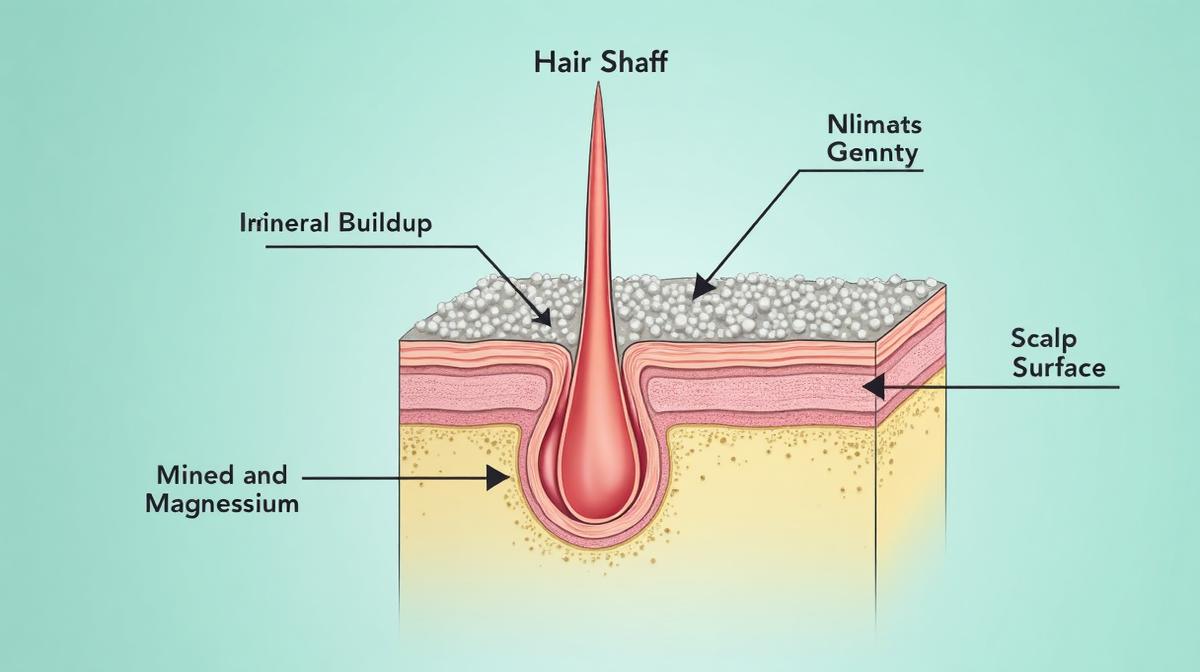
300-500 ppm: Hard water. This is where damage becomes predictable and consistent. Mineral deposits accumulate on hair shafts, creating that characteristic rough texture. Shampoo doesn’t lather well. Conditioner sits on top instead of penetrating. According to a study published in the International Journal of Trichology, water with hardness above 200 ppm significantly increases hair breakage and surface roughness.
500+ ppm: Very hard water. Common in Gulf countries, parts of the southwestern United States, and areas with high limestone content in soil. At this level, you’re not just dealing with cosmetic issues. You’re fighting chemistry. Every wash deposits a new layer of minerals. Chelating becomes mandatory, not optional.
For context: most Gulf region municipalities report TDS between 400-800 ppm, with some areas exceeding 1,000 ppm during summer months when desalination output increases.
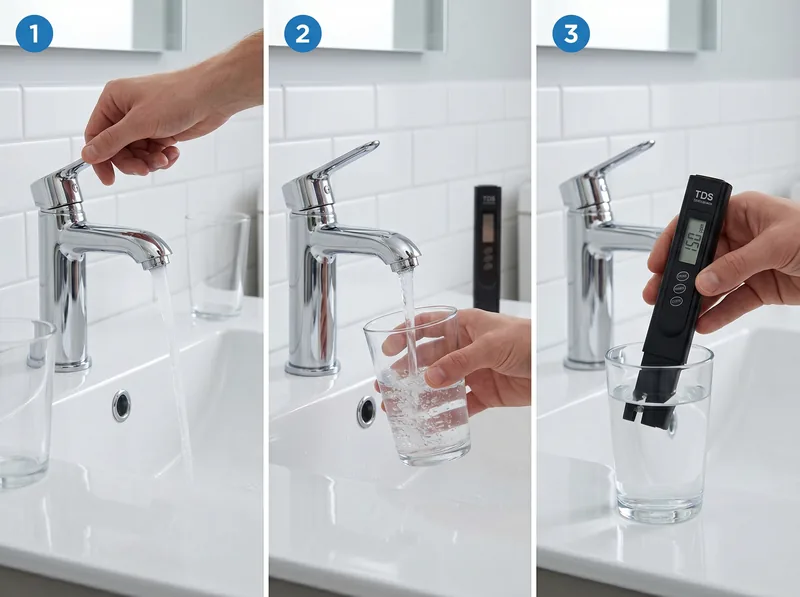 Proper testing technique ensures accurate readings. Always test fresh running water, not standing water from a container.
When Your Reading Demands Action
If your TDS reads under 300 ppm, you can relax. Hard water isn’t your primary hair concern. Focus on product choices, heat styling habits, and nutrition instead.
Between 300-500 ppm? You need a strategy. Start with a chelating shampoo like Regrowth+ once or twice a week to remove mineral buildup. On other days, use a gentle sulfate-free formula. This prevents accumulation while avoiding over-stripping.
Above 500 ppm, you’re in damage control mode. Every shower without intervention adds mineral layers. You’ll need consistent chelating (2-3 times per week minimum) and potentially a shower filter, though as covered in our analysis of shower filter effectiveness, filters alone rarely solve high-TDS problems completely.
Here’s what people miss: the number tells you severity, but your hair’s response tells you urgency. Someone with low-porosity hair might tolerate 400 ppm better than someone with high-porosity, color-treated hair at 250 ppm. The TDS reading is your starting point, not your entire diagnosis.
One practical test: if your TDS is above 300 and you’ve been in the Gulf for more than three months, run your fingers through dry hair. Does it feel rough, even after conditioning? Does it tangle more than it used to? Those are mineral deposits. The TDS meter confirmed the cause; your hair is telling you it’s time to act.
Testing Mistakes That Skew Results
The most common error? Testing filtered water and thinking you’ve tested your actual shower water. Your refrigerator filter, countertop pitcher, or under-sink system changes TDS dramatically. That’s the point of filtration. But unless you’ve installed a whole-house system or a shower-specific filter, that reading doesn’t reflect what’s hitting your hair.
Second mistake: testing once and assuming it’s constant. TDS fluctuates. Seasonally (higher in summer when water tables drop), daily (higher during peak usage hours), and even hourly in some systems. Test at different times over a week to understand your range. The highest reading is what you should plan for.
Third: comparing your reading to someone else’s in the same building and assuming they should match. Different floors, different pipe materials, different distances from the main line, all create variance. Your neighbor’s 220 ppm doesn’t mean yours isn’t 380 ppm.
Fourth: thinking a low TDS reading means your water is ‘safe’ or ‘healthy.’ TDS doesn’t measure contaminants. It measures minerals. You can have perfectly safe water at 600 ppm and contaminated water at 50 ppm. For drinking water safety, you need different tests. For hair concerns, TDS is what matters.
And the big one: testing your water, seeing a high number, then doing nothing because you don’t know what to do with the information. The point of testing isn’t to confirm you have a problem. It’s to know which solution to implement. Above 300 ppm means chelating shampoo moves from ‘optional’ to ‘essential.‘
Beyond the Numbers: What to Do Next
You’ve tested. You have a number. Now what?
If you’re under 300 ppm: Focus on your nutrition for hair health, product ingredients, and styling practices. Hard water isn’t your bottleneck. Don’t waste money on solutions for a problem you don’t have.
If you’re 300-500 ppm: Implement a chelating routine. Use a mineral-removing shampoo 2-3 times per week. On alternate days, use a gentle, sulfate-free cleanser. Deep condition after every chelating session since the process is inherently stripping. Track results over 4-6 weeks. If you’re not seeing improvement, increase chelating frequency or consider a shower filter as supplementary support.
If you’re above 500 ppm: You need a multi-layer approach. Chelating shampoo becomes your primary cleanser, not your occasional treatment. Consider a shower filter to reduce (not eliminate) incoming mineral load. Avoid leave-in products that contain silicones or heavy oils since they trap minerals against the hair shaft. And critically, manage expectations. You can’t reverse years of mineral damage in two weeks. But you can stop new damage and gradually improve texture over 2-3 months.
The TDS meter doesn’t solve your problem. It diagnoses it. The solution is what you do with that diagnosis. Most people in the Gulf need chelating protocols. Some need shower filters. A few need both. But everyone needs to know their baseline number before spending money on solutions that might not match their actual problem.
Test your water. Know your number. Act accordingly. That’s the sequence that works.
References
- Hardness of Water - US Geological Survey
- A study to evaluate the effect of water hardness on hair quality - PubMed - International Journal of Trichology
- Total Dissolved Solids in Drinking Water - World Health Organization
- Water Quality Parameters: Total Dissolved Solids - US Environmental Protection Agency